
Amazon’s Climate Pledge Friendly (CPF) programme highlights eligible products whose sustainability features are backed by recognised third-party certifications. GRS, RCS, FSC and ISCC PLUS, however, are separate systems with different credentials, scopes and public verification tools. They should not be collapsed into one rule such as “every certification has the same annual audit and three-year renewal cycle.”
Four objects must still point to the same product
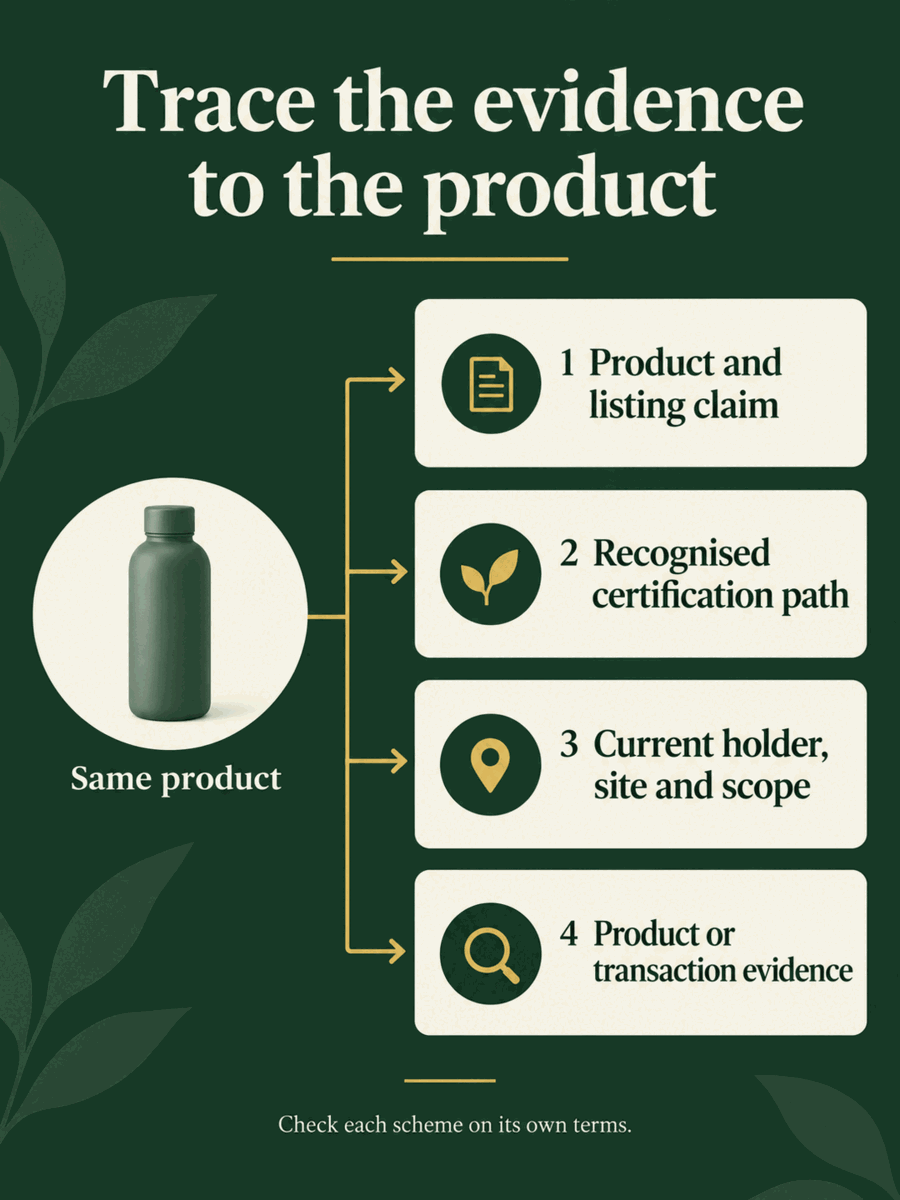
The first object is the CPF certification path used for the product. The second is the current organization- or site-level credential. The third is evidence that covers the product, material or transaction. The fourth is the actual marketplace item, including its identifier, site, model and customer-facing claim.
A credential can be genuine while still belonging to a different legal entity, facility, material or product scope. It can also be current at organization level without resolving the evidence needed for a particular shipment or SKU.
The four objects form a traceability question, not four interchangeable approvals. Take a hypothetical listing that says one named model contains recycled material. A current scope certificate from the supplier may establish who is certified and for which processes and products. It does not, by itself, connect that model's incoming material to a particular transaction or show that Amazon has identified the ASIN under an accepted path. The useful next step is to match the certificate holder, site and scope to the supply chain, then inspect the product or transaction evidence required by the relevant scheme and compare it with the exact listing claim. This example is an evidence test, not a finding about a real listing.
Official verification tools answer different questions
Textile Exchange describes “Find a Certified Company” as the single source of truth for scope certificates. It separately provides authentication for transaction certificates issued after 1 October 2022. For older TCs, its guidance directs the reader to the certification body; absence from the newer lookup is not proof that an older document is invalid. A scope certificate describes the certified organization and scope; a transaction certificate supports a particular movement of claimed material. One should not be used as a substitute for the other.
FSC's public certificate page explains how to search by organisation name, licence code or certificate code and inspect status and scope. FSC currently labels its new Search service a public beta and also directs readers to its public certificate dashboard for updated certificate data. An old PDF or an FSC mark on a page is therefore not the end of the check: the holder, current status and relevant scope still need to align with the claim.
ISCC PLUS illustrates why certification schedules must remain scheme-specific. ISCC states that each site handling alternative materials needs a valid site-specific certificate and that an ISCC PLUS certificate is valid for 12 months. Its database also distinguishes valid, suspended and withdrawn records. That 12-month rule belongs to ISCC PLUS; it should not be copied into a GRS, FSC or RWS record.
Build a relationship register, not a generic renewal calendar
For each marketplace item, record the product identifier and target site, the recognised certification path, the certification system, legal certificate holder, facility address, certificate number, current database status, validity period, certified scope, product or material linkage, transaction-level evidence where applicable, and the exact customer-facing claim.
Review should also be event-driven. A new facility, supplier change, material-percentage change, BOM revision, scope extension, certificate status change, scheme update or Amazon evidence request may require action before a calendar reminder does.
For an actual review, start with the scheme's official record and preserve the date, identifier, status and scope found there. Then map those fields to the product's supply chain and the wording on the listing. If a supplier PDF conflicts with a public record, ask the issuing certification body to resolve the discrepancy. If the Amazon badge remains visible, do not infer that the underlying certificate is still valid. Equally, a certificate change alone cannot establish when or whether a listing will change; that requires the programme's current decision and product-level facts.
The practical conclusion is that CPF eligibility maintenance is not one annual audit imposed across every certification. It is the continuing task of showing that the current product, current claim and current valid evidence still refer to the same object. A badge that remains visible is not proof of certificate status, while a certificate change does not by itself establish an exact timing or commercial outcome for the marketplace page.
Information checked on 3 October 2026 against public pages from Amazon, Textile Exchange, FSC and ISCC. This article provides general evidence-preparation guidance only and does not guarantee certification, CPF display or audit outcomes.
绿色方舟(深圳)认证有限公司
Primary checks: Amazon's CPF explanation; Textile Exchange certificate authentication; FSC public certificate search; ISCC PLUS certification. The cross-scheme review method here is editorial guidance, not a unified rule issued by those organisations.


