
On 31 August 2026, the Australian Competition and Consumer Commission (ACCC) reported that suppliers of fire extinguishers marketed for lithium-ion battery fires had amended claims that raised concerns. The central issue was not a blanket ban on a product category. It was whether existing product information had been stretched into claims about an Australian standard, a specific fire use case and suitability for the general public.
What the ACCC actually said
The ACCC stated that there is currently no applicable Australian safety standard covering the use of extinguishers on lithium-ion battery fires. It was also concerned that some products did not clearly state that they were only suitable for trained firefighting professionals.
This does not establish that every product in the category is automatically unsafe. It also does not mean that no technical standard or test can apply to any feature of an extinguisher. The important boundary is narrower: a standard or test covering one object or performance characteristic must not be presented as official recognition of a different, specific use.
Separate five parts of the claim
Before publishing a statement such as “complies with Australian standards for lithium battery fires”, a supplier should identify:
• the exact product model and extinguishing medium;
• the full name of the cited standard, report or technical document;
• the tests and conditions actually covered;
• the intended user, including any training requirement; and
• the source of the emergency and safety instructions.
These elements are not interchangeable. A report about container performance does not necessarily validate a lithium-ion battery fire application. A technical document for professional use does not make the product suitable for household users. A certificate does not mean that a regulator has approved every statement appearing on a product page.
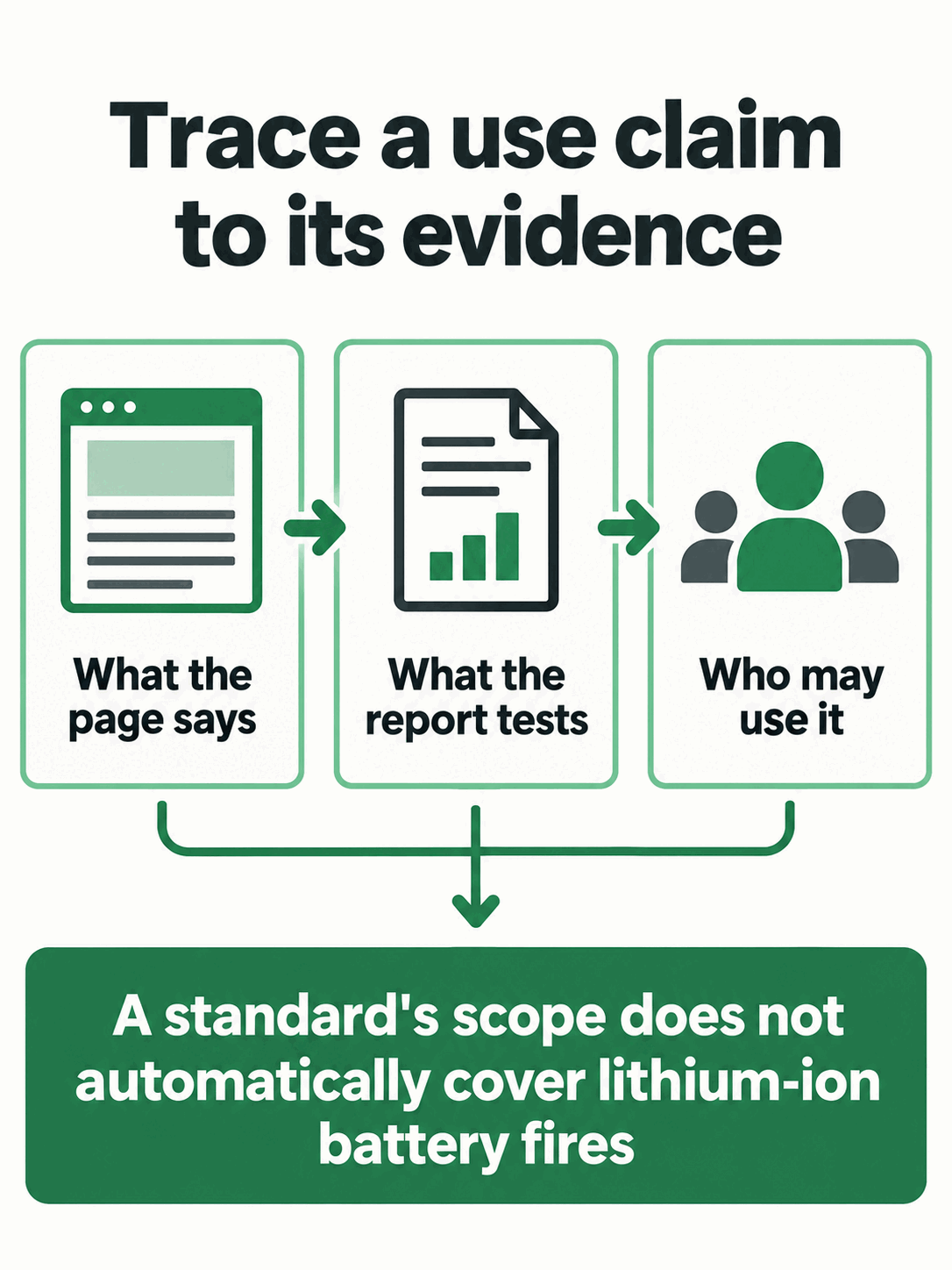
Consider a listing that cites a real Australian extinguisher test and then says “approved for lithium-ion battery fires”. The first statement may be verifiable while the second has no matching evidence. The useful correction is to name the exact test scope and remove the unsupported use claim; changing “approved” to “designed for” would still leave the same gap. The same review should cover packaging, images and demonstration videos, because those can communicate a household-use claim even when the written disclaimer is narrow.
User suitability must be prominent
If a product is suitable only for trained firefighting professionals, that limitation should not be hidden in fine print. Titles, photographs, demonstrations and instructions should not create the opposite impression by showing an ordinary consumer approaching a battery fire.
The ACCC referred to fire-safety advice that lithium-ion battery fires can spread quickly, produce toxic smoke and be difficult to extinguish. Members of the public are advised to evacuate to a safe place and call emergency services, rather than attempt to fight the fire themselves.
A bounded rewrite is more than softer wording
Replacing “guaranteed” with “designed to help” does not solve a scope problem. A sound rewrite states what was tested, under which document, for which model and under which conditions. If evidence does not cover a lithium-ion battery fire use case, that use claim should not be inferred. If the intended user is trained personnel, the full customer-facing presentation should preserve that boundary.
The practical lesson is straightforward: do not use an existing standard to endorse a use case that the standard does not cover. Safety marketing should explain the evidence and its limits, not turn a limited test into a broad assurance.
Information checked on 3 October 2026 against the ACCC Product Safety announcement of 31 August 2026. This article provides general evidence-preparation guidance only and does not determine the compliance, approval, safety or effectiveness of any particular product.
Greenark (Shenzhen) Certification Co., Ltd.


