
An importer may call a product a “baby lounger” and put “not for sleep” on its label. The listing may nevertheless show a sleeping newborn, promise naps, or suggest placement on an adult bed. For a U.S. product team, the practical question is whether the physical design and the complete customer-facing message point to sleep. A change of name cannot answer that question on its own.
Source check: 3 October 2026. This article distinguishes two CPSC product warnings and uses the agency’s infant sleep product and infant support cushion guidance. The notices concern identified products; they do not establish that every lounger is recalled or compliant.
Read each notice on its own terms
On 3 September 2026, the CPSC warning for Aila+Aiden baby loungers identified sides too low to contain an infant, enclosed foot openings wider than allowed, and no stand. The agency connected those conditions to falls, entrapment and the danger of placing the product on an elevated surface. It urged immediate discontinuation and disposal, and warned against resale or giving the product away. This was a product safety warning, not a joint 3 September recall of two brands.
The CooCooBaby warning is dated 10 September. It described low sides and a hazardous foot opening, but also a sleeping pad thicker than permitted, creating a suffocation hazard, and the absence of a stand. A separate CPSC recall page gives 18 June as the recall date. A seller reviewing its own inventory should therefore match brand, model, label and sales history to the relevant notice before deciding what action applies. Combining the two hazard lists into a generic test checklist would lose the product-specific facts and remedies.
Classification begins with intended use and design
Under the CPSC’s infant sleep products FAQ, an infant sleep product is marketed or intended to provide sleeping accommodation for an infant up to five months old, unless it is already covered by another listed sleep product standard. For products in its scope, 16 CFR part 1236 applies and calls for compliance with the bassinet and cradle requirements. The phrase “up to five months” matters; the earlier Chinese copy incorrectly said “under five years.”
The agency advises firms to consider advertising, labels, design and consumer use, including foreseeable misuse. “Supervised sleep” still describes sleep. It also says a product designed for infant sleep cannot escape the rule solely by relabeling it as not intended for sleep. The first decision is therefore not which phrase sounds safer in a headline. It is what the product offers, how it is built, and what a reasonable caregiver is led to do with it.
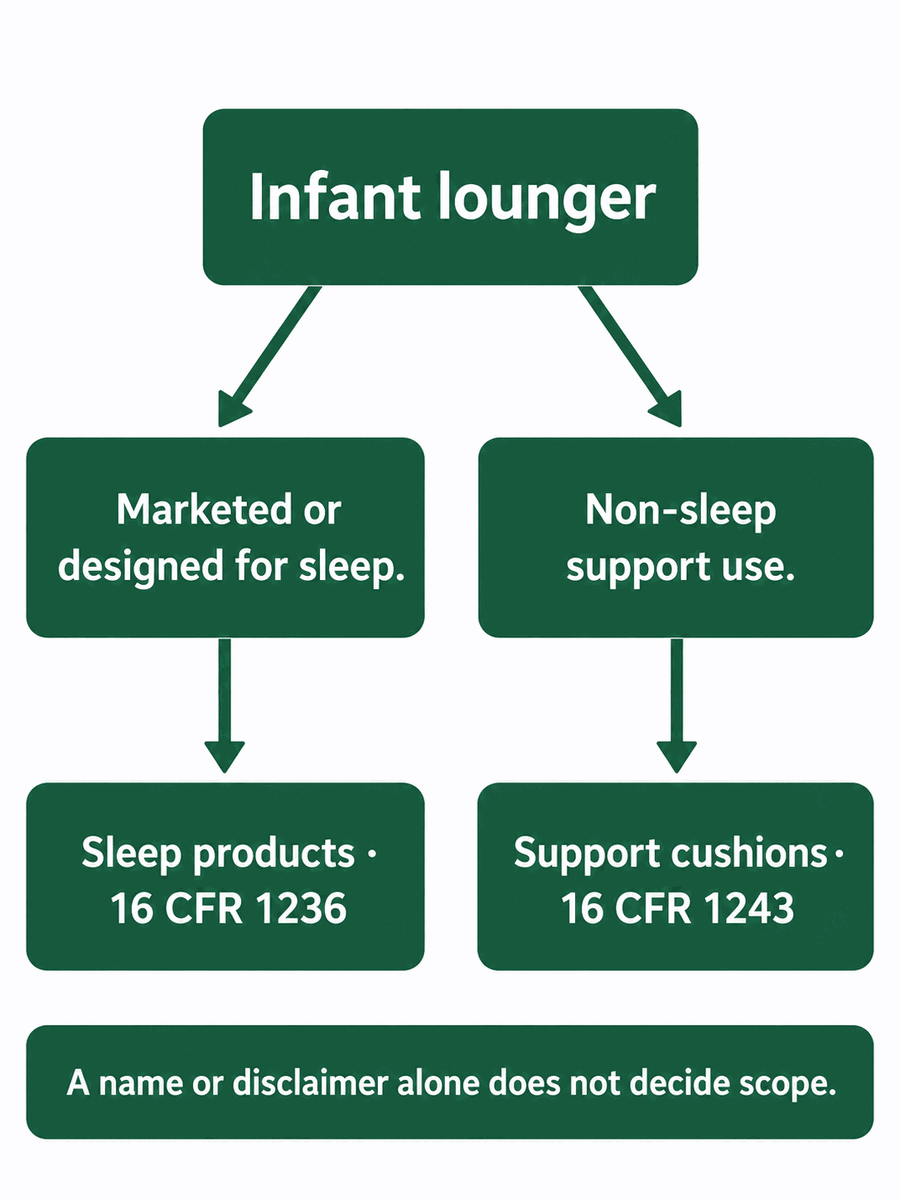
The diagram shows a review route, not an automatic legal classification. A genuine non-sleep support product may still fall under the CPSC’s infant support cushion guidance. That guidance includes qualifying infant loungers within 16 CFR part 1243 and says its requirements apply to products manufactured after 5 May 2025. Other rules may also matter to a particular configuration. Calling a product “non-sleep” is consequently neither an exemption certificate nor a remedy for a product already identified in a CPSC warning.
Why the listing must be reviewed with the sample
Consider a hypothetical SKU whose package says “for awake, supervised use” while its lead image depicts a sleeping baby and its Q&A recommends naps. An audit of the package alone would miss the message delivered by the listing. Deleting “nap” from one line would still leave the image and perhaps the underlying design. CPSC specifically treats words such as sleep and nap, as well as images of sleeping infants, as possible signals of sleep intent. The team should capture the first screen, captions, instructions, age claim, physical configuration and test record together before approving a claim.
The two warnings also show why a report for a different configuration cannot close the review. Side construction, pad thickness, foot openings, support or stand and accessories affect the applicable assessment. A report identifies a tested sample, method and scope; it does not silently extend to a revised pad or a newly advertised sleep use. The warning pages do not supply a single universal measurement that a seller can copy across every lounger. Nor does adult supervision cure a structural hazard.
The decision for a live SKU
First, determine whether the SKU is an identified warned or recalled product by checking its brand, model and labels against the exact CPSC page. If it is, stop selling and follow that notice’s action and remedy route. A copy edit is no substitute for the stated safety action. If it is a different product, preserve the current listing and assemble one versioned record: intended age and use, all sleep-related words and imagery, design and accessory configuration, reports for that exact sample, the applicable Children’s Product Certificate, and tracking information. Where the message or configuration exceeds the evidence, pause the disputed claim and obtain a product, regulatory and testing review before changing the page. CPSC lists third-party testing, certification and tracking labels among the requirements for in-scope infant sleep products; the exact obligations depend on the product and its applicable rules.
Prepared by 绿色方舟(深圳)认证有限公司. This is a source-based review framework, not a finding on an unexamined SKU.


