
A seller may have a test report on file and a “3+” age label on the listing, yet still feel uneasy when a parent asks whether a pull toy is safe for a younger child. That uncertainty is reasonable. A report answers a question about the sample that was tested; a listing describes the version currently offered. The useful next step is to establish whether those are the same toy, intended for the same age group, with the same cord and attachments.
This is a way to turn an anxious, general question into a product-specific one. It does not assume that every toy with a cord is unsafe, or that a document settles every later design change.
Age is more than a number on the listing
The Australian Competition and Consumer Commission (ACCC) includes push-and-pull toys among the examples that may be covered by the mandatory standard for toys for children up to and including 36 months. It also warns that an older age label does not necessarily remove a toy from scope if the toy is commonly recognised as suitable for children under 36 months.
Read the label beside the object itself: what does the toy invite a child to do, what do the packaging photographs show, and whom does the sales page appear to address? Changing “18 months+” to “3+” cannot change a cord or an end fitting. Equally, the presence of a cord alone does not establish the applicable clauses for every design. If the age position remains unclear, the laboratory needs the actual product, packaging and listing context, not only a label copied into an email.
Two hazards deserve two different answers
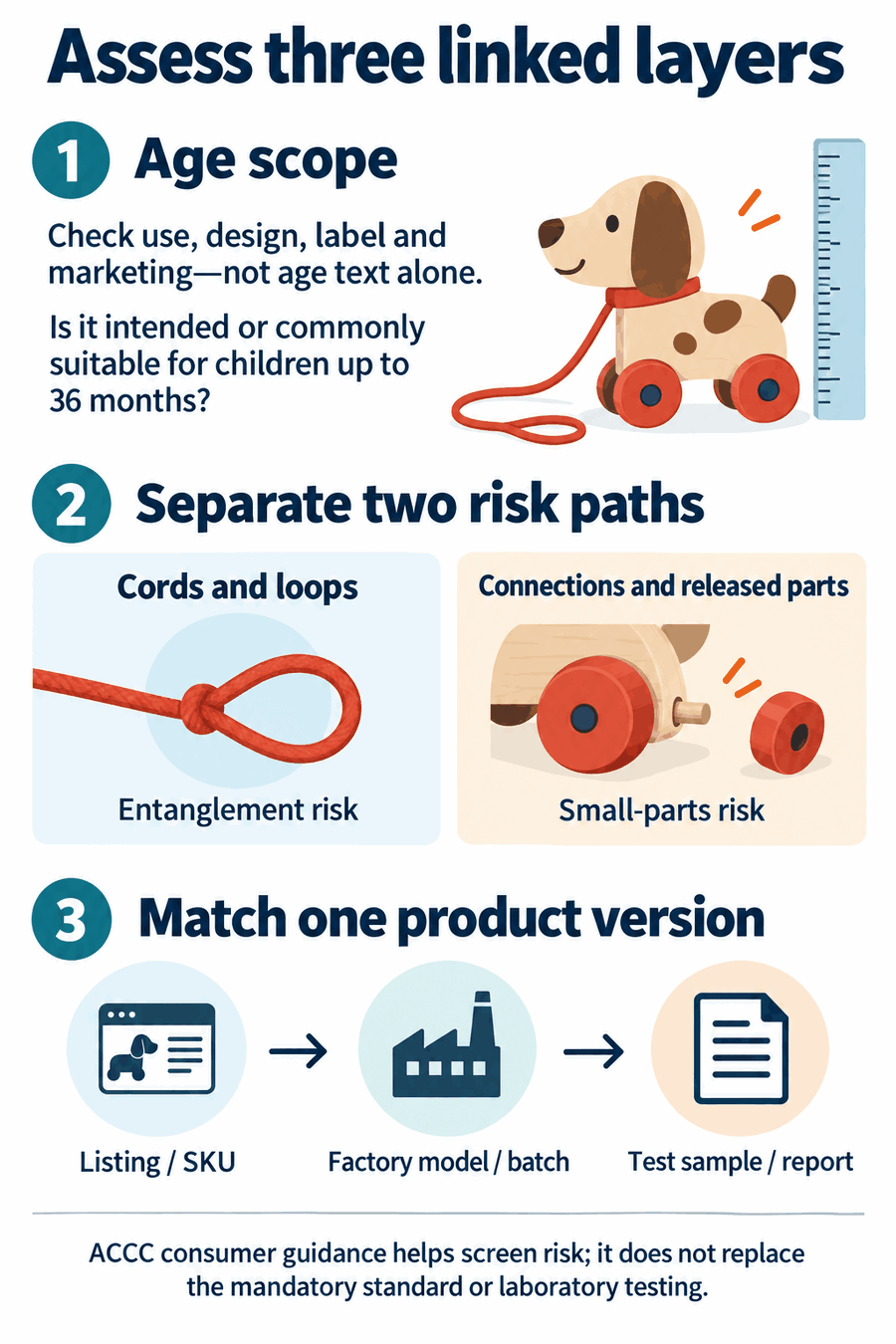
The diagram separates age scope, cord and detachable-part risks, and the link between the tested sample and the version for sale.
A cord may present an entanglement concern depending on its length, flexibility, loop formation and attachments. A knot, handle, wheel or decorative fitting presents another concern if it can come away during play or reasonable wear and tear and become a small part. Measuring a cord does not show that a fitting will stay attached. A photograph of an intact toy does not show what happens after wear.
The ACCC's consumer guide to push-and-pull toys offers age-specific safety advice. For children aged 1.5 years or younger, it recommends a pull cord shorter than 22 cm. For children aged 1.5 to 3 years, a cord longer than 22 cm should not have beads or other attachments that can tangle into a loop or noose. The guide also recommends a cord at least 1.5 mm thick to reduce cutting risk. These are useful prompts for a design review, but they are consumer guidance, not a universal “under 22 cm means compliant” rule. The three measurements and conditions address different hazards.
For detachable parts, the ACCC's mandatory-standard overview describes a small-parts cylinder 31 mm in diameter and 57 mm long, used to assess possible swallowing or choking hazards. Its dimensions are not a shortcut for a seller to measure a finished toy and issue a compliance verdict. The ACCC says the overview is not a complete guide to compliance. Applicable clauses and test conditions must be checked against the full standard and the toy's construction.
The reassuring document is the one that matches this batch
Suppose the tested sample had one cord-end attachment, but production later changed the knot or fitting. The earlier report may be genuine, while its coverage of the revised toy remains unanswered. Match the listing and seller SKU to the factory model, drawings, material and cord specification, production batch, sample photographs and report scope. If material, tooling, cord length, supplier or joining method changed, ask whether the change affects the original test coverage.
A better question for a supplier than “Do you have a certificate?” is “Which tested sample corresponds to the toy we are selling now?” Put a current production sample beside its packaging and listing, collect the relevant version and batch records, then ask a competent laboratory which mandatory-standard provisions and tests apply, what the existing report actually covers, and which evidence is still missing. The answer can inform listing, stock and testing decisions without pretending that a generic report covers every version.
If a parent reports a loose fitting, link the report to the precise model and batch, keep the product and communication records, and seek a prompt assessment from people qualified to examine the item. Repeating “we have a report” does not resolve a question about a changed or damaged structure. This article offers a review method; it does not determine whether a particular product is safe, noncompliant or subject to a specific response.
Confidence comes from being able to say what is known and what remains to be checked: the intended age, the hazard pathway, the version on sale and the sample behind the report. That is more useful to a seller, a laboratory and a concerned customer than an unsupported promise that everything is fine.
Official sources
ACCC: Toys for children up to and including 36 months of age mandatory standard


