

Reviewed: 27 September 2026. Japan’s revised Four Product Safety Acts took effect on 25 December 2025. For a business already selling into Japan, that date is a status-check point, not a future deadline: confirm the product, the importing operator and the filing position under current METI guidance.
A marketplace listing does not tell you who imports the product. One seller may supply a Japanese distributor that imports and resells the goods; another may sell directly from overseas to Japanese consumers with no domestic importer in the chain. The legal route depends first on whether the exact product is covered by the PS-mark regime, then on who conducts the import business. The presence of a Japanese warehouse, marketplace account or locally registered company is evidence to examine, not a conclusion by itself.
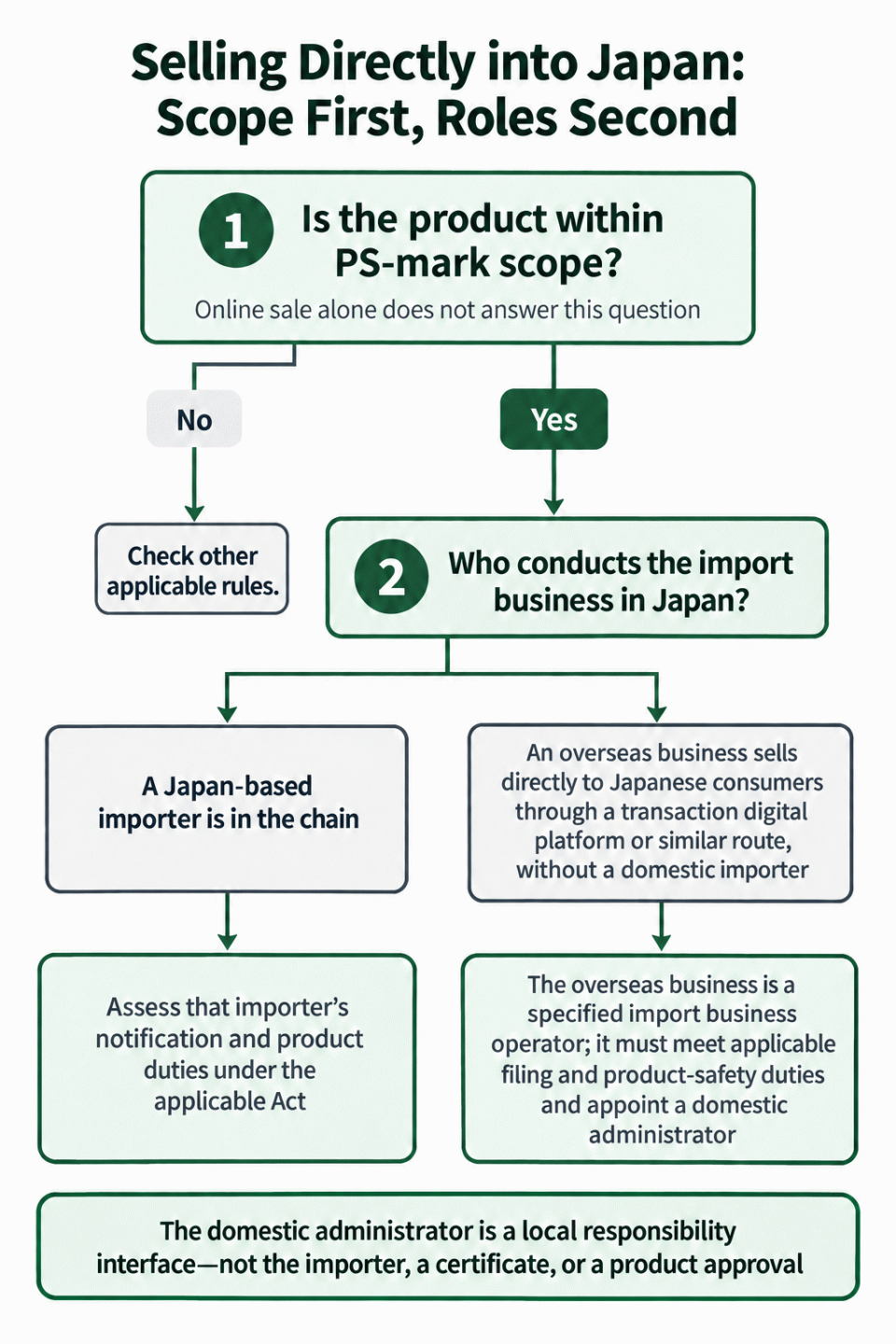
A scope-and-role summary of METI’s framework; assess the specific product and applicable Act before drawing a filing conclusion.
Start with the product, not the storefront
METI describes the overseas-operator route under Japan’s Four Product Safety Acts: the Consumer Product Safety Act, Electrical Appliances and Materials Safety Act, Gas Business Act, and Act on Securing Safety and the Optimization of Transaction of Liquefied Petroleum Gas. The relevant question is whether the exact product falls within the applicable PS-mark scope. “Sold online” is not a product classification, and this route should not be generalized to every cross-border listing. If the product falls outside that scope, other Japanese requirements may still apply; this particular route does not resolve them.
METI’s current guidance describes a specified import business operator as an overseas business that imports covered products directly to consumers in Japan through a transaction digital platform or similar arrangement, without an importer in Japan. The definition turns on the product and the business’s actual role. It is not safely answered by reading the storefront name, fulfilment label or warehouse address in isolation.
Reconstruct one real transaction
Take one live order and follow it backwards. Which entity contracts with the consumer? Who is responsible for bringing the product into Japan? Does a Japanese business import and resell the item, or does the overseas operator sell directly to the consumer? What do the distribution, fulfilment and customs contracts actually assign?
A Japanese distributor that buys stock and imports it for resale is a different chain from an overseas brand that contracts with the consumer and dispatches the product directly. Both offers can appear on the same Japanese marketplace. The marketplace is the sales venue; its presence alone does not identify the statutory import business operator. Likewise, a domestic address or company registration does not prove that the entity undertakes the relevant import business.
This is why a useful review compares the commercial documents rather than relying on a single listing field: order terms, invoices, import/customs records, distribution contracts and the product’s technical file should point to a coherent operator for the exact model and version. If those records name different entities or model variants, resolve that mismatch before treating the notification chain as settled.
A domestic administrator is a regulated interface
Where the overseas operator falls within the specified-importer framework, METI requires appointment of a domestic administrator and the applicable notification and product-safety steps. Appointment does not turn the administrator into the importer, transfer the overseas operator’s status, or certify the product.
The role is more substantial than a mailing address. METI guidance sets standards that include an address in Japan, authority to receive relevant government notices, Japanese-language communication capability and a contractual arrangement covering product-safety responsibilities. It also describes record-retention and cooperation duties. The current requirements and supporting documents should be checked against the specific Act, product category, form and METI procedure; do not assume one generic appointment letter completes every case.
For a proposed arrangement, test the handoff with a specific model: who receives an authority notice, who can retrieve the current inspection or conformity records, how does a manufacturer or model change reach the administrator, and how are records transferred if the contract ends? If the answer depends on recreating the product file from old emails, the appointment may exist on paper while the working interface remains incomplete.
A practical review sequence
Choose one product model and record its version, intended use and PS-mark scope rationale. Map the order and import chain to the entity that undertakes the import business. Then compare the notification details, technical evidence, marking, packaging and listing for that same version. Only after the first two questions—product scope and operator identity—are clear can a business meaningfully assess the domestic-administrator arrangement and its required documents.
This is a preparation framework, not an authority determination. If the product classification or statutory operator remains uncertain, seek a product-specific interpretation from the relevant authority or qualified legal and technical advisers.
Official references: METI’s overseas-business-operator procedure page, Product Safety Guide, and English guideline for overseas business operators. This page reflects a review of those public materials on 27 September 2026.


