
Source checked: September 27, 2026 · FDA public materials
When a marketplace asks for an “FDA cosmetic registration certificate,” the seller has a practical problem: FDA says it does not issue that document. The next step is not to rename a portal screenshot. It is to find out what fact the reviewer is trying to verify.
FDA’s September 9, 2026 notice says it does not provide certificates or other documents verifying cosmetic facility registration or product listing. It also does not issue a letter or email confirming that a facility or responsible person is exempt. The notice describes FDA’s documents; it does not prescribe what a marketplace must accept instead.
Start with the object behind the request
“FDA registration proof” can blur together a facility record, a product listing, or an exemption question. They concern different records and different legal actors. A single number cannot answer all three.
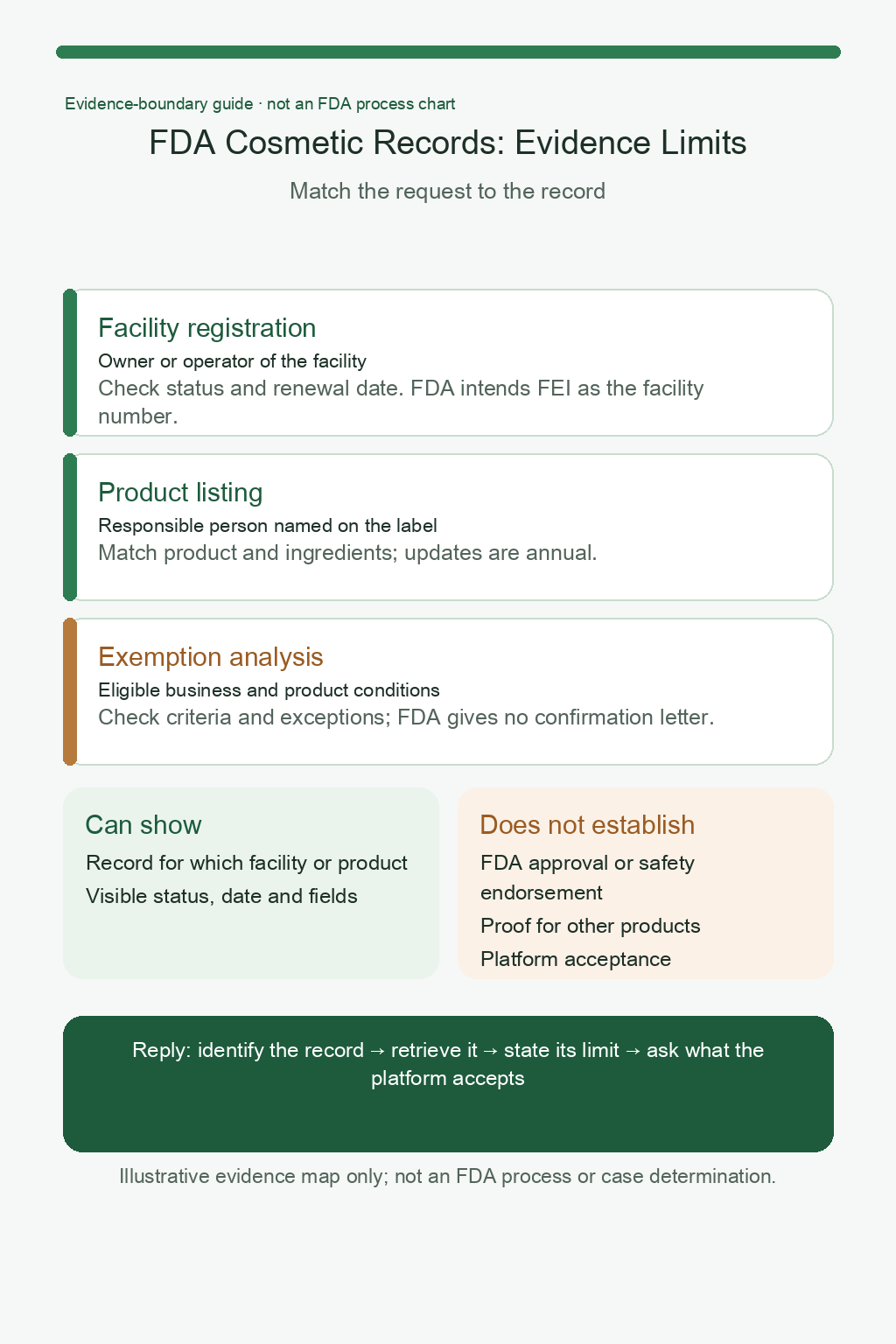
Illustrative evidence map only. It is not an FDA process chart or a determination for a particular product.
Three records that should stay separate
Facility registration. Owners or operators of facilities that manufacture or process cosmetics are generally required to register with FDA and renew every two years. Cosmetics Direct displays a registration status and renewal date. FDA’s final guidance says the agency intends to use a facility’s FEI as its cosmetic facility registration number. That identifier relates to the facility; it is not a product listing or a safety endorsement.
Product listing. The responsible person must list each marketed cosmetic product, including ingredients, and provide updates annually. Under the FD&C Act definition, the responsible person is the manufacturer, packer, or distributor whose name appears on the product label. FDA’s guidance explains that a company outside the United States can be the responsible person if it meets that definition. Do not automatically substitute a U.S. agent or importer for the label-based role.
Exemption analysis. MoCRA exempts certain small businesses from facility registration and product listing, subject to statutory exceptions. The listed exceptions include products that regularly contact the eye’s mucous membrane under customary use, injected products, products for internal use, and products intended to alter appearance for more than 24 hours when consumer removal is not customary. Eligibility depends on the facts and the current criteria. FDA will not issue an exemption confirmation letter.
A portal record is evidence with a defined limit
A dated Cosmetics Direct record can show the facility or product submission and the fields displayed for it at the time checked. FDA says the portal displays registration status and renewal date for facility registration. Name a portal page or receipt for what it is. If a submission status reads “Submission Accepted,” describe that status only; do not call it FDA approval. Separately verify the current facility or product record that applies to the question.
A facility record does not replace the product listing, and a listing does not establish FDA’s safety conclusion for the product. FDA’s notice does not choose a substitute for each marketplace. That is a separate question for the platform that made the request.
A response process that preserves the evidence boundary
1. Keep the exact request. Save its wording, date, case reference, marketplace and SKU. An internal paraphrase such as “they want FDA approval” may not match what the platform actually asked.
2. Identify the object. Decide whether the question concerns a facility, a marketed product or an exemption. Map the facility name and FEI, the label’s responsible person, the product name and the seller SKU.
3. Retrieve the matching record. Use the current portal record or authentic submission material, and state its date and scope. If the only record at hand is an FEI, call it a facility identifier; do not describe it as a product listing or certification.
4. Explain the limit and ask what is acceptable. State that FDA does not issue the requested certificate, identify the records you can provide, and ask the platform which alternatives it will review. Do not imply that FDA has endorsed the substitute or that the platform must accept it.
5. Keep the response package. Retain the documents sent, the explanation, the date and any follow-up. Each claim should be traceable to the facility or product record it describes.
The distinction is simple but consequential: an FDA registration or listing is a regulatory record, not a cosmetic approval certificate. A platform’s document label does not change the legal meaning of the record you hold.
Official FDA sources
Registration & Listing of Cosmetic Product Facilities and Products (includes the September 9, 2026 update)
https://www.fda.gov/cosmetics/registration-listing-cosmetic-product-facilities-and-products
Guidance for Industry: Registration and Listing of Cosmetic Product Facilities and Products (December 2024)
https://www.fda.gov/media/170732/download
Greenark (Shenzhen) Certification Co., Ltd. can help businesses map product, facility and registration records. Specific obligations and platform document requests should be assessed against the relevant business and product facts.
This article explains FDA’s public materials; it does not determine a company’s or product’s status or promise platform acceptance or a regulatory outcome.


