
A coloured lens can appear to be a fashion accessory when a campaign places it in a Halloween, cosplay or makeup setting. That merchandising choice does not settle the Australian regulatory question. The relevant starting point is the actual product: what it is, its intended purpose, how it is supplied, and what the complete page communicates to consumers.
Keep three checks separate: product status, advertising claims and recall scope. An ARTG record for one product does not cover every shade in a brand family. A product that is not named in one recall has not thereby earned support for every safety or wear-time claim on its listing.
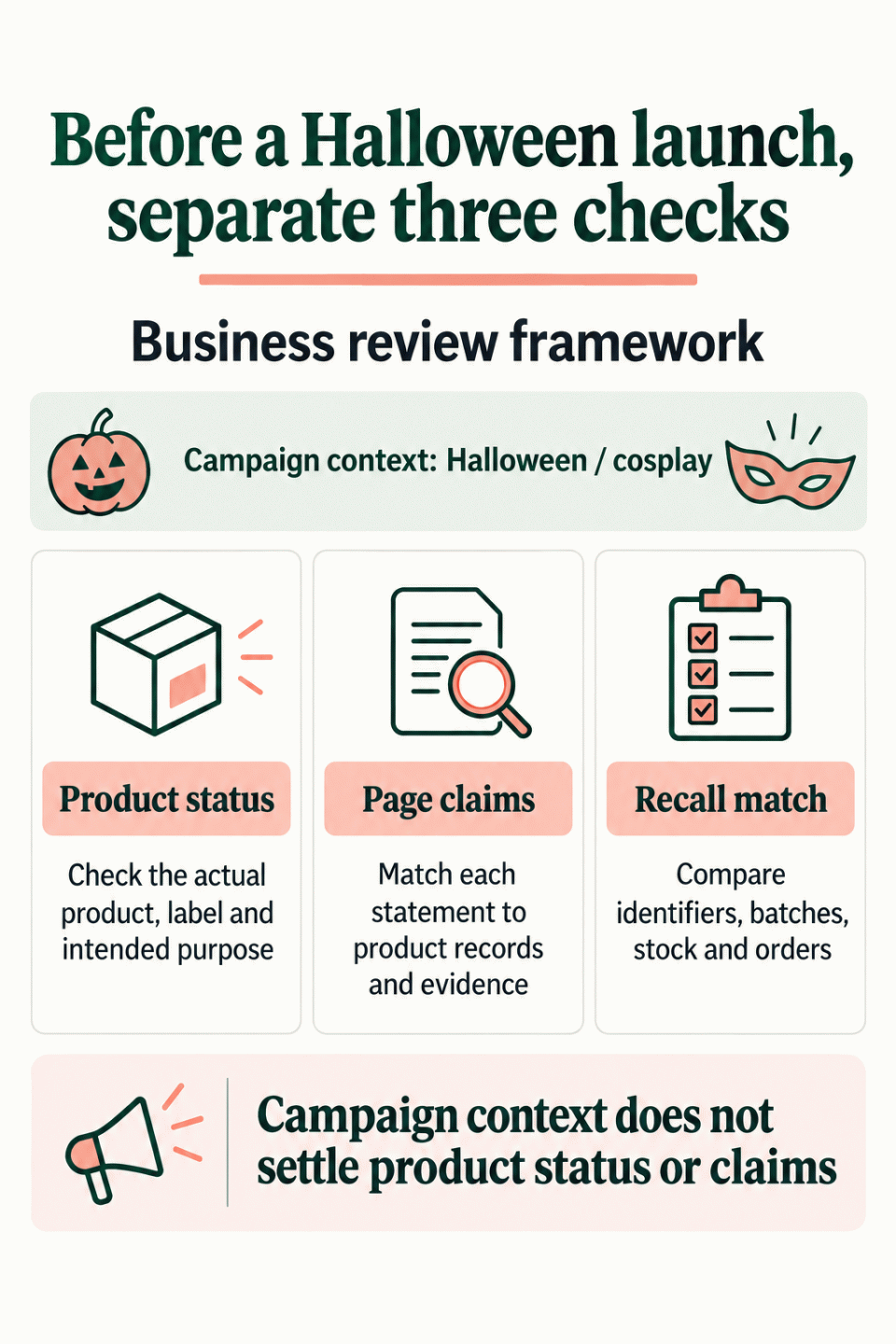
This is an operational review framework, not an official TGA classification diagram.
Start with the product, not the menu label
The TGA does not determine status simply from a retailer's category name such as “cosmetic” or “accessory”. Its guidance points to factors including composition, use, labels and instructions, claims, and relevant statutory exclusions or exemptions. Product boundaries need to be assessed in context; guidance does not replace the law, and the supplier remains responsible for the goods it supplies.
Begin with one identifiable item: manufacturer and model, packaging and instructions, specifications, intended purpose, Australian sponsor or responsible entity, and the version of the page being reviewed. Then determine whether that item is a medical device or another therapeutic good, and whether an exclusion or exemption applies. If it is regulated and ARTG inclusion is required, confirm that the entry actually corresponds to the product, responsible entity and intended purpose being advertised. Do not infer that “decorative” means unregulated; do not turn that caution into a blanket classification of every coloured lens either.
An ARTG entry tells you what is recorded in the Register. It is not a quality badge or TGA endorsement of the advertising around it. The TGA says claims such as “TGA approved” and “TGA registered” must not be used in therapeutic goods advertising to imply government endorsement. If an entry is relevant to the exact product, state only the verified and applicable fact. An entry covering one model cannot simply be carried across every colour or variant.
Review what the whole page leads a buyer to believe
Substantive claims are not limited to bullet points. The product title, image overlays, video, creator content and use context combine to shape the overall impression. Placing “comfortable”, “all-day wear”, “suitable for everyone” or “safe” beside Halloween imagery does not turn those statements into mere colour descriptions.
For therapeutic goods, TGA advertising requirements call for claims that are accurate, balanced, not misleading, substantiated and consistent with the relevant ARTG entry. Advertising must not present a product as having no risk, working in all cases or carrying a guarantee. Each material sentence should map to evidence for the actual product. Evidence about a material or supplier in general does not automatically support a finished product, a wear experience or a universal safety claim.
Keep the 2025 contact lens and spectacle lens permission within its defined scope. It applies to specified eligible goods, including a Class IIa contact lens included in the ARTG for an intended purpose of correcting refractive error or myopia control, and carries conditions such as consistency with the intended purpose and a prominent statement about suitability by an eye health professional. It is not a general restriction on every coloured lens or a blanket permission for Halloween decorative lenses. Check the instrument and the product's own ARTG intended purpose before relying on it for copy.
A recall is matched to the notice, not to an entire category
On 11 September 2026, ACCC Product Safety listed a recall titled “Coloured contact lenses designed for cosplay and makeup applications”. It identified specific white coloured lenses supplied by SHEIN Distribution Australia Pty Ltd; the packaging solution may have been contaminated with Burkholderia cepacia complex. That is evidence of a recall for the identified goods. It is not a statement that every coloured contact lens has been recalled, and it does not expand the notice beyond its own identifying details.
Compare the notice's product and supplier identifiers, packaging details and any stated scope against your SKU, batch, procurement and sales records. If a match is confirmed, follow the notice and regulator directions for affected goods, stock, orders and consumer communication, and retain the action record. If the match is uncertain, resolve the model or batch discrepancy before making a broader statement. A copy change alone does not remediate stock or orders.
Connect the three evidence paths before launch
Select one SKU and establish the product, label, instructions and intended purpose. Confirm the applicable TGA status analysis, any exclusion or exemption, and any required ARTG entry. Extract the material claims from the title, images and page; map each claim to product-specific evidence and visible qualifications. Finally connect recall identifiers to batches, stock and orders. Keep the item and page versions used in that review so a new shade, package or copy revision does not inherit an outdated conclusion.
This sequence guards against two opposite errors: extending one product-specific recall to an entire category, or treating “not named in this notice” as proof that the product status and advertising are settled. A seasonal campaign can change the creative setting. It cannot supply the product record or evidence.
This article draws on public ACCC Product Safety and TGA material. It is a general business review framework, not a product-specific regulatory determination or medical advice. A particular item must be assessed against its own records and applicable law.
Sources
• TGA: Determining if a product is a cosmetic or therapeutic good
• TGA: Confirm whether your product needs ARTG inclusion
• TGA: General requirements for advertising therapeutic goods
• TGA: 2025 contact lens and spectacle lens permission
• TGA: “TGA approved” must not be used to imply endorsement
• ACCC Product Safety: Coloured contact lenses designed for cosplay and makeup applications recall
Greenark (Shenzhen) Certification Co., Ltd.
sui@greenark-sz.com · www.greenark-sz.com · +86 184 0755 9004


