
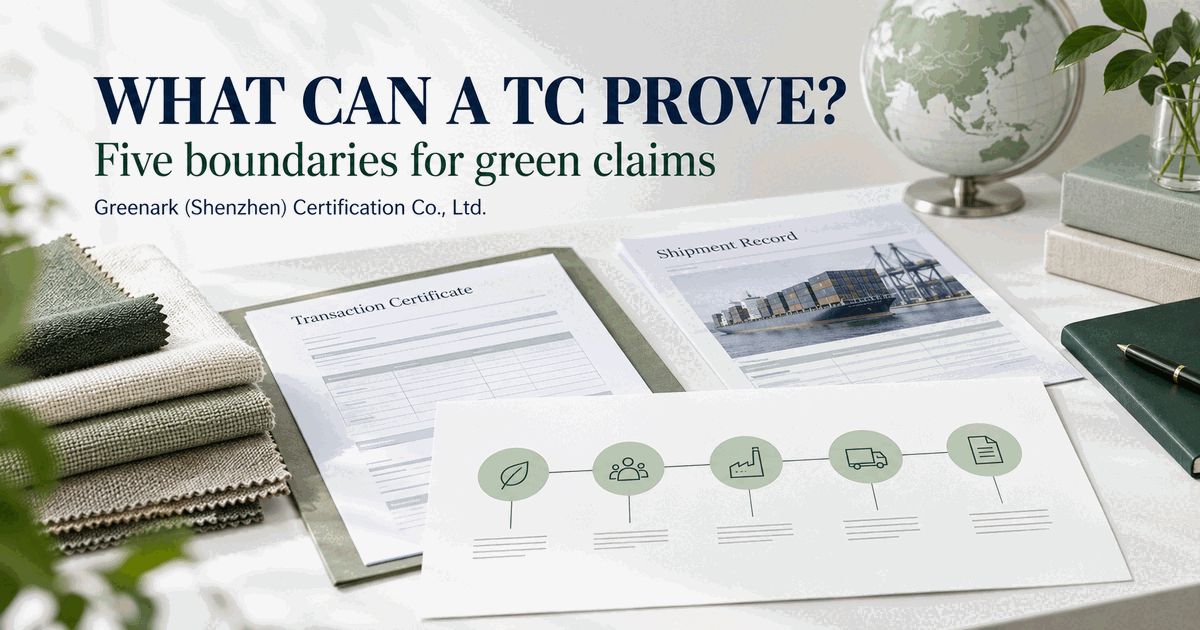
A supplier sends a Transaction Certificate (TC) with certified material, and the ecommerce team asks whether the product page can now say “100% recycled” or “better for the environment.” The answer does not come from the mere presence of a certificate. First establish which transaction it covers. Then establish whether the finished product qualifies for the proposed statement. Finally identify the rules that govern that kind of claim.
Start with the transaction the TC records
Treat a TC as a record of one material transaction in a supply chain, not as a certificate for a brand’s entire catalogue. Match the seller, buyer, material or product description, standard, quantity, certificate status, and shipment records. Connect those details to the purchase order, receiving lot, and subsequent production records. If the page concerns a different SKU, material lot, or shipment, the document’s presence does not close that gap. For an on-product claim, Textile Exchange also says to check that the TC comes from the direct supplier: a mid-chain TC does not by itself show that chain of custody is complete beyond the issuer. See its TC FAQ.
A Scope Certificate (SC) and a TC answer different questions. The SC describes the certified organization, sites, product categories, or processes within scope. The TC records a particular transaction that meets the applicable requirements. An SC alone does not identify the material in a specific shipment; a TC should not be read without checking the supplier’s scope, the parties, and the transaction status.
Textile Exchange has published TE-TXL-POL-203 V4.0. Its official timeline says the policy is effective and may be used from October 1, 2026; it becomes mandatory for certificate issuance on April 1, 2027. On the verification date of September 27, 2026, the effective date is only days away. Teams can prepare field mappings and records now, while describing the mandatory date as a future requirement. Consult the policy text and the official policy update page.
The input percentage is not the finished-product percentage
The certified-material percentage on a yarn or fabric TC does not automatically become the percentage for a garment or other finished product. Mixing, processing losses, trims, product structure, and the calculation denominator can change what the number means. Before making a finished-product claim, define whether it refers to the whole product or an identifiable component, then reconcile the bill of materials, input lots, output, and transaction records. If that calculation cannot be reproduced, do not copy an input percentage onto the product page.
The subject of the sentence matters. “This yarn shipment is certified to a standard” refers to a transaction material. “This jacket contains a stated share of certified material” refers to a specific finished product or component. “Our products are better for the environment” asserts a much broader environmental benefit. Those statements require different evidence.
B2B eligibility, consumer product claims, and broad green claims differ
Textile Exchange’s TE-301 Standards Claims Policy distinguishes product-related claims made between businesses in a supply chain (B2B) from claims made about final products to consumers (B2C). The routes are not interchangeable. A B2B product-related claim still has to meet the applicable standard’s minimum content requirements, and the selling organization needs a valid SC covering the relevant product category. A consumer-facing claim about a final product has additional conditions, including certification up to the brand and TCs for the claimed materials. Thresholds vary by standard and claim type; there is no universal “TC percentage” that authorizes every claim.
A product-related claim or label must also follow the applicable approval process and logo-use rules. Textile Exchange says the claim is submitted to the organization’s certification body for approval; a TC is not permission to print a mark or to use any wording the marketer chooses. The document helps trace a certified attribute through a defined supply chain. It does not certify every product from the supplier or substantiate a whole-brand conclusion.
For products marketed in the United States, environmental-benefit wording needs a separate check. The FTC’s Green Guides summary cautions against broad, unqualified general-benefit claims such as “green” or “eco-friendly,” and recommends qualifying them with specific benefits. Third-party certification does not remove the need to substantiate the express and implied claims consumers are likely to understand. The Green Guides are U.S. FTC guidance; they do not replace the laws or standards that apply in other markets.
Keep the 2026 claims timetable separate
A further distinction concerns organizational commitments and sourcing-progress statements, rather than product TCs. Textile Exchange published the TE-TXL-POL-303 Commitment and Sourcing Claims Policy on September 24, 2026; it is effective now and mandatory from December 31, 2026. For claims connected to Textile Exchange standards or programs, it sets criteria for the scope of the commitment, measurable goals, and dates, among other things, and says standards-related commitment claims are made off-product. A transaction certificate cannot establish that a company has achieved an organization-wide future sourcing target.
The October certificate-policy date, the December commitment-and-sourcing-claims date, and the rules for a product claim are separate checkpoints. For each statement, return to the policy that applies to its claim type and publication date.
Trace one sentence back to its evidence
Start with the exact sentence proposed for the page. Name the brand, SKU, component, lot, and standard it refers to. Trace that object to the SC, TC, transaction and production records; independently reproduce any finished-product percentage. Then classify the statement as B2B transaction information, a consumer product claim, a standards-related commitment or sourcing claim, or a general environmental-benefit claim. Check the relevant threshold, approval route, mark permission, and destination-market rules. Keep the approved wording and live page version linked to the evidence file. If the records support only an input lot, narrow the statement to that lot; a claim about the whole product or its overall environmental performance needs evidence for that broader subject.
A TC is valuable because it makes a defined certified-material transaction traceable. It is not a shortcut from a transaction fact to a finished-product percentage, consumer-claim approval, or an overall environmental benefit.
绿色方舟(深圳)认证有限公司
Email: sui@greenark-sz.com
Website: www.greenark-sz.com
Phone: +86 18407559004 (WeChat same number)


