

Facts checked through September 27, 2026. This article separates CCS volume reconciliation, GRS claim rules, and version transition. Confirm the applicable audit requirements against current official documents and the certification body.
A site may process claimed recycled fiber, hold work in progress, and sell both claimed and unclaimed output. A single “purchases minus sales” total can look balanced while hiding a broken link between a site, a production lot, a process loss, or an inventory movement.
Textile Exchange calls this control volume reconciliation under CCS 3.1. It tracks claimed materials purchased, on site, processed, and sold so that certified output does not exceed what available certified inputs can support after site-level losses. This article addresses CCS volume reconciliation; it does not treat it as the same method as ISCC PLUS mass-balance allocation.
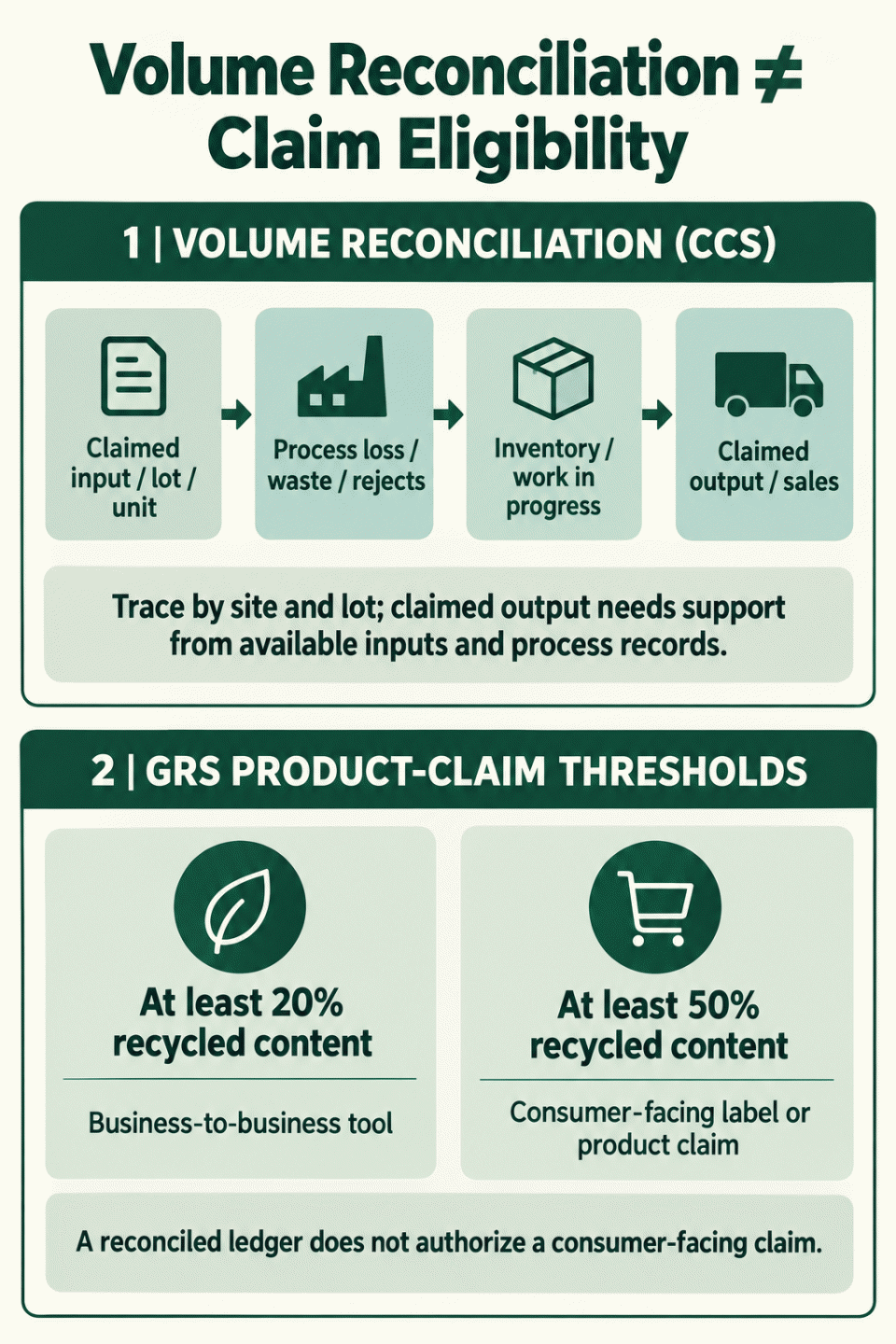
This image summarizes the relationships; confirm applicable requirements in current CCS/GRS documents and with the certification body.
1. Start with the unit and the point in the chain
CCS 3.1 generally bases reconciliation on standardized material weight. If the inputs are already final products, the organization may use item counts. A fiber or fabric processor therefore needs a weight-based trail, while a trader handling finished goods may follow the item counts on incoming transaction certificates.
Record the unit, any conversion basis, and whether the input is a final product. Kilograms and item counts cannot be added as if they measured the same thing. Losses during shipping, receipt, or storage also need to remain tied to the relevant product and record.
2. Treat each loss factor as a product-and-process question
The CCS User Manual requires expected waste factors for each processing step. Where factors vary, the organization must define factors that cover the relevant products and processes in scope and document how each factor was determined. A generic industry percentage cannot explain a particular site’s output.
Loss also affects content calculations. If claimed and non-claimed materials experience the same loss rate, the manual’s example allows content to be calculated from input weights. If their loss rates differ, calculate each material’s output separately before calculating the resulting content. Applying the raw input ratio in the second case can misstate what remains in the finished product.
Keep records for actual input, conforming output, waste, rejects, rework, and the source of each measurement. The high-level equation “input weight minus processing loss equals output weight” describes the relationship; it does not supply a company’s loss factor.
3. Keep the lot trail continuous; use alternatives only when they fit
CCS 3.1 calls for ongoing reconciliation by lot or batch and records that identify which claimed inputs went into a given output. Incoming transaction certificates, receipt, production lots, and output records should therefore connect without relying on a site-wide total to fill the gaps.
Continuous production is not, by itself, permission to collapse all lots into a monthly balance. CCS-105 provides an alternative volume-reconciliation route for limited circumstances. Confirm that the policy applies to the operation with the certification body, and retain the formula, product scope, and reason for the alternative method.
4. Account for stock and every disposition
A reconciliation is not simply certified purchases minus certified sales. CCS 3.1 requires the calculation to take account of inventory, waste, rejected products, and claimed material sold without a certification claim. Work in progress and stock movements matter because they explain why current output may not match current-period receipts.
Link incoming transaction certificates and receiving records to production issues and output, waste and rejects, claimed and non-claimed sales, and physical inventory. Keep the reconciliation at the relevant site so a combined total does not hide where claimed material went.
At least annually, CCS 3.1 requires review of the reconciliation, including a physical inventory, actual versus expected waste factors, claimed material sold without certification claims, and production capacity. A deviation of more than five percent from an expected waste factor must be investigated. This is an investigation trigger, not an allowance to increase a recycled-content claim by five percentage points and not an automatic non-conformity finding.
5. Separate the ledger test from consumer-claim eligibility
Textile Exchange’s GRS FAQ distinguishes two uses: products with at least 20% recycled content may use GRS as a business-to-business tool; consumer-facing GRS labels or product claims require at least 50% recycled content. These thresholds answer a claim-eligibility question. They are not reconciliation formulas.
A web-page statement still needs to match the actual product, the applicable claims rules, and approved wording. A component claim and a whole-product claim do not describe the same object. A reconciled ledger supports traceability and volume control; by itself, it does not authorize a consumer-facing statement.
Current transition: check GRS 5.0 and reclaimed-material records
As of September 27, 2026, GRS 5.0 has been effective since July 1, 2026, with December 31, 2026 listed as its mandatory date. The July update focuses on reclaimed-material tracking and the revised Reclaimed Material Declaration Form (RMDF); it does not replace CCS 3.1 volume reconciliation with a new general formula.
The official RMDF guidance assigns the form to the first certified organization in the reclaimed-material supply chain. It calls for a separate form for each supplier and monthly submission to the certification body for months in which reclaimed-material shipments are received. The revised form becomes mandatory for GRS/RCS certifications on December 31, 2026. Downstream sites should first identify their role before assuming they own this filing.
Textile Exchange also announced a revision to CCS 3.1 in June 2026. A revision process is underway, but that does not make a proposed future text an effective requirement. Use the currently published CCS documents unless the certification body confirms a relevant transition instruction.
A practical first pass
Choose one certified site and one real product lot. Trace the incoming transaction certificate to receipt; record the unit and process-specific loss basis; connect output, work in progress, rejects, and closing stock; reconcile claimed and non-claimed sales; then assess the separate consumer claim. When a unit, lot boundary, or loss factor changes, document where the change enters the record instead of smoothing it into one total.
Official sources
绿色方舟(深圳)认证有限公司 (Greenark (Shenzhen) Certification Co., Ltd.)
Email: sui@greenark-sz.com
Website: www.greenark-sz.com
Phone: +86 184 0755 9004 (WeChat same number)


