Information checked: September 25, 2026
Amazon's public materials describe Climate Pledge Friendly (CPF) as a shopping program that highlights products with sustainability features supported by recognized certifications. This article addresses internal evidence management for a catalog with multiple ASINs. It does not claim that Amazon offers a bulk-review shortcut, and it does not replace current Seller Central instructions, certification requirements, or a certifier's records.
When a brand manages dozens of ASINs, two weak operating models appear quickly. One team rebuilds every file from the beginning, creating unnecessary repetition. Another copies the first product's evidence into every variant, creating a much more serious problem: a consistent-looking folder can hide inconsistent products, suppliers, batches, certification scope, and listing claims.
The practical answer is not to choose between those extremes. Reuse the workflow and field structure, but keep the product-level evidence decision independent.
A template is not evidence
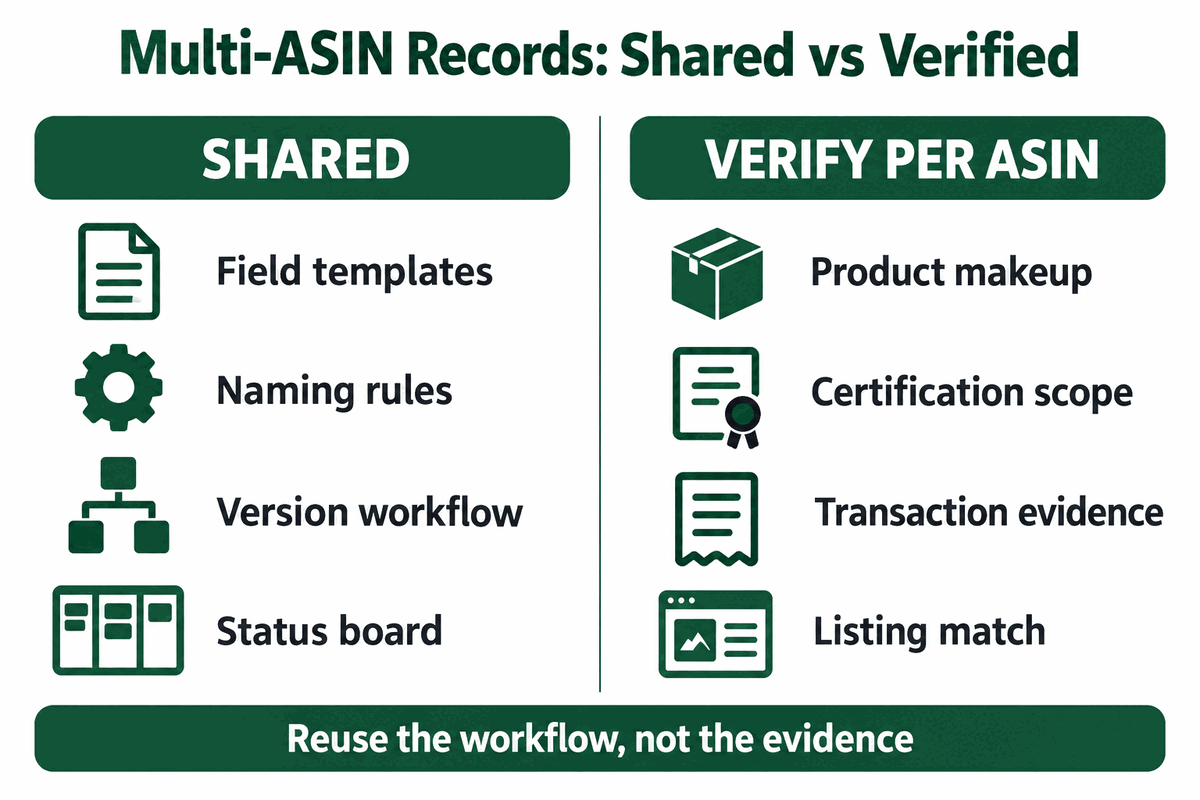
Teams can usually standardize the machinery around a review: field names, folder naming, document identifiers, version rules, owners, status values, exception notes, and a source register. This common structure is useful because every product is examined in the same order and missing links become visible.
The conclusion-bearing records are different. Product composition, certification scope, transaction or supply-chain evidence, and the match between a marketplace listing and the certified object should not be treated as shared merely because two products belong to the same family.
Consider two color variants from the same factory. They may use the same pattern and supplier account, yet the fabric batch, dye system, accessories, weight, or shipment history can differ. Copying the first variant's file may preserve the document names while breaking the chain between the second ASIN and its actual materials.
That distinction is the foundation of scalable catalog control: standardize how a decision is made; do not standardize the answer before checking the product.
Build one matrix with two layers
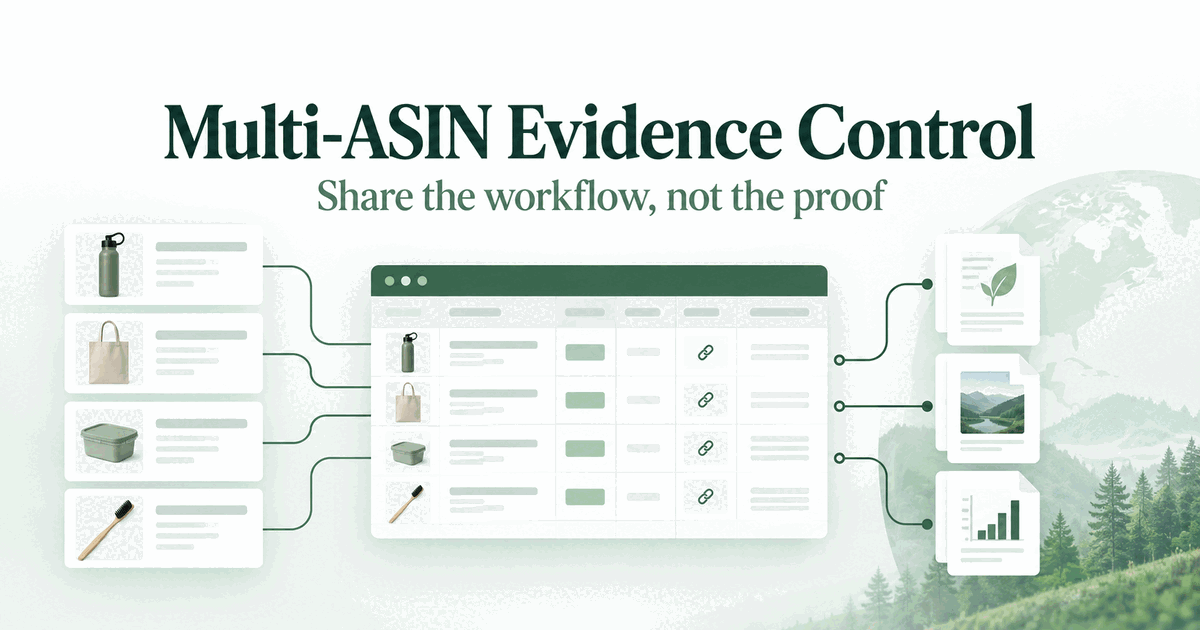
Instead of cloning a complete folder for every ASIN, maintain a master matrix with one row per ASIN and links to controlled source files. The matrix should separate shared process fields from product-specific evidence fields.
Product identity
Record the ASIN, internal SKU, model, size or color variant, marketplace, and the actual product shown on the current listing. This is the anchor for every later comparison. A supplier style name is not enough if several marketplace products use it differently.
Composition and certification scope
Link the current composition or BOM version and identify which materials, product categories, facilities, and organizations are covered by the certification record being relied on. A valid organization-level certificate does not, by itself, prove that every product sold by that organization is within the same scope.
Transaction and supply-chain evidence
Link the actual record that connects the relevant seller, buyer, product, quantity, shipment, and batch where those fields apply. Textile Exchange's scope and transaction certificate policies treat SC and TC records as structured, verifiable objects. An internal matrix should therefore point to the specific record and version, not merely say "GRS available."
Do not invent an "ASIN allocation" by editing a TC or dividing its quantity across products without support from the applicable certification and transaction records. Internal planning fields may help reconcile demand and documents, but they must remain clearly separate from official certificate data.
Listing match
Compare the current listing's brand, product name, composition, sustainability language, and claimed object with the evidence. "Product," "packaging," "component," and "company" are different claim subjects. A certificate connected to the organization does not automatically substantiate every environmental statement on a product page.
For each cell, record more than "complete." Keep a document identifier, date or version, covered object, reviewer, and exception note. Then a certificate renewal, supplier change, or listing edit can trigger a targeted review of affected ASINs instead of a blind catalog-wide overwrite.
Three judgments that efficiency cannot replace
One scope certificate does not automatically cover an entire product family
Check the certified organization, sites, product categories, materials, and other applicable scope details, then compare them with the current ASIN. Similar appearance or a shared supplier is not a substitute for that match.
One workbook does not make transaction evidence reusable
A spreadsheet can summarize records, but it cannot change the seller, buyer, product, quantity, shipment, or other facts in an official transaction record. The matrix is an index and control surface, not a new certificate.
A similar listing is not necessarily the same claim
Two pages may use nearly identical creative assets while referring to different claim subjects or material boundaries. Review the exact statement and the object it describes. Do not let a shared template turn a product-specific statement into a catalog-wide assertion.
A better starting sequence
Choose one representative product family and complete the chain for one ASIN:
Product identity → current composition → certification scope → transaction evidence → listing statement.
Once the chain is clear, standardize the field definitions, naming rules, ownership, and version workflow. Then reuse that workflow for the next ASIN. If the next product has a different composition, supplier, batch, certification scope, transaction path, or listing claim, retain an independent record and make a fresh decision.
This approach does not promise faster approval or a particular CPF outcome. Its value is more basic and more defensible: the team can identify which record supports a conclusion and which products must be reviewed when that record changes.
Official sources and timing boundary
Source:Amazon Sustainability Solutions Hub states that CPF highlights products that meet sustainability standards through trusted third-party certifications and Amazon-developed certifications, and directs sellers to Seller Central for current operating guidance.
Source:Textile Exchange TE-TXL-POL-203-V4.0, published April 1, 2026, combines the scope and transaction certificate policy. It becomes effective October 1, 2026 and mandatory April 1, 2027. As of this article's verification date, the effective date has not yet arrived; operational use should confirm the currently applicable version.
Source:Textile Exchange's Standards Policy & Resource Updates page explains the transition between the legacy SC/TC documents and the new policy and its supporting standard-specific details.
No universal approval rate, review time, bulk-processing result, or certification outcome is stated here. For a real product, use the current Amazon instructions for the target marketplace, the applicable certification scheme, and valid certifier-issued records.
Greenark (Shenzhen) Certification Co., Ltd.
For a multi-ASIN catalog, a useful first check is whether each row in the internal matrix can be traced to the exact product, certificate, transaction record, and current listing language it relies on.
Email: sui@greenark-sz.com Website: www.greenark-sz.com Phone: +86 18407559004 (WeChat)