Verified on September 25, 2026. This page separates Amazon Climate Pledge Friendly (CPF) public eligibility criteria, Textile Exchange certification rules, and practical internal evidence preparation. Badge display remains subject to the certification, product category, marketplace, and current platform review.
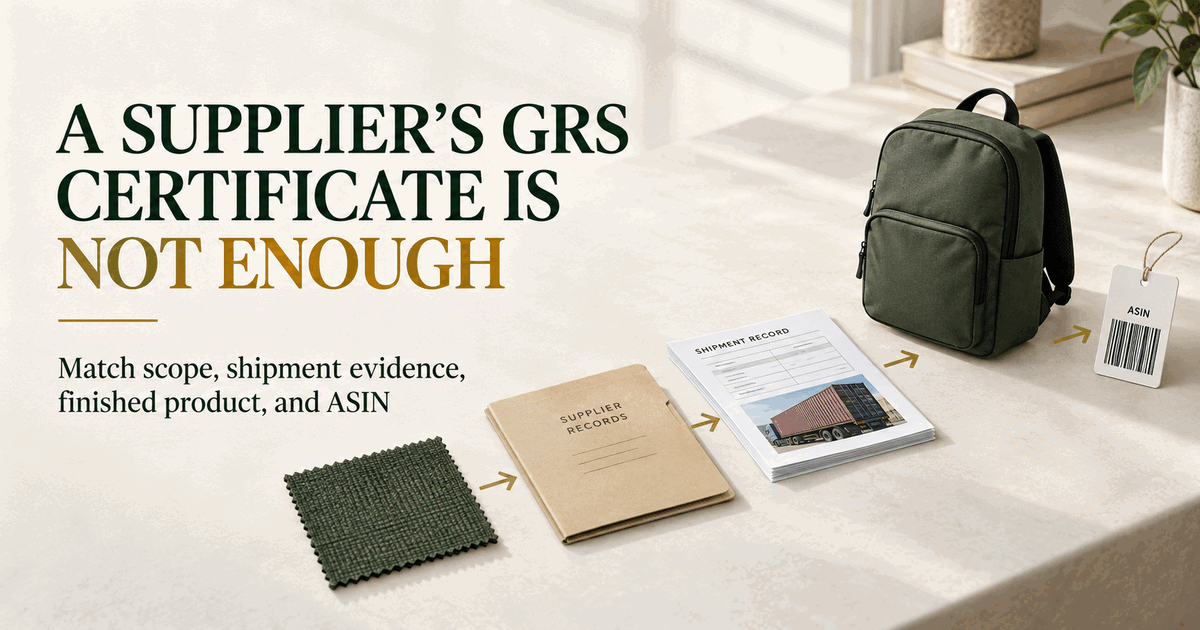
A supplier's valid Global Recycled Standard (GRS) scope certificate answers a limited question: which organization, sites, processes, materials, and products were within certification scope during the certificate's validity.
It does not automatically prove that a particular shipment was sold as certified, that the certified material reached a finished consumer product, or that the finished product maps to the ASIN being reviewed.
That distinction changes the working question. Instead of asking, “Does the factory have GRS?”, ask whether four records agree: valid SC scope, a direct-supplier TC, the finished product and BOM, and the ASIN.
Start with the eligibility route, not the certificate image
Amazon's current Climate Pledge Friendly certification directory lists GRS for textiles only and states that a product must contain at least 50% certified GRS material to qualify through that route.
Textile Exchange uses a related but different boundary. Its public GRS guidance explains that products containing at least 20% recycled material may use GRS as a business-to-business certification tool, while consumer-facing GRS labeling requires at least 50% recycled content.
Those statements are not contradictory. A product can enter the GRS certification system at a lower content level without meeting the public CPF condition for GRS. The mistake is to treat “50%” as a universal CPF rule across every certification and category. RCS, FSC, ISCC Plus, and other programs each need a separate check against the current CPF directory and the certification owner's rules.
What a scope certificate can establish
A scope certificate is organization-level evidence. Review it for:
the certified organization's legal name and actual site;
the applicable standard and certificate validity;
covered product and material categories;
covered processing steps; and
current authentication status in Textile Exchange's certificate directory.
Suppose a supplier's scope covers recycled polyester fabric, while the ASIN is a finished backpack. The certificate may support the fabric stage, but it does not replace records showing how the fabric moved through final manufacturing, commercial transfer, and product identification.
A certificate can be genuine and still be irrelevant to the product under review.
What a transaction certificate can establish
Textile Exchange describes a transaction certificate (TC) as a certification-body-issued record for an actual certified product shipment. It identifies the supplier, buyer, products, shipment details, and certification status.
For a product-level claim, the critical TC should come from the direct supplier. An upstream TC may explain the origin of material, but it does not by itself show that chain of custody continued through the intervening sale and conversion steps.
Textile Exchange also notes that a non-certified buyer may receive a TC. However, when certified goods are sold to a non-certified buyer, the chain of custody is broken at that point and further certification claims cannot be passed on. Receiving certified goods and being able to carry a certification claim into a branded finished product are therefore separate questions.
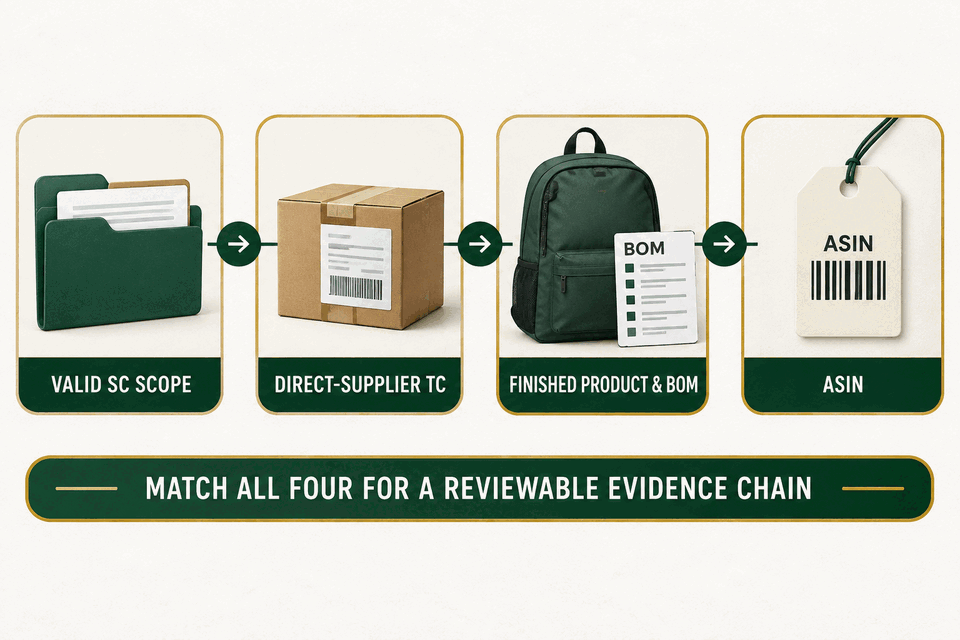
This is an internal review model, not an Amazon form. It puts documents that normally sit in different teams into one product-level readback.
Build a record that can be read back in both directions
For each ASIN, maintain one evidence row with at least:
1. ASIN, internal SKU, finished-product name, and marketplace;
2. intended CPF certification route and the route's current eligible category;
3. certified material, finished-product weight basis, and calculated percentage;
4. direct supplier, SC identifier, validity, site, product scope, and process scope;
5. direct-supplier TC identifier, seller, buyer, product description, quantity, and shipment references;
6. matching identifiers across BOM, purchase order, invoice, packing list, receipt, label, and packaging; and
7. platform identifier, submission date, current status, and any request for additional evidence.
This row is not a substitute certificate. Its purpose is to expose mismatches early. Typical failures include a production site outside the SC, a TC for fabric while the ASIN is a finished bag, a buyer name that cannot be reconciled to the brand or trading entity, a certified-content calculation that does not match the product statement, or one certificate being reused across unrelated categories.
Correct the transaction-certificate timeline
A blanket “apply within 45 days” rule is not supported by the current Textile Exchange policy.
As of September 25, 2026, ASR-104 v3.1 says a certification body shall issue a TC when it receives a complete and valid application within 90 calendar days after the earliest shipment date. From day 91 through day 180, the certification body may issue the TC. Beyond 180 days, issuance is limited to specified exceptions.
Operationally, organizations should still prepare TC applications immediately after shipment. The policy maximum is not a service target, and incomplete applications can create delay or rejection risk.
Textile Exchange has published TE-TXL-POL-203, a new combined policy for scope and transaction certificates. It becomes effective October 1, 2026 and mandatory April 1, 2027. During the transition, confirm the applicable policy version with the certification body before relying on a timeline.
Do not generalize from FSC or ISCC Plus
FSC uses a distinct Amazon CPF route, product portal, and trademark framework. FSC currently states that a company cannot enroll products using a supplier's or manufacturer's FSC certificate; the participating company must hold its own FSC Chain of Custody certification or Promotional Licence.
That is an FSC-specific participation rule. It should not be copied into a GRS, RCS, or ISCC Plus workflow without checking the relevant certification owner's current rules.
ISCC Plus likewise has its own certification scope and chain-of-custody options. “SC + TC + 50%” is not a safe cross-certification formula.
A practical review sequence
Choose the route. Identify the exact CPF-recognized certification intended for the ASIN and confirm its current category and material conditions.
Authenticate the SC. Check status, organization, site, product, material, process, and validity rather than relying on the certificate title or logo.
Read the direct-supplier TC. Reconcile seller, buyer, product description, quantity, and shipment references with purchasing and logistics records.
Return to the finished product. Use the BOM, finished-product identifier, label, and packaging to confirm that the certified material and claimed percentage relate to this product.
Bind the evidence to the ASIN. Keep the product identifier used by the relevant certification or platform route, and preserve submission and readback status. If a certification owner or marketplace uses a different identifier or portal, follow its current instructions.
Conclusion
A supplier's GRS scope certificate is the beginning of the evidence chain, not product-level proof on its own.
A reviewable case exists only when certificate scope, direct transaction evidence, finished-product composition, and the ASIN can be read back to one another. If one link fails, correct the record or supply-chain route before making a platform or consumer-facing claim.
Greenark (Shenzhen) Certification Co., Ltd. can help organizations review the boundaries between certificate scope, transaction records, BOM data, and marketplace identifiers. It does not guarantee certification or badge outcomes.
Greenark (Shenzhen) Certification Co., Ltd.
Email: sui@greenark-sz.com
Website: www.greenark-sz.com
Phone: +86 18407559004 (WeChat)
Sources reviewed
Amazon Climate Pledge Friendly: Certifications
Textile Exchange: Recycled Claim Standard + Global Recycled Standard
Textile Exchange: Transaction Certificate FAQs and ASR-104 v3.1
Textile Exchange: Materials Matter Standard and SC/TC policy updates
FSC Connect: eCommerce Sustainability Programs