Data verified: August 29, 2026. This article provides preparation guidance based on Amazon Seller Central official policies, FTC Green Guides, Textile Exchange certification standards, and public industry cases. It does not guarantee certification approval, platform display, traffic, sales, audit results, or certification issuance.
Overview
As global consumer interest in sustainable products continues to rise, more and more Amazon sellers are using green marketing terms like "recycled," "organic," "eco-friendly," and "sustainable" in their listings to attract eco-conscious shoppers and gain competitive advantage. However, many sellers don't fully realize that every environmental claim on a product page requires a corresponding evidence chain, and failure to provide it can lead to listing removal, account restrictions, or even legal risks.
This article systematically梳理s Amazon's green claim compliance requirements, explains the evidence levels corresponding to different claim strengths, clarifies the relationship between Climate Pledge Friendly (CPF) and page claims, and provides actionable self-audit and risk management solutions.
1. The Regulatory Framework for Green Claims
1.1 Legal Level: FTC Green Guides
The Federal Trade Commission's (FTC) Green Guides (officially titled "Guides for the Use of Environmental Marketing Claims") are the core legal basis for environmental marketing claims in the United States. First published in 1992 and revised multiple times since, the latest version sets forth detailed requirements for various types of environmental marketing claims.
Core principles of the FTC Green Guides include:
- Claims must be clear and specific: Vague, generalized environmental terms should not be used
- Environmental benefits must not be overstated: The claimed benefit must match the actual situation
- Third-party certifications must be genuine and valid: Use of certification marks requires authorization and must be within validity period
- Comparative claims require complete substantiation: Comparative environmental claims require Life Cycle Assessment (LCA) data
1.2 Platform Level: Amazon Environmental Claims Policy
Amazon, as one of the world's largest e-commerce platforms, has clear platform rules for environmental claims on product pages. Its policy framework is based on the FTC Green Guides but adds platform-specific review mechanisms and enforcement methods.
Key points of Amazon's environmental claims policy:
- All environmental claims in product detail page elements (title, bullet points, description, A+ content, images, videos) require substantiation
- Use of certification marks must comply with the certification body's trademark usage guidelines
- Climate Pledge Friendly is an independent certification program and does not equate to general green claim authorization
- Violations are handled progressively: from listing removal to account restrictions
1.3 Certification Level: Third-Party Certification Standards
Third-party certifications such as GRS (Global Recycled Standard), RCS (Recycled Claim Standard), FSC (Forest Stewardship Council), OCS (Organic Content Standard), and ISCC (International Sustainability and Carbon Certification) are important evidence sources to support green claims. But each certification has its specific scope and proof content:
| Certification | Core Proof Content | Applicable Categories | CPF Relationship |
|---|---|---|---|
| GRS | Recycled content ≥20% + social + environmental | Textiles, etc. | CPF recognized, 50% threshold |
| RCS | Recycled content ≥5% | Textiles, etc. | CPF recognized, 50% threshold |
| FSC | Sustainable wood sourcing | Wood, paper products | CPF recognized |
| OCS | Organic content ≥5% | Textiles, etc. | CPF recognized, 50% threshold |
| ISCC PLUS | Sustainable/recycled mass balance | Plastics, chemicals | CPF recognized, 50% threshold |
| RWS | Responsible Wool Standard | Wool products | CPF recognized |
2. The Gradient Relationship Between Claim Strength and Evidence Level
2.1 Gradient Model Overview
Green claim compliance is not a black-and-white binary judgment, but rather a gradient system corresponding to claim strength. The stronger the claim, the higher the evidence level required; the more specific and verifiable the claim, the lower the risk (provided evidence is complete).
Based on FTC Green Guides, Amazon platform policies, and industry practice, we classify green claims into five strength levels.
2.2 Five-Level Gradient Explained
Level 1: Specific Content Claims
Typical phrasing: "70% recycled polyester," "made with 55% recycled plastic"
- Characteristics: Clear quantified material ratio, points to specific environmental attribute
- Required evidence: Third-party certification + complete TC chain + BOM calculation basis
- Risk assessment: Low risk (provided evidence chain is complete and numbers match precisely)
- Compliance key point: The ratio stated on the page must exactly match the ratio on the certificate/TC
Level 2: Certification Mark Claims
Typical phrasing: "GRS Certified," "FSC Certified"
- Characteristics: Explicitly references third-party certification marks or names
- Required evidence: Valid SC held by certificate holder + corresponding batch TC + brand authorization
- Risk assessment: Low risk (provided certificate holder is compliant and product is in scope)
- Compliance key point: Certificate holder must be seller itself or have explicit authorization
Level 3: Attribute Description Claims
Typical phrasing: "contains recycled material," "made with organic cotton"
- Characteristics: Describes environmental attribute but without quantification or specific certification
- Required evidence: Supplier declaration + material test report + purchase records
- Risk assessment: Medium risk
- Compliance key point: Must not imply main ingredient has the attribute
Level 4: Vague Environmental Terms
Typical phrasing: "eco-friendly," "sustainable," "green"
- Characteristics: Broad meaning, no specific environmental benefit points
- Required evidence: Clear specification of benefit points + corresponding evidence
- Risk assessment: High risk
- Compliance key point: FTC Green Guides state broad terms are likely to mislead
Level 5: Absolute/Comparative Claims
Typical phrasing: "100% eco," "most sustainable," "50% less carbon than traditional"
- Characteristics: Absolute statements or environmental performance comparisons
- Required evidence: Complete LCA report + third-party verification + clear baseline
- Risk assessment: Extremely high risk
- Compliance key point: Most sellers cannot provide required LCA reports
3. Common Overclaim Scenarios and Risk Points
3.1 Exaggerated Content Numbers
Typical manifestation: GRS certification shows 65% recycled content, but the page says "100% recycled."
Risk analysis: This is the most common and most easily judged violation. Numerical mismatch constitutes substantive false representation with almost no room for appeal.
3.2 Misuse of Supplier Certificates
Typical manifestation: The supplier holds certification, and the seller directly uses the certification mark on their own listing.
Risk analysis: The certificate holder is the supplier, not the seller. Direct use of supplier certificates violates trademark usage guidelines and Amazon's policies. FSC has the strictest requirements.
3.3 Abuse of Vague Environmental Terms
Typical manifestation: Pages heavily use vague terms like "eco-friendly," "sustainable" without specifying concrete benefits and without evidence.
Risk analysis: According to FTC Green Guides, broad environmental terms are likely to mislead consumers due to their unclear meaning.
3.4 Overextension of CPF Green Badge
Typical manifestation: After obtaining CPF green badge, adding various green claims under the assumption that "having the badge means you can write anything."
Key insight: CPF green badge is "bonus points" (obtaining identification and traffic entry), while page claim compliance is the "baseline." Even with CPF, green claims exceeding certification scope still need independent evidence.
3.5 Excessive Visual Implication
Typical manifestation: Main images and A+ content heavily use environmental theme icons like Earth, leaves, recycling arrows, paired with "Save the Planet" slogans.
Risk analysis: Visual elements also constitute environmental claims. If images convey comprehensive environmental benefits but the product only has a single attribute, it may be deemed misleading.
3.6 Packaging Claim Omissions
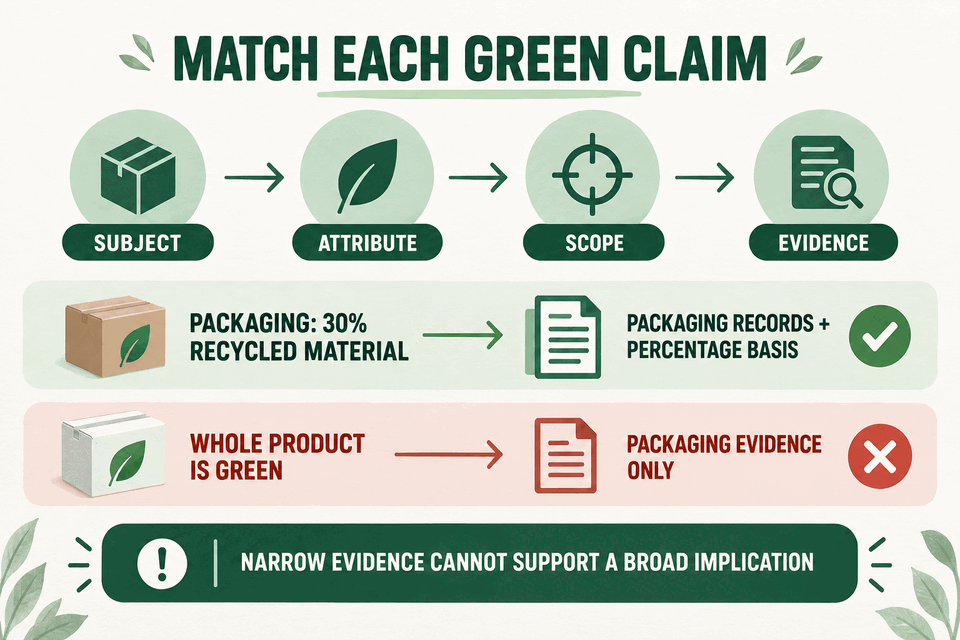
Typical manifestation: The product itself is certified, but packaging is not, yet the page says "recyclable packaging" or "plastic-free packaging."
Risk analysis: Packaging is part of the product, and environmental claims about packaging also require evidence.
3.7 Unsubstantiated Comparative Claims
Typical manifestation: Pages claim "30% fewer carbon emissions than traditional products" but have no LCA report.
Risk analysis: Comparative environmental claims have the highest evidence requirements and need complete lifecycle assessment data.
4. Analysis of the Relationship Between CPF and Page Claims
4.1 Positioning of CPF Green Badge
Climate Pledge Friendly (CPF) is a sustainable product label program launched by Amazon in partnership with Global Optimism. Products with the CPF green badge display a special label in search results and detail pages and enjoy exclusive filtering entry and traffic support.
Core roles of CPF green badge:
- Traffic boost: Exclusive filtering entry, search result label, detail page display
- Trust endorsement: Amazon officially certified sustainable product label
- Differentiated competition: Forms recognition among similar products
4.2 Boundary Between CPF and Page Claims
The relationship between CPF green badge and page green claims can be summarized as: CPF is a bonus; claim compliance is the baseline.
| Dimension | CPF Green Badge | Page Green Claims |
|---|---|---|
| Nature | Platform label program | Product disclosure obligation |
| Function | Extra traffic + trust endorsement | Accurate product description |
| Evidence Requirement | Specific certification + Amazon review | All claims need evidence |
| Coverage | Only certification scope claims | All environmental statements |
| Violation Consequence | Lose badge eligibility | Listing removal, account risk |
4.3 Common Cognitive Misconceptions
Misconception 1: Having CPF means you can write any green term
Correction: CPF green badge only proves the product meets a specific certification standard. Green claims exceeding the certification scope still require independent evidence.
Misconception 2: Without CPF, you can't write "recycled"
Correction: Even without CPF, as long as you have a complete evidence chain, you can still truthfully describe environmental attributes.
Misconception 3: CPF approval is permanent
Correction: CPF green badge is dynamic. Certification expiration, product changes, or evidence chain breaks can all lead to badge removal.
5. Green Claim Compliance Self-Audit Plan
5.1 Self-Audit Steps
Step 1: Comprehensive inventory of environmental claims
- Scan titles, bullet points, descriptions, A+ content of all ASINs
- Extract all environment-related keywords
- Also check text and visual implications in images and videos
Step 2: Match evidence one by one
For each environmental claim, answer: What is the specific meaning? What evidence do I have? Is the evidence holder myself? Does the evidence match product scope and ratio? Is the evidence valid?
Step 3: Risk grading and prioritization
Rate each claim according to the five-level gradient model, and prioritize high-risk items.
Step 4: Build evidence chain management table
Establish an ASIN-claim-evidence correspondence table recording ASIN numbers, page claims, certification numbers, TC information, BOM basis, supplier information, etc.
5.2 Tools and Templates
It is recommended to use Excel or online spreadsheet tools to建立 a unified evidence chain management ledger, ensuring every green claim for every ASIN is traceable. Conduct comprehensive reviews quarterly, and promptly update expired or changed certificates.
6. Risk Response and Remedial Measures
6.1 Handling Process After Receiving Amazon Compliance Notice
- Immediate assessment: Read the notice carefully, clarify specific violating claims and reasons
- Contain risk: If multiple ASINs are involved, check similar products first
- Gather evidence: Organize all certification documents, TCs, test reports related to the claim
- Develop plan: Decide whether to appeal or revise and resubmit
- Execute rectification: Modify copy, supplement evidence, submit appeal
- Review and optimize: Analyze causes, improve processes, prevent recurrence
6.2 Handling Strategy When Evidence is Insufficient
If certain environmental claims are found to lack sufficient evidence, take the following measures:
- Prioritize copy revision: Replace high-risk claims with low-risk formulations
- Supplement evidence chain: Promptly apply for required certifications or testing
- Phased rollout: Prioritize high-traffic ASINs and high-risk claims
- Establish mechanisms: Incorporate green claim compliance into new product reviews
7. Summary and Recommendations
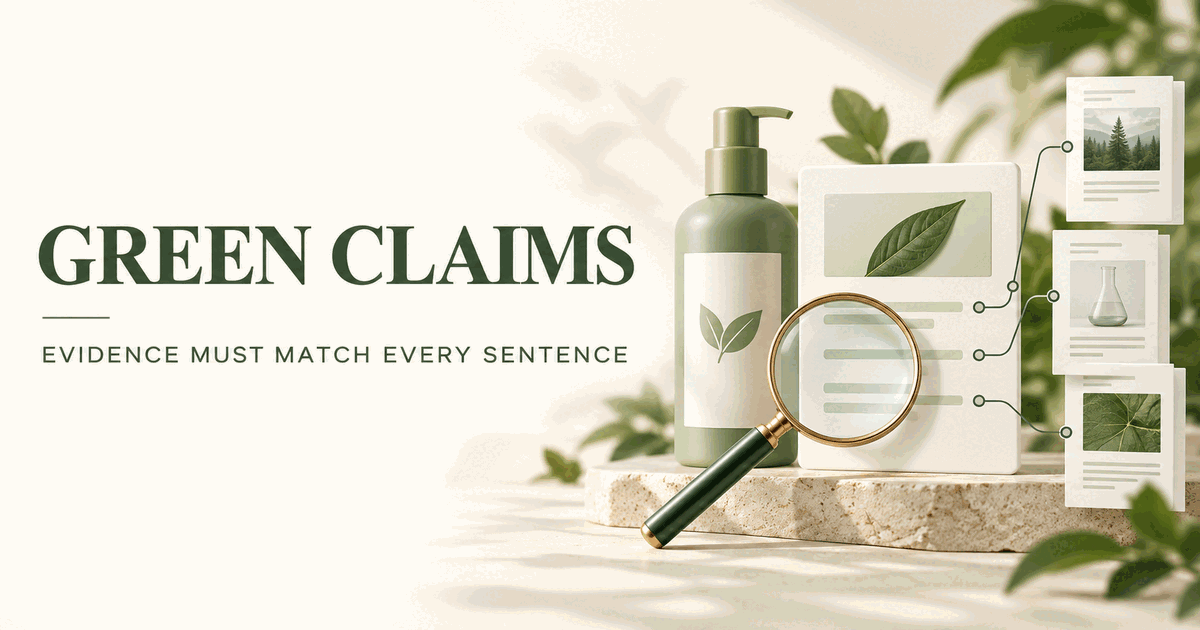
The core of Amazon green claim compliance management is establishing the awareness that "claims and evidence must be equivalent." Every environmental claim is a promise to be kept, not marketing copy that can be used freely.
Key recommendations for Amazon sellers:
- Specific is better than vague: Use specific, quantified, verifiable environmental attribute descriptions
- Evidence before claims: Confirm evidence availability before adding any green claim
- Build management system: Incorporate green claim compliance into daily operations
- Manage CPF and claims separately: CPF is a traffic tool; claim compliance is a baseline
- Stay updated on policy changes: Environmental compliance regulations are dynamically changing
Sustainable consumption is a major trend, and green marketing is an effective differentiation tool. But only under compliance conditions can green claims truly translate into consumer trust and commercial value, rather than potential risk sources.
About Greenark (Shenzhen) Certification Co., Ltd.
Greenark (Shenzhen) Certification Co., Ltd. specializes in helping Amazon sellers and supply chain enterprises organize FSC/GRS/RCS/OCS/ISCC/RWS and other sustainability certification materials, building a compliance evidence chain that supports CPF green badges, Climate Pledge Friendly, and green claims.
If you are sorting out listing green claims, preparing CPF green badge application materials, or need to assess the compliance risk of existing claims, welcome to contact us for professional consultation.
Email: sui@greenark-sz.com
Website: www.greenark-sz.com
Phone: +86 18407559004

This article's data comes from public industry reports and platform information, for reference only. Greenark (Shenzhen) Certification Co., Ltd. does not guarantee any certification results, search rankings, or traffic results.