
Information reviewed on September 24, 2026. This article separates a certification standard's own rules, the current Amazon Climate Pledge Friendly (CPF) program criteria, and the evidence for a specific SKU. Certification lists, standards, and transition dates can change. Confirm the current requirements for the target store before making a submission. Nothing here determines that a product qualifies or guarantees certification, approval, or a badge.
A seller may have recycled fiber in the product, an FSC-claimed paper package, and a wool component in the same offer. The supply chain may present GRS, FSC, or RWS documents. The practical question is not which acronym is most familiar. It is which product attribute the seller expects CPF to recognize, whether the current program accepts the certification for that context, and whether the records reach the exact SKU being sold.
A material-to-certification lookup table can be useful for discovery, but it is unsafe as a final decision tool. A standard's scope does not determine Amazon's current eligibility rules. Inclusion in a program does not make a supplier certificate cover every finished product, batch, packaging component, or page claim.
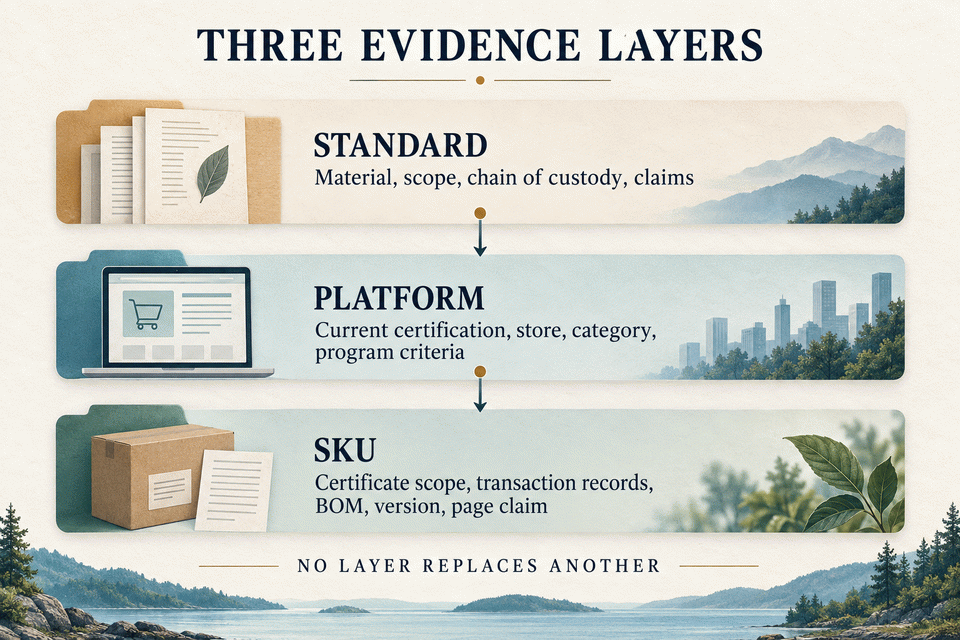
The three questions that should not be collapsed
1. What does the standard verify?
This layer defines eligible materials or products, chain-of-custody rules, certification scope, and allowed claims. Textile Exchange published and made GRS 5.0 and RCS 3.0 effective on July 1, 2026, with a mandatory date of December 31, 2026. The update is limited to the Reclaimed Material Declaration Form and related tracking requirements rather than a broad rewrite of the standards. Textile Exchange's current FAQ still summarizes GRS as applying from 20% recycled material with additional social, environmental, and chemical requirements, and RCS as applying from 5% recycled material with a focus on content verification and traceability. Those percentages belong to the relevant standards and claim categories. They are not a universal CPF threshold. During the transition, an organization should confirm with its certification body which version applies to the audit at hand.
2. What does the platform currently recognize?
Amazon describes CPF as a program that uses vetted third-party and Amazon-created certifications to identify products with sustainability features. In a January 2026 public explanation, Amazon used GRS as an example and described CPF-recognized GRS products as containing at least 50% recycled content. That is a program-facing condition for this certification example. It should not be generalized into a single 50% rule for FSC, OCS, RWS, ISCC PLUS, or every certification in CPF.
Amazon also says it routinely reassesses the certification landscape. A current decision therefore needs the live certification route, store, product category, and program criteria. An old screenshot, a search-result summary, or another seller's outcome is not a substitute.
3. Do the records reach this SKU?
The SKU layer connects the certificate holder and scope to the supplier, transaction records, bill of materials, batch or formulation, finished-product description, and page wording. A valid supplier certificate proves what is stated on that certificate. It does not automatically establish that a seller's current ASIN, a later production run, or a broader consumer claim is covered.
Counterexample: An FSC claim on a paper box does not certify the plastic item inside. A GRS scope certificate does not replace the transaction and product records needed to link the certified supply chain to the current finished-product version. State the object of the claim—product, component, or packaging—rather than allowing the page to imply more.
What the six common systems actually ask you to prove
GRS: recycled content plus processing requirements
GRS is a full product standard. It verifies recycled content and chain of custody while adding social, environmental, and chemical requirements. Textile Exchange's current FAQ describes the applicability threshold as at least 20% recycled material. Consumer-facing claims and a CPF route may impose different conditions, so a team should not use the 20% figure as a complete platform answer. GRS also does not replace product-quality or legal-compliance assessment.
RCS: percentage and traceability of recycled material
RCS verifies the percentage of recycled material and tracks it from the source to the final product. RCS Blended claims cover 5–94% certified recycled material, while RCS 100 claims require at least 95%. This distinction matters for product wording, but it still does not answer whether the current CPF route accepts the product or whether the evidence maps to the seller's SKU.
OCS: organic input and chain of custody
OCS verifies the percentage of organically grown material and traces it from source to finished product. It does not certify every processing impact or turn an organic component into an unqualified claim about the whole item. OCS 100 and OCS Blended represent different content ranges, so the certificate, claim type, and product wording must remain aligned.
RWS: animal welfare, land management, and traceability
RWS verifies wool against animal-welfare and land-management requirements and tracks it from farm to final product. It is not merely a wool-content label. The current date also matters: Textile Exchange's Materials Matter Standard is scheduled to become effective on December 31, 2026 and mandatory for relevant Tier 4 audits on December 31, 2027. In September 2026, that transition should be described as upcoming—not as a completed replacement.
FSC: distinguish chain of custody from promotional use
FSC chain-of-custody certification is designed for organizations that produce, process, or sell forest-based products with FSC claims. A retailer or brand promoting unchanged, finished, labeled products may instead need a promotional licence. Organizations that label, transform, repack, or pass FSC claims on sales documents generally need chain-of-custody certification. The correct route depends on the organization's activity; “the supplier is certified” is not a complete trademark or claim decision.
ISCC PLUS: alternative feedstocks and chain-of-custody methods
ISCC PLUS verifies sustainability characteristics of alternative feedstocks and supports physical segregation, controlled blending, and mass balance. Its scope includes plastics and packaging, textiles, and other markets linked to alternative feedstocks. Under mass balance, certified inputs and outputs are connected through controlled accounting; the method does not mean the same physical percentage of recycled molecules is present in every individual item. Product claims must follow the selected chain-of-custody and licensing rules.
Why category shortcuts are only a starting point
“Use ISCC PLUS for plastics and GRS for textiles” can surface likely routes, but it is not a standards rule. GRS and RCS are written for any product that meets their recycled-material criteria, while ISCC PLUS also covers textiles and other markets beyond plastics. The better question is which system the supply chain uses, what attribute the seller intends to claim, whether the current CPF route accepts it, and whether the certificate and transaction evidence reach the finished SKU.
Mixed-material products expose the weakness of a shortcut. A team must define the claimed object before calculating anything: the whole product, a component, or packaging. The applicable standard and platform rule—not a generic BOM template—determine the calculation boundary, exclusions, and chain-of-custody treatment.
A four-way reconciliation before submission
Product: Lock the target store, ASIN/SKU, material composition, packaging, and production version.
Standard: Confirm the current version, scope, chain-of-custody method, claim category, and transition dates.
Records: Connect certificate scope, supplier, order or transaction records, BOM, and batch to the same commercial version.
Page: Review every statement for the correct object, percentage, qualification, and evidence boundary.
The central conclusion is simple: certification selection is not a jump from material name to certification name. First establish what the standard verifies, then what the platform currently accepts, and finally whether the records cover the SKU being sold. No one layer can repair a gap in another.
Official sources reviewed
Amazon Sustainability, “Products you can trust: helping customers shop with the planet in mind,” January 28, 2026.
Textile Exchange: GRS 5.0 / RCS 3.0 policy updates, current standards FAQs, Standards Claims Policy, Organic Content Standard, Materials Matter Standard, and the transition policy.
Forest Stewardship Council: Chain of Custody Certification and Promotional Licence guidance.
ISCC: ISCC PLUS scope, chain-of-custody methods, and Climate Pledge Friendly collaboration.
Greenark (Shenzhen) Certification Co., Ltd.
Email: sui@greenark-sz.com
Website: www.greenark-sz.com
Phone: +86 18407559004


