
Checked on September 24, 2026 against Textile Exchange's current ASR-104 V3.1 policy, the published TE-TXL-POL-203 V4.0 policy, the official standards update page, certificate authentication services, and Amazon's public Climate Pledge Friendly information. The issuing certification body and the live system record remain controlling for an individual certificate.
Textile Exchange's new Policy for Scope and Transaction Certificates becomes effective on October 1, 2026 and mandatory on April 1, 2027. That six-month transition creates an operational question for brands, importers, suppliers, and compliance teams: does an existing Transaction Certificate need to be replaced simply because the new policy has taken effect?
The short answer is no. An effective date changes the framework available to certification bodies; it is not a blanket cancellation date for every certificate already issued. The correct review starts with the certificate's issue date, policy and template version, current status, version history, transaction data, and the certification body's record.
The practical risk is not merely holding an “old-looking” PDF. It is losing control of which record is current while suppliers and certification bodies move through the transition at different times. A defensible process therefore tracks policy version and certificate status as separate fields.
The handover has two dates, not one cliff edge
October 1, 2026: V4.0 is effective and may be used.
During the transition, organizations should ask each certification body which policy and template it will apply to a given TC application.
April 1, 2027: V4.0 is mandatory.
Certificates issued from the mandatory date must use the new policy. The superseded V3.1 policy documents are not to be used for issuance after that date.
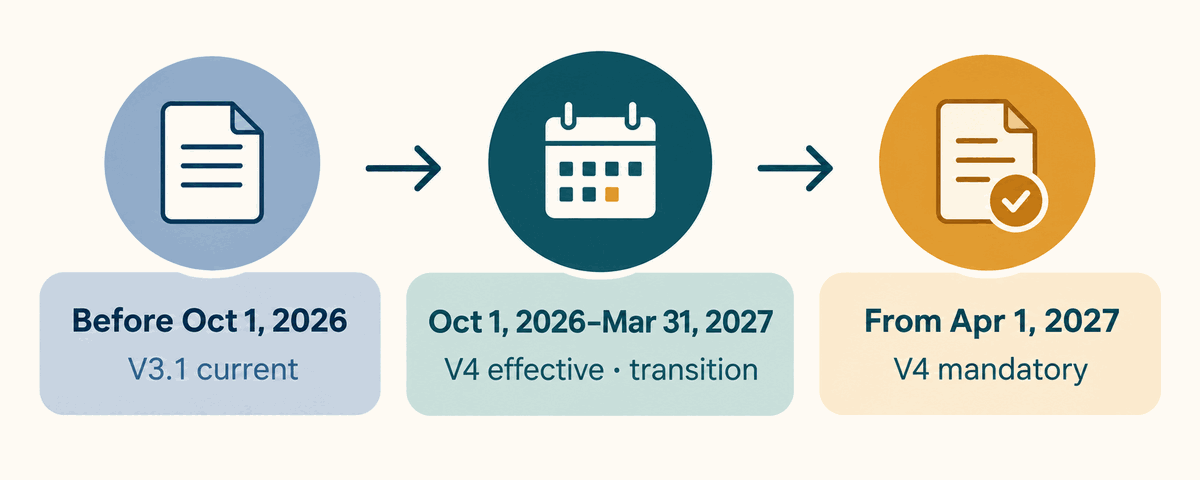
Treat the date as a routing question: which policy did the certification body apply? Then verify the current certificate record and the transaction evidence.
What changes matter to an evidence reviewer
V4 combines requirements that previously sat in separate scope-certificate, transaction-certificate, material-ledger, and certification-procedure documents. It also formalizes a more structured relationship between certificate data and Textile Exchange's Trackit environment. A reviewer should therefore look beyond visual template differences.
Certificate identity and version. V4 requires a unique TC number and a version number. The initial version and later amendments should be distinguishable. A folder containing three similarly named PDFs is not a version-control system; the team needs to know which version the issuing body treats as current.
Status and downstream effects. V4 distinguishes Valid, Amended, and Invalid status. If an incoming TC is amended and the changed information affects a subsequent outgoing TC, the downstream record may also need amendment. Teams should not forward the original file after receiving a corrected version without checking who relied on it.
Application timing. ASR-104 V3.1 requires issuance when a complete and valid application is received within 90 days after the earliest shipment date, allows certification-body discretion from day 91 through day 180, and generally limits later issuance to stated exceptions. V4 section 4.2.3 requires issuance when the complete and valid application is received within 180 days, with listed conditions and delay reasons for later cases. In both versions, these are application-timing rules—not a universal 180-day expiry period for an issued TC.
How to handle three common transition scenarios
An existing TC was issued before October 1, 2026
Do not instruct the supplier to reissue it solely because V4 is effective. Authenticate the transaction through Textile Exchange where the service applies, compare the returned fields with the certificate, and check whether the record is current, amended, or invalidated. If a buyer, marketplace, or auditor identifies a concrete discrepancy, send that discrepancy to the issuing certification body. Policy transition is not a substitute for a certificate-specific determination.
A complete application is submitted during the transition
Ask the certification body to identify the policy and template it will use, and preserve that answer with the application record. Keep evidence of when the certification body received a complete and valid application, not just the date of the first enquiry or an incomplete email package.
This distinction becomes important when a team sends documents in stages. A shipping document sent on Monday does not necessarily establish Monday as the application date if a required sales record arrives later and the application was not complete until Friday.
A new TC is issued on or after April 1, 2027
The V4 framework is mandatory. Review the new numbering and version structure, status, Trackit data, and any standard-specific details that apply to the product. If a supplier still provides only a legacy-format document, ask the issuing certification body to explain the record. The buyer should not convert the document or reconstruct missing fields internally.
Build a transition register around evidence objects
For each TC expected between October 2026 and April 2027, record:
• TC number, current version number, status, and last-update date.
• Issuing certification body, seller, buyer, standard, and transaction product.
• Earliest shipment date, complete-application receipt date, and issue date.
• Policy and template version confirmed by the certification body.
• Invoice, shipment document, product identifier, and any marketplace claim that relies on the transaction.
The register is an internal control, not a replacement certificate. Its purpose is to show which evidence is current, who confirmed the policy version, and which downstream teams or customers must receive an amendment or invalidation notice.
Three assumptions to reject
“Every legacy TC becomes unusable on October 1.”
No. October 1 is the V4 effective date, not a universal invalidation event. Review the individual certificate's issue basis, version, and current status.
“The applicant can choose whichever policy is more convenient.”
No. The certification body applies Textile Exchange requirements. The applicant should obtain and retain the version decision, not edit the template or combine fields from different policies.
“An authentic TC automatically qualifies the product for Amazon CPF.”
No. Certificate authentication, certification scope, transaction traceability, and Amazon's product-level program decision are separate questions. A policy transition does not expand product eligibility or guarantee a marketplace outcome.
A practical readiness sequence
1. Inventory transactions likely to need TCs between October 2026 and April 2027.
2. Ask each certification body for its transition schedule, policy version, template, and submission route.
3. Preserve evidence of the complete-application receipt date and any deficiency notice.
4. Authenticate the TC and record its current version, status, and last update.
5. Reconcile the TC with the SC, invoice, shipment record, product identifier, and external claim.
6. Route any certificate correction or version conflict to the issuing body; do not edit the PDF.
Official sources
Textile Exchange, TE-TXL-POL-203 V4.0 Policy for Scope and Transaction Certificates
Textile Exchange, ASR-104 V3.1 Policy for Transaction Certificates
Textile Exchange, Standards Policy & Resource Updates, Standards FAQs, and Certificate Authentication
Amazon, Sustainability Solutions Hub and Climate Pledge Friendly Creative Guidelines
This article explains public policy and evidence-management practices. It is not an individual decision by Textile Exchange, a certification body, or Amazon, and it does not guarantee certification, certificate issuance, marketplace labeling, review approval, or processing time.
Greenark (Shenzhen) Certification Co., Ltd.
Email: sui@greenark-sz.com
Website: www.greenark-sz.com
Phone: +86 184 0755 9004


