
Checked on September 24, 2026 against Amazon's public Climate Pledge Friendly information, Amazon Ads creative guidance, and Textile Exchange's current certificate policies, FAQs, and authentication tools. Requirements may differ by certification program, marketplace, and the wording of the live Seller Central request.
Amazon's Climate Pledge Friendly (CPF) program identifies qualifying products, not entire brands or suppliers. A Transaction Certificate (TC) can support a chain-of-custody review, but it does not by itself make a product eligible for a CPF label.
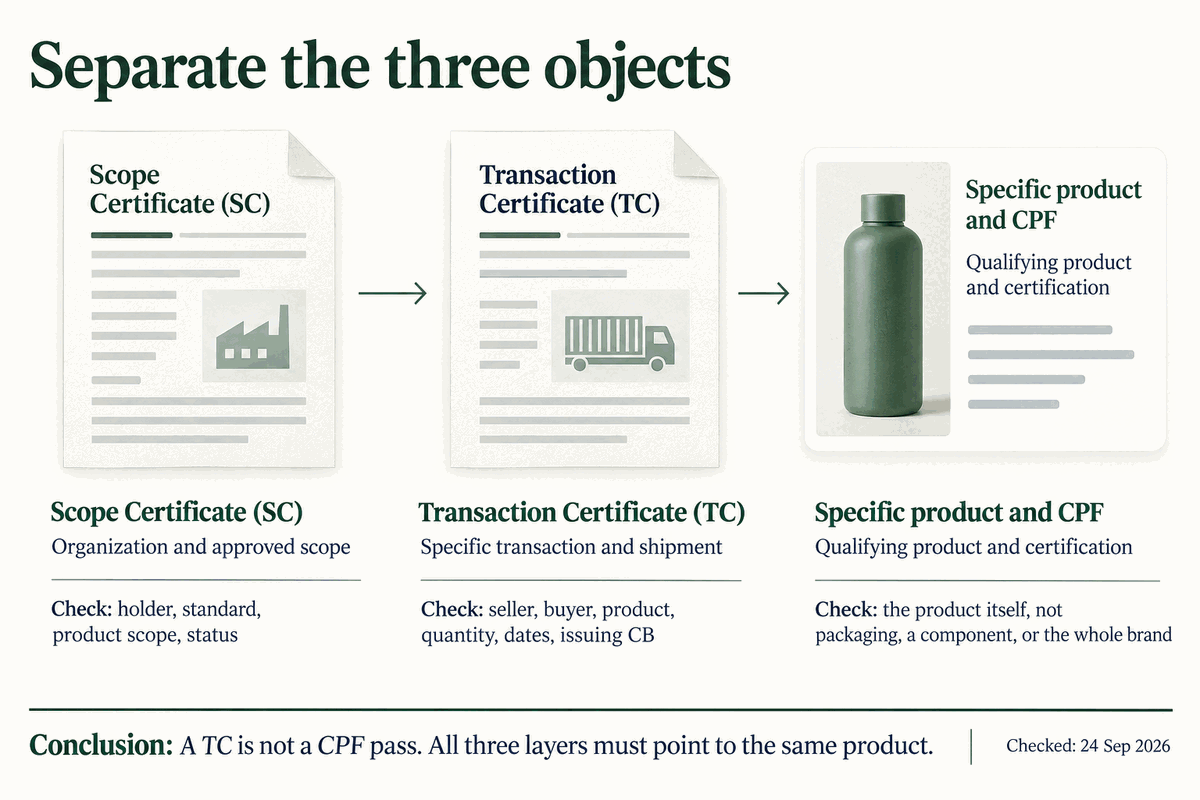
When Seller Central asks for supporting information, three separate questions need answers: Is the organization certified for the relevant scope? Does the transaction have verifiable evidence? Is the product under review the same product covered by that evidence? Treating these as one question is a common cause of repeated submissions.
This article uses Textile Exchange Scope Certificates (SCs) and TCs to explain an evidence-chain review. Requirements can differ by certification program, marketplace, and the wording of the live Seller Central request. The current notice, the applicable standard, and the issuing certification body remain controlling.
Three objects, three different jobs
An SC establishes organizational scope. It identifies the certified organization, applicable standard, activities, and product scope. A valid SC does not mean every product or every transaction from that organization is automatically covered.
A TC documents a specific certified transaction. Textile Exchange policy governs seller, buyer, product, shipment, and related transaction information. A TC connects a particular sale and shipment to the chain of custody; it is not a general product approval.
CPF is a product-level program. Amazon states that CPF works with trusted third-party certifications and Amazon-created certifications. Amazon Ads guidance also says the CPF label applies to a single product, not to a brand. Certification of packaging, one component, or the supplier alone cannot be assumed to qualify the finished product.
The practical distinction is simple: the SC defines the boundary, the TC documents the transaction, and Amazon evaluates the specific product against the relevant program.
Start with the actual request
Do not begin with a universal document checklist. Read the current Seller Central notice and identify the product or ASIN, the certification program, the disputed field, the submission route, and any stated deadline. If the notice does not request an item, do not invent a requirement based on a previous case.
Preserve a dated snapshot of the notice, product record, certification data, and proposed documents. This prevents teams from comparing a new listing, a different supplier, or an amended certificate against an old request.
A five-step evidence-chain review
1. Confirm what the certification applies to
The product name, model, material claim, and certification program must describe the same object. Evidence for packaging does not automatically support a claim about the finished product. A TC for yarn cannot be treated as a TC for a garment simply because the supplier is the same.
2. Verify the SC and its scope
Use Textile Exchange's Find a Certified Company service and review the actual SC. Check the certified organization, standard, activities, product categories, and current status against the supplier's role and the product under review.
If the product falls outside the documented scope, ask the certification body whether a scope extension or a different route is required. A narrative explanation cannot expand the certificate.
3. Authenticate the TC and read its transaction fields
Textile Exchange provides Authenticate a Transaction for TCs issued after October 1, 2022. For earlier certificates, verification should be requested from the issuing certification body.
Compare the issuing body, seller, buyer, product description, certified claim, quantity or weight, shipment dates, and shipment references. The question is not whether every database uses identical formatting. The question is whether the records can be reconciled to the same legal entities, product, and transaction. Any difference in a name, address, model, quantity, or date should be traced to its source document.
4. Reconcile the records in one table
Use columns for:
• The product, model, and listing claim.
• The SC holder, standard, activities, and product scope.
• The TC parties, product, certified claim, quantity, and shipment information.
• Invoice and shipment references, discrepancy, owner, and resolution status.
The table is not new evidence. It is a control that shows whether a discrepancy is a data-entry issue, a version issue, an entity change, or a genuine coverage gap.
5. Route each discrepancy to the correct owner
Certificate error or amendment: Ask the issuing certification body to confirm or amend the TC. Do not edit a PDF, add a stamp, or assemble pages internally.
Product outside the evidence scope: Pause the submission and confirm the correct certification route. An explanation letter cannot create missing scope.
Wrong marketplace object or product mapping: Return to the exact product and field named in Seller Central. Do not substitute a document from a different product or shipment.
Ambiguous request: Ask for clarification through the channel provided in the notice and preserve both the question and the response. Uploading several contradictory document sets usually makes the evidence harder to review.
What the TC timelines actually mean
Textile Exchange's current Policy for Transaction Certificates, ASR-104 V3.1, distinguishes when a complete and valid TC application is submitted. If it is submitted within 90 days after the earliest shipment date, the certification body shall issue the TC. From 91 to 180 days, the certification body may issue it. Beyond 180 days, issuance is generally limited to exceptions allowed by the policy.
These are application-timing rules. They do not establish a universal “180-day validity period” for an already issued TC.
Textile Exchange's Standards FAQs also state that a certification body should issue a TC within 14 calendar days after completion of a valid application. The 14-day period does not run from shipment and should not be described as an Amazon review deadline.
As of September 24, 2026, ASR-104 V3.1 remains the current policy. Version 4 takes effect on October 1, 2026 and becomes mandatory on April 1, 2027. During the transition, confirm the version being applied by the certification body rather than treating a future mandatory date as already in force.
Three common misreadings
“The supplier has a valid SC, so the shipment is covered.”
Not necessarily. The SC establishes organizational scope; the TC relates to a specific transaction. Neither replaces Amazon's product-level evaluation.
“A valid TC guarantees the CPF label.”
No. CPF eligibility is product-specific. The product, qualifying certification, marketplace record, and evidence chain all need to align, and Amazon makes the final determination.
“A relationship letter can cure any name mismatch.”
No. First determine whether the difference is a legal name change, a corporate relationship, a clerical error, or a different transaction party. If a certificate field needs correction, the issuing certification body must handle it.
A practical pre-submission checklist
1. Save the current Seller Central notice and identify the product, program, and disputed field.
2. Verify the SC and TC through official tools, not only through supplier screenshots.
3. Reconcile the SC, TC, listing, invoice, and shipment records in one field-level table.
4. Assign every discrepancy to the marketplace record, company data, supplier document, or certification body.
5. Ask the issuing body to correct certificate data; pause if the evidence does not cover the product.
6. Before upload, confirm that the final file version belongs to the same product and shipment named in the request.
Official sources
Amazon Sustainability Solutions Hub: sell.amazon.com/programs/sustainability
Amazon Ads Climate Pledge Friendly Creative Guidelines: advertising.amazon.com/resources/ad-policy/climate-pledge-friendly
Textile Exchange Policy for Transaction Certificates, ASR-104 V3.1
Textile Exchange Standards FAQs, Find a Certified Company, and Certificate Authentication
Textile Exchange Policy for Scope and Transaction Certificates, TE-TXL-POL-203 V4.0
This article explains public rules and evidence preparation only. It does not represent a decision by Amazon or a certification body and does not guarantee certification, label display, review approval, or processing time.
Greenark (Shenzhen) Certification Co., Ltd.
Email: sui@greenark-sz.com
Website: www.greenark-sz.com
Phone: +86 184 0755 9004


