
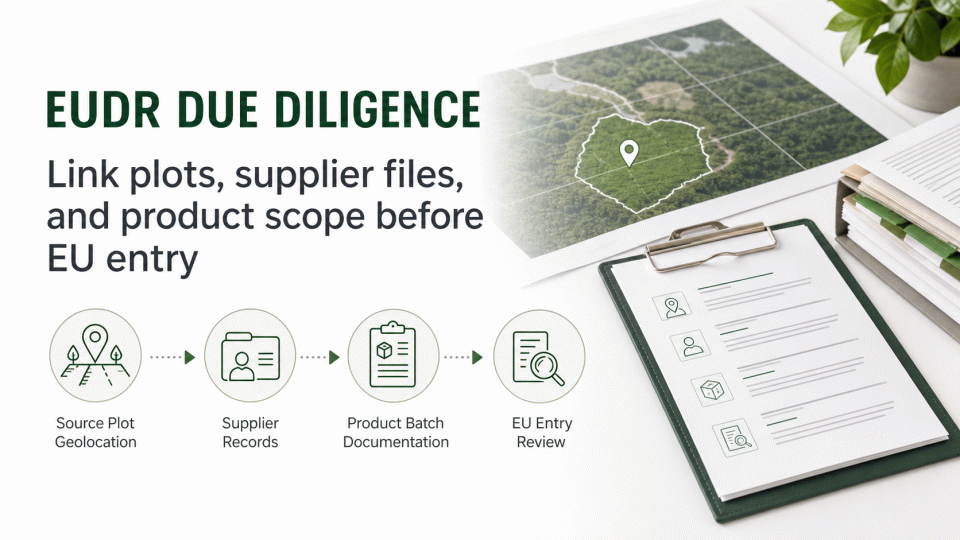
Who this is for: Cross-border sellers, manufacturers, procurement teams and import functions handling wood, rubber, coffee, cocoa, oil palm, soy or cattle, as well as products listed in Annex I. Scope cannot be decided from a product name alone. Check the product description, CN/HS code, country of production and the operator's role against Regulation (EU) 2023/1115 and its Annex I.
Important boundary: This is an evidence-preparation framework, not a legal conclusion for a particular SKU, country or document. The current Commission implementation page lists 30 December 2026 for large and medium operators and for micro and small operators already covered by the EU Timber Regulation, and 30 June 2027 for other micro and small operators. The Commission also stated in July 2026 that some newly added derived products are intended to become subject to the Regulation from 30 December 2027. Do not apply one date to every product or business.
1. Confirm the product, role and timing first
The relevant commodities are cattle, cocoa, coffee, oil palm, rubber, soya and wood. Only relevant products listed in Annex I are within scope. A product containing a relevant commodity is not automatically covered in every form: map the finished product's CN/HS code, raw-material composition, processing relationship, country of production and the act of first placing it on the EU market.
An upstream operator carries out due diligence before a relevant product is first placed on the EU market or exported. A non-EU producer or supplier that does not perform that placing-on-the-market or export activity does not become an EUDR operator merely because it is in the supply chain, but its plot, production, supply-chain and legality information may be essential inputs for the EU operator. For imports, the DDS reference number or simplified-declaration identifier must be made available to the customs declarant as required.
2. The official framework has three steps, not one “compliance certificate”
Step 1: Collect Article 9 information
For each relevant product, build a record that can be read back:
- Trade name and product type, including the relevant commodities or relevant products used; for wood, the common and full scientific species names;
- Quantity, recorded as net mass, volume, number of items or the applicable supplementary unit;
- Country of production and any relevant part of that country;
- The geolocation of all plots where the relevant commodity was produced, together with the date or time range of production. For cattle and products fed with relevant products, the location requirements follow the Regulation's specific rule for establishments where cattle were kept;
- Name, postal address and email address of businesses or people supplying the relevant products, and of relevant downstream operators or traders; and
- Adequately conclusive and verifiable information showing that the product is deforestation-free and was produced in accordance with relevant legislation in the country of production.
A country, province or state name is not a substitute for the required geolocation. The appropriate level of detail depends on the product, plot and legal requirements; a product made from several plots cannot be supported by one representative point. The Commission's practical explanation states that if the required information cannot be collected, the relevant product must not be placed on the EU market or exported.
Step 2: Assess risk using the collected information
Risk assessment is not an unsupported “low-risk” label for a supplier or SKU. Record at least the production country's risk classification, the presence of forests, indigenous peoples and related land-use or ownership concerns, the prevalence of deforestation or forest degradation, the reliability and links of the documents, supply-chain complexity, the risk of mixing with unknown-origin material or circumvention, and any other information pointing to non-compliance. Certification, sector schemes and third-party material may support the assessment, but they do not replace the Article 9 information.
Step 3: Mitigate risk until it is no or negligible
When additional documents, independent surveys or audits are needed, record the measure, owner, completion condition and review evidence. An operator may submit the DDS only after concluding that there is no or only a negligible risk of non-compliance. Products from low-risk countries may use simplified due diligence, but the required information still needs to be collected and a simplified declaration submitted. If substantiated new information appears later, the original conclusion cannot simply be reused: reassess promptly and follow the applicable notification and downstream-information duties.
3. Make the plot–supplier–finished-product chain readable
| Layer | Question to answer | Records to retain |
|---|---|---|
| Product scope | Is this SKU or batch in Annex I? Which commodity, code and processing relationship trigger the check? | SKU/model, BOM or recipe, CN/HS classification basis, product and packaging records, and the applicable-date assessment. |
| Plots and production | Where and when was the relevant commodity produced, and which plots make up the material in this batch? | Plot IDs and geolocations, country/region, production date or time range, production or harvest quantity, plot-to-raw-material-batch mapping, and source records for legal production and deforestation-free status. |
| Supply chain | Who transferred what, from the plot through processing and trade to the EU operator? | Supplier names, addresses and emails, contracts, invoices, transport/goods-in/goods-out records, batch IDs and quantity reconciliations. |
| Finished product and declaration | How did the raw-material batch become the finished SKU, what quantity is covered, and how can the submission be traced back? | Finished-goods batch, BOM, production and dispatch records, mapping and quantity calculations, DDS or simplified-declaration receipt and reference number. |
Statements such as “one certificate covers every SKU,” “every batch must be one-to-one,” or “all quantity differences must fit one fixed percentage” are not a universal EUDR legal format. The Commission explains that due diligence is not a fixed tick-box checklist. Businesses may design records for their supply chain, provided they cover information collection, risk assessment and risk mitigation and explain the relationship between the product, plots, suppliers and quantities.
4. Commodity-specific evidence questions
| Commodity/product direction | Start with | Boundary |
|---|---|---|
| Wood and wood products | Species, harvest plots, harvest time, quantity and the connection to the finished-product batch. | FSC/PEFC and similar certificates may be supporting material; they do not automatically replace EUDR plot, production-time and legality information. |
| Coffee and cocoa | How smallholder or cooperative plots are aggregated, the production period, batch mixing and exporter records. | A certification or sector traceability scheme does not automatically prove that every finished product is within the EUDR evidence boundary. |
| Rubber, oil palm and soya | Source plots, mixing and processing nodes, and the relevant commodity's composition and quantity in the finished product. | A sector platform or supplier declaration should link to the actual batch and plot records; a country-level origin or logo is not a complete evidence set. |
| Cattle and leather products | The establishments where cattle were kept, source and transfers, processing batch and whether the finished product is in Annex I. | “From country X” or one slaughter/leather certificate cannot replace the required establishment and legal-production information; the exact record set depends on the product and role. |
5. Handoffs: who acts, who supplies data, and what triggers an update?
| Role | Primary action | Update trigger |
|---|---|---|
| Upstream operator | Complete due diligence before first placing on the EU market or export, submit the DDS/simplified declaration and retain responsibility for the submission. | A material change to the product, plots, quantity, supplier or risk evidence, or substantiated new information. |
| Non-EU supplier/manufacturer | Provide verifiable plot, production, batch, supply-chain and legality information under the commercial handoff. | A change in plot, batch, formulation, supplier tier or production period, or a correction or mixing of unknown origin. |
| Downstream operator/trader | Retain declaration identifiers according to its role and size; non-SME downstream actors verify upstream due diligence when a substantiated concern exists. | A substantiated concern, an identifier that does not match the goods, or a product scope that cannot be reconciled. |
| Customs declarant/logistics | Use the operator's DDS reference number or simplified-declaration identifier in the relevant import declaration and retain the shipment link. | The customs quantity, batch or product description no longer matches the declaration coverage. |
6. Eight checks before listing, shipment or import
- Scope: Compare the SKU, BOM, packaging and CN/HS code with Annex I instead of relying on the product nickname.
- Role: Identify the operator placing the product on the EU market or exporting, the declaration owner and the non-EU suppliers providing source data.
- Plots: Record every production plot, its geolocation, country/region and production date or time range.
- Quantity: Make plot output, supplier batch, processing loss, finished-goods batch and customs quantity explainable; do not use an unsupported fixed tolerance to hide a difference.
- Legality: Retain verifiable evidence of relevant laws in the country of production and link each document to the plot, batch and product.
- Risk: Record the risk basis and, where the result is not negligible, the owner and completion condition for additional evidence, investigation or audit.
- Declaration: Submit the DDS or simplified declaration before placing on the market or export, and match the reference number to the actual goods and quantity.
- Retention: Keep the due-diligence system, evidence, updates and mitigation records for at least five years, with version control and a read-back check.
7. Do not turn platform rumours into regulatory facts
This article does not repeat unsupported claims such as “a platform will fully auto-scan from a fixed date,” fixed 7/14/30-day cure windows, automatic badge removal, guaranteed high-risk triggers, or a stated uplift in approval rates. The official EUDR responsibility chain is the Regulation, Commission guidance, competent authorities and the Information System. Marketplace listing, warehouse or product-data policies must be checked separately against the platform's current rules; an EUDR article cannot make a platform promise.
“Prepare the evidence” also must not become “guaranteed approval,” “no detention or delisting,” or “guaranteed certification.” If the product scope, role, country of production, plot data or supply-chain mixing has not been confirmed, mark it as needing verification rather than filling the gap with template figures.
Official sources for continued checking
- European Commission: Regulation on Deforestation-free Products — scope, dates and implementation resources.
- European Commission, 13 July 2026: Commission updates product scope and tools — newly added derived products and their later application boundary.
- European Commission Green Forum: Understand due diligence — Article 9 information, risk assessment, mitigation, DDS and five-year retention.
- EUR-Lex: Regulation (EU) 2023/1115 — the legal text and Annex I; check the latest amended version before applying it.
This article provides general evidence-preparation information. The scope, role, documents and timing for a specific SKU, supply chain and country of production should be confirmed against the latest legal text, Commission materials and the relevant Member State competent authority.


