
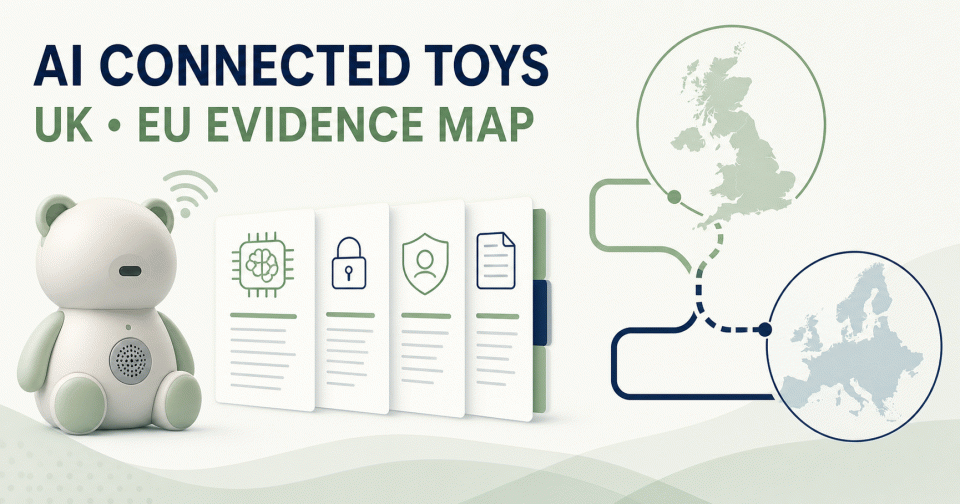
A toy with voice, connectivity, a camera or generative AI cannot be assessed by treating the CE mark as the whole answer. Start with the product scope and the market route, then connect toy safety, chemicals, electrical or radio functions, software, technical documentation and online presentation to the same model and version.
1. Separate the market route from the product label
The current UK guidance describes toys as products designed or intended, whether or not exclusively, for play by children under 14, subject to listed exclusions. An electronic or connected feature may bring additional questions about radio, electrical, software, data or product-safety rules. Do not classify a product only by the marketing phrase “AI toy”. Record the age positioning, intended use, connection method, radio functionality, battery configuration and destination market.
- Great Britain: review the Toys (Safety) Regulations 2011 and the current GB guidance. CE or UKCA routes may be available under the current arrangements, but the correct marking depends on the product, conformity assessment route and applicable UK requirements. A mark shown in an image is not proof of compliance.
- Northern Ireland: apply the 2011 Regulations as they operate in NI together with the relevant EU goods rules. CE remains required; where a UK body is used for a conformity assessment that requires a third party, CE and UKNI may be required under the applicable conditions. That combination is not for the EEA market.
- EU/EEA: determine the applicable EU toy-safety route, conformity assessment, technical file, declaration, CE marking and language requirements. Record the target Member State, importer, authorised representative and sales channel in the model file.
A visually similar product may need a new scope review when its age grading, materials, radio module, software behaviour or destination changes. Certificates, reports and declarations should not be copied across SKUs, versions or markets without a documented coverage rationale.
2. Keep current rules separate from future reform
For the EU route, prepare the applicable toy-safety assessment, conformity procedure, technical documentation, declaration of conformity, CE marking, warnings and instructions. The Commission’s published list of harmonised toy standards is updated through official decisions, so the current standard reference and any limitations must be checked rather than treated as permanent conclusions from an old report.
Regulation (EU) 2025/2509: the new Toy Safety Regulation has been published, with the main regime applying from 1 August 2030 and transitional arrangements for toys already placed on the market. It will require manufacturers to create a digital product passport (DPP) for an individual toy, connected through a data carrier on the toy, label, packaging or accompanying documentation. The DPP must be accurate, current and accessible according to the relevant permissions. A 2026 preparation project can connect model, version, materials and documents, but the future DPP regime should not be described as a single blanket obligation already applying to every toy today.
UK call for evidence: on 6 July 2026 the UK government published a call for evidence on toy safety, covering chemical safety, DPP, connected toys and AI, among other topics. It discusses possible policy directions and the EU reform; it does not replace the current GB rules or make a UK-wide DPP mandatory for all toys.
3. Build chemical evidence from parts, materials and exposure
Chemical evidence is not a generic “toy compliance certificate”. Start with the BOM and material formulation: coatings, adhesives, inks, soft plastics or rubber, textiles, treated wood, electronic parts and batteries. Then assess the parts children may touch, mouth, inhale from or contact for longer periods.
- EU toy-safety requirements address risks to children’s health and safety during normal and reasonably foreseeable use. Chemical restrictions may also intersect with REACH Annex XVII, POPs, CLP or other product legislation.
- REACH Annex XVII contains substance and article restrictions. Phthalates, PAHs and other entries cannot be covered by a report that does not identify the part, the applicable entry and the test or assessment basis.
- Test scope, samples, methods, limits, report entity and sample version must map back to the actual SKU. There is no single 24-month validity rule for every AI-enabled toy; refresh timing depends on law, standard changes, material changes and any documented platform or customer requirement.
Supplier declarations can be source material, but they do not replace the manufacturer’s product-safety and technical-file assessment. A change to formulation, housing, coating, adhesive, factory or battery model should trigger a version review instead of an automatic carry-over of the old evidence package.
4. Screen connected and AI functions for applicability
For a connected toy, record Bluetooth, Wi-Fi, cellular connectivity, cloud accounts, voice or image collection, remote updates, parental controls and data flows. Wireless functions may require separate radio, EMC or electrical-safety analysis. Where children’s personal data is involved, the responsible parties should separately assess the applicable data-protection requirements. “AI-enabled” does not automatically mean “high-risk AI”, and an icon on a listing page is not a legal conclusion.
EU AI Act: an AI system becomes subject to high-risk rules only when the relevant classification conditions are met. For an AI system that is a safety component of a product, the analysis also depends on whether that product is required to undergo third-party conformity assessment under the listed Union harmonisation legislation. Describe the AI function, its safety role and the assessment route before making a high-risk conclusion.
Cyber Resilience Act: the Act covers products with digital elements whose intended use includes a direct or indirect data connection to a device or network. Its main requirements apply from 11 December 2027, with earlier dates for certain vulnerability-reporting and governance provisions. A 2026 pre-check can cover cybersecurity risk, update support, vulnerability handling and version records; it should not be presented as a completed, uniform certification for all connected toys.
5. Make the technical file and listing tell the same story
Use the model or SKU as the evidence key. The following records should be connected rather than split into unrelated “testing” and “operations” folders:
- Product identity: model, version, batch or serial information, age grading, images, BOM and change history.
- Safety assessment: mechanical and physical risks, flammability, chemical exposure, batteries and charging, radio or electrical functions, connected services and software updates.
- Compliance file: applicable-law matrix, standard versions, test or other verification evidence, conformity route, declaration of conformity, manufacturer and importer information.
- Consumer information: market-language instructions, warnings, age limits, manufacturer/importer or responsible-economic-operator information and any required online fields.
- Version control: application, firmware, cloud features, privacy notice, label artwork and product-page versions with release dates.
The EU General Product Safety Regulation includes safety and traceability requirements for online sales and specific obligations for online marketplaces. A platform’s upload fields remain a platform process. Keep model, manufacturer, responsible party, warnings and feature descriptions consistent with the physical product and technical file, but do not describe a platform review, page status or pre-check box as government approval or customs clearance.
6. SKU-level release checklist
- Is the route clearly identified as GB, NI or EU/EEA, with a matching responsible party and import arrangement?
- Are the toy scope, age, intended use and each connected or AI function documented with a risk rationale?
- Can the BOM, material declarations, chemical tests and samples be traced to the current production version?
- Do CE, UKCA or CE+UKNI conditions match the actual conformity-assessment body and route? Are other product rules potentially in scope?
- Do warnings, instructions, manufacturer/importer details, model identifiers and online pages match in the required market language?
- Are the app, firmware, cloud service, vulnerability handling, parental controls and data-protection notices part of change control?
- Have the future EU DPP, future CRA requirements and the UK call for evidence been kept separate from obligations currently in force?
A complete file does not guarantee acceptance by a regulator, conformity-assessment body or platform. The conclusion depends on the product’s actual construction, destination, responsible parties, applicable law and current evidence. Confirm the scope and facts before setting a testing plan, certification route or launch date.
7. Sources for the review
- GOV.UK: Toys (Safety) Regulations 2011 — Great Britain
- GOV.UK: Toys (Safety) Regulations 2011 — Northern Ireland
- GOV.UK: Toys safety regulations: call for evidence (6 July 2026)
- EUR-Lex: Regulation (EU) 2025/2509 on the safety of toys
- EUR-Lex: Regulation (EU) 2023/988 on general product safety
- EUR-Lex: Regulation (EU) 2024/1689 — Artificial Intelligence Act
- EUR-Lex: Regulation (EU) 2024/2847 — Cyber Resilience Act


