
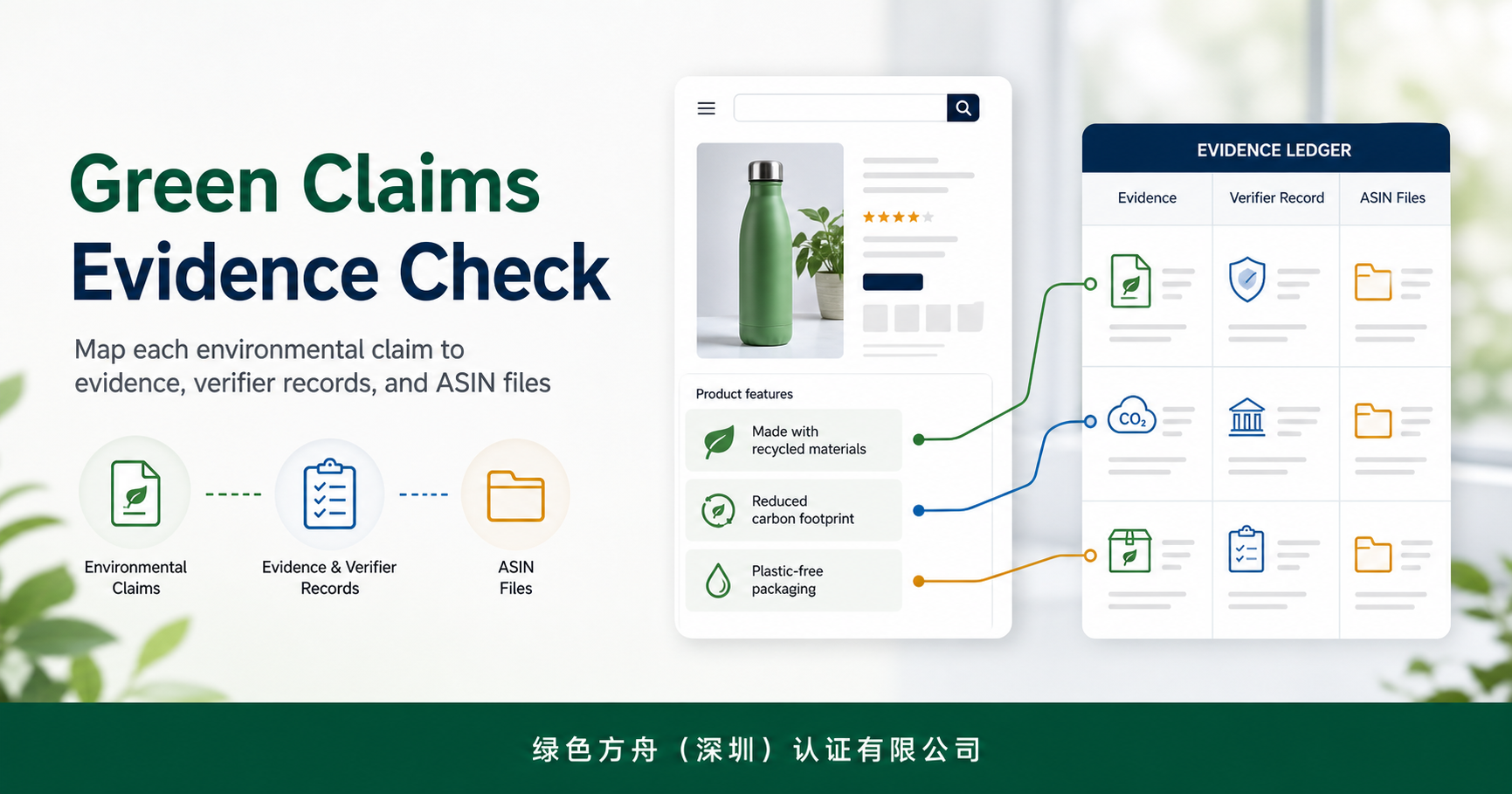
Words such as “sustainable,” “low carbon,” “recyclable,” and “biodegradable” do not describe the same kind of claim. A defensible EU-facing listing review starts by treating each visible sentence, icon, label, and image as a separate claim, then matching it to the product, packaging, or process that it actually describes.
1. Split a green message into reviewable claim units
One ASIN may contain product, packaging, material, manufacturing, and company-level language at the same time. Capture the exact wording, location, language, and target market before asking what the sentence actually covers. “Bottle contains 20% recycled plastic” points to a material proportion; “plastic-free packaging” points to packaging; “reduced carbon footprint” requires a baseline, functional unit, lifecycle boundary, and calculation method. Evidence for one material feature does not support describing the whole product as “green.”
For a comparative claim, record the comparator, baseline period or product, data source, and calculation method. For an absolute claim, record the scope and any operating or end-of-life conditions. Text, colour, leaf imagery, badges, and product names can work together to create an environmental impression, so visual elements should be reviewed with the wording rather than treated as decoration.
2. Separate current law, proposals, and platform requirements
Directive (EU) 2024/825 defines an environmental claim as a commercial message or representation that states or implies a positive, zero, or improved environmental impact, or less harm than another product, category, brand, or trader. It also introduces boundaries for generic environmental claims without relevant recognised excellent environmental performance and for sustainability labels without a transparent and credible basis. It is a consumer-protection framework for how products are presented; it is not a single import, customs, or Amazon approval rule.
The Green Claims Directive proposal addresses substantiation and communication of explicit environmental claims, but it remains a proposal and should be labelled as such while the European Parliament, Council, and Commission process continues. PPWR, EUDR, CBAM, product-safety rules, and product-specific labelling laws have their own scope, actors, dates, and records. Do not combine them into a universal “2026 green compliance package,” and do not state that platforms generally demand files months before every official date unless a specific marketplace notice supports that statement.
3. Build an ASIN-level evidence ledger
Keep at least the following fields for each claim. When the record is incomplete, narrow or hold the wording instead of filling the gap with a broad environmental term.
| Ledger field | Review question |
|---|---|
| Exact claim and placement | What appears in the title, bullets, A+, packaging image, icon, or brand page? Do the language versions keep the same scope? |
| Product and market boundary | Which ASIN, variation, formula, packaging version, batch, and sales country are covered? Is it a product, packaging, process, or company claim? |
| Evidence and method | Which specification, BOM, supplier record, mass-balance record, lifecycle calculation, certificate, or test report supports which part? |
| Source and validity | Can the issuer, certificate or report number, standard, scope, date, version, and original file be traced? |
| Limits and approval | Are there baseline, assumption, geography, facility, use-condition, or partial-material limits? Who approved the wording and when? |
Third-party verification is not an automatic fixed requirement for every environmental sentence. Whether verification is needed, and by whom, depends on the claim, applicable law, the public rules of a certification scheme, and any specific marketplace or buyer request. A supplier file should not enter the ledger merely because it is called a certificate: check the holder, product scope, batch or material proportion, and connection to the listed ASIN.
4. Test labels, certificates, and icons against public rules
When a listing displays a sustainability label or certification mark, retain the scheme’s public rules, product scope, authorisation terms, and verification mechanism. Confirm that the mark covers the current product and the wording being used. Do not draw an “official certification,” “zero impact,” or “100% eco” badge yourself, and do not treat a laboratory test, a supplier declaration, and a third-party certification as interchangeable evidence types.
Terms such as “recyclable,” “biodegradable,” “plastic-free,” and “carbon neutral” can be understood as whole-product statements unless their scope is clear. If the evidence covers packaging only, limit the copy and imagery to packaging. If it covers one variation or batch, do not expand it to the brand, range, or all inventory.
5. Complete one claim review before publishing
- Export the target market’s title, bullets, description, A+, image text, and labels, and keep the version reviewed.
- For each statement, record the claim, object, scope, evidence, limitations, and owner. Do not use one general certificate as a substitute for claim-by-claim matching.
- Check the legal entity, model, material proportion, batch, date, method, and version in the evidence, and store the calculation or original file in a traceable location.
- Compare English with Chinese and other target languages. Remove wording that expands the scope or certainty after translation; turn unsupported sentences into factual descriptions or hold them.
- Record the review date and re-review triggers: a formula, packaging, supplier, certificate scope, legal rule, or marketplace-policy change.
Boundary note: An evidence ledger explains where a claim came from. It does not itself grant certification, marketplace eligibility, or immunity from further questions by regulators, platforms, or customers. Confirm the law, marketplace policy, and buyer standard for the specific product and market.
Sources and verification points
- EUR-Lex: Directive (EU) 2024/825 for the definitions, sustainability-label boundaries, and application date.
- European Commission: Sustainable consumption for implementation information, FAQs, and the consumer-protection context.
- European Parliament Legislative Observatory: Green Claims Directive for the legislative status of proposal COM(2023)166.


