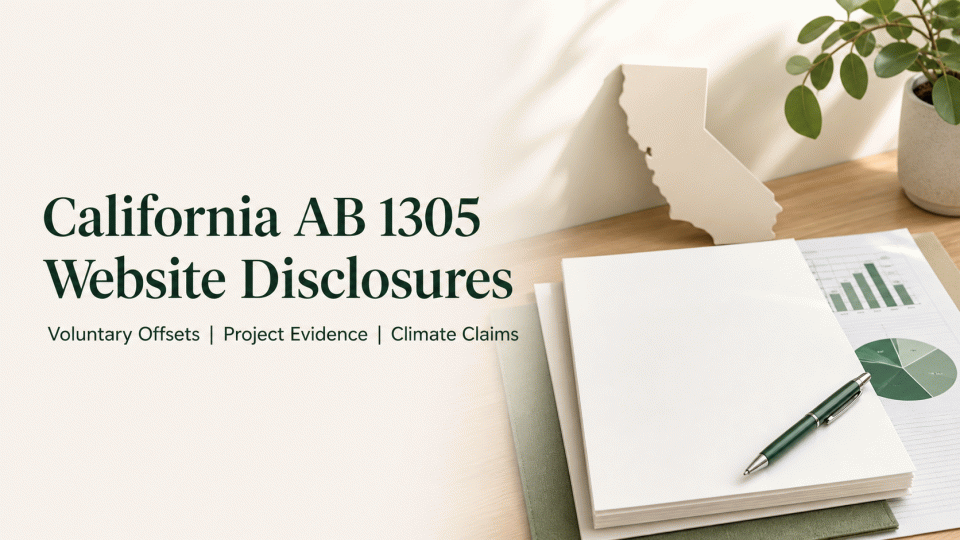
California AB 1305 is not a product “climate-friendly certificate.” It is a website-disclosure framework for specified roles and claims involving voluntary carbon offsets, net-zero statements, carbon-neutral statements, and similar climate representations. Start by identifying the claim, the entity’s role, the relevant project or program, and the evidence supporting the wording shown to readers.
1. Start with the claim and the entity role
HSC §44475 addresses a business entity marketing or selling voluntary carbon offsets within California. The statutory definition covers products sold or marketed as greenhouse-gas emissions offsets, voluntary emissions reductions, retail offsets, or like terms that convey a reduction in atmospheric greenhouse gases or prevention of emissions that would otherwise occur. Products representing legal or regulatory mandates are excluded from that definition.
If an entity purchases or uses voluntary carbon offsets and makes net-zero, carbon-neutral, or similar claims, review §44475.1. If the entity, an affiliate, or a product is represented as adding no net greenhouse gases or having made significant reductions, review §44475.2 as well. “Eco-friendly,” “low carbon,” or “climate-friendly” does not automatically trigger every provision, but changing the headline does not change what the claim communicates.
Create a claim inventory before drafting the webpage. Record the exact wording, URL, audience, entity making the claim, whether offsets are used, the linked project or program, the relevant market, and first-publication and last-update dates. Include product pages, sustainability pages, project pages, and advertising copy.
2. If you sell voluntary offsets, make the project and calculation traceable
For a seller or marketer within §44475, a single certificate does not substitute for the disclosure set. Organize the website evidence into three groups:
- Project attributes: the specific protocol, project location, project timeline, start date, dates and quantities of reductions or removals, annual emissions reduced or carbon removed, project type (removal, avoided emissions, or a split of both), relevant legal or nonprofit standards, and the durability period where known durability is shorter than the atmospheric lifetime of carbon dioxide.
- Verification and accountability: whether independent experts or a third party validated or verified project attributes, and what the entity or its contractual arrangements will do if the project is not completed, projected benefits do not materialize, or carbon storage is reversed.
- Reproducible calculations: the data and calculation methods needed for an independent person to reproduce and verify the number of credits issued, including the baseline, monitoring data, emission factors, calculation steps, and version history.
Project name, identifier, protocol, location, quantities, and dates should reconcile with the registry, project documents, validation records, and transaction records. Where avoided emissions and removals coexist, do not show only an undifferentiated total. Retain the reason, affected scope, revised calculation, and accountability record for reversals or data corrections.
3. If you use offsets for a net-zero or carbon-neutral claim, identify each project
HSC §44475.1 calls for website information for each project or program, including the offset seller, offset registry or program, project identification number and registered name when applicable, project type and location, the specific protocol used to estimate reductions or removals, and whether independent third-party verification covers the company data and claims listed.
An internal ledger can connect the claim to the project, registry record, purchased or retired quantity, protocol, verification record, and transaction documents. A supplier marketing page, generic green icon, or registry entry for one project is not by itself the company’s net-zero conclusion. “Offsets were purchased” should not be rewritten as “the product has no emissions.”
Section 44475.1 uses an “or” exclusion: it does not apply where an entity does not operate within California or does not purchase or use voluntary carbon offsets sold within California. Apply that boundary to actual operating and purchasing facts rather than the place of incorporation or website language alone.
4. For a net-zero or carbon-neutral claim, explain how the conclusion was reached
HSC §44475.2 focuses on the greenhouse-gas information associated with the claim. The website should explain how a carbon-neutral, net-zero, or similar claim was determined to be accurate or actually accomplished, and how interim progress is measured. The statute identifies materials such as independent third-party verification of the entity’s greenhouse-gas emissions, science-based targets and an emissions-reduction pathway, the relevant sector methodology, and third-party verification of the targets or pathway.
Do not list only offset quantities without the emissions boundary covered by the claim. Do not present a target or forecast as an achieved result. State what the third-party review actually covers. Section 44475.2 also has an exclusion for an entity that does not operate within California or does not make the relevant claims within California; cross-border businesses should examine actual operations, page distribution, and claim audience.
5. Use a six-step pre-publication review
- Capture the claim: preserve the exact wording on webpages, advertisements, and packaging, and flag offset, net-zero, carbon-neutral, and similar meanings.
- Confirm the role: distinguish selling or marketing offsets, using offsets for a claim, and making a direct net-zero or carbon-neutral claim.
- Map the project: connect each claim to the project or program, registry, project identifier, location, project type, and protocol.
- Check the method: retain data sources, baseline, monitoring, calculation method, reduction/removal quantities, durability, verification status, and version date.
- Review the website: confirm that project information, accountability measures, emissions boundaries, and verification information can be found and match the ledger.
- Maintain the record: under §44475.3, update disclosures at least annually; log reversals, quantity corrections, protocol changes, verification changes, and claim-scope changes as they occur.
A practical evidence pack can contain the page snapshot or HTML version, data and calculation workbook, registry or contract records, verification documents, revision log, approver, and publication date. It explains the claim’s basis; it does not replace the statute or represent a certification conclusion for a particular product.
6. State penalties and boundaries using the statutory wording
HSC §44475.3 provides for a civil penalty of up to $2,500 per day for each violation while information is unavailable or inaccurate, with a total cap of $500,000. It also requires disclosures to be updated at least annually. This is not the same as an automatic marketplace suspension, customs detention, recall, or a fixed percentage-of-revenue penalty; those mechanisms should not be presented as inevitable AB 1305 outcomes.
AB 1305 is not a universal review framework for every environmental statement. Product safety, packaging, chemicals, advertising, marketplace rules, and other state or national requirements may apply separately. Keep the legal basis, territory, responsible entity, and evidence scope separate for each claim.
California Legislative Information: AB-1305 Voluntary carbon market disclosures