
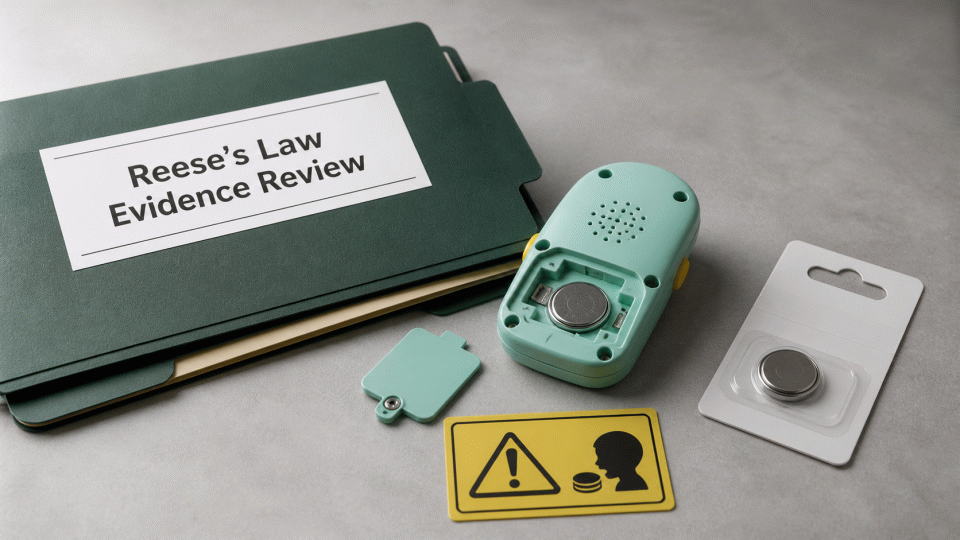
Reese’s Law is not a universal “battery certificate.” For a U.S.-bound consumer product that contains or is designed to use a button cell or coin battery, the review should connect the product, battery compartment, product packaging, instructions, separately supplied batteries, and certificate records at SKU level. This page uses the U.S. Consumer Product Safety Commission (CPSC) Button Cell and Coin Battery Business Guidance, FAQ, and linked rule materials as its source boundary. It is designed as an evidence-preparation checklist for sellers and supply-chain teams.
1. Separate the three Reese’s Law review tracks
In practice, Reese’s Law (Public Law 117-171) should not be reduced to “UL 4200A certified.” The CPSC business guidance addresses different objects and obligations. First record which track applies:
- Consumer products containing or designed to use the battery: 16 CFR part 1263 addresses battery-compartment access, protection during reasonably foreseeable use and misuse, and warnings on the product, packaging, and instructions. CPSC identifies ANSI/UL 4200A-2023 as the mandatory safety standard incorporated for this track.
- Battery-package warnings: 16 CFR § 1263.4 addresses packaging for button cell or coin batteries, including batteries packaged separately with a consumer product. The CPSC guidance states that this requirement applies to products manufactured or imported after September 21, 2024.
- Child-resistant battery packaging: Section 3 of Reese’s Law requires relevant battery packaging to meet 16 CFR § 1700.15. The CPSC guidance identifies February 12, 2023 as the starting point for products manufactured or imported after that date. Packaging that satisfies the statutory ANSI C18.3M marking and packaging exception must be checked separately; a generic UL report is not a substitute.
CPSC describes a covered button cell or coin battery as a single-cell battery whose diameter is greater than its height, and excludes zinc-air button cell or coin batteries from the scope of part 1263. That definition resolves one part-1263 scope question; it does not automatically remove other applicable requirements. Zinc-air battery packaging therefore needs a separate review.
2. Product and battery compartment: begin with design evidence
For a consumer product that contains or is designed to use a covered battery, the first step is not finding a generic supplier certificate. It is confirming the final SKU’s battery-compartment design and access path. Based on the CPSC summary of ANSI/UL 4200A-2023, the review should address:
- A replaceable-battery compartment must require a tool, or at least two independent and simultaneous hand movements, to open. A simple sliding cover or one-step action should not be assumed to satisfy the requirement.
- Under reasonably foreseeable use and misuse conditions, the battery should not become accessible to a child or be liberated from the product. Keep design drawings, sample photographs, BOM records, and test evidence tied to the actual structure, screws, latches, cover, and battery model.
- The overall product packaging must carry an applicable warning; the product itself must carry a warning when practicable; and accompanying instructions or manuals must include applicable warnings. Label placement, size, and language cannot be inferred from a promotional image.
If one enclosure can accept batteries with different diameters, heights, or chemistries, record the designed battery model separately from the battery actually shipped. A battery change, cover change, screw change, packaging change, or changed child-access path may make earlier evidence unsuitable for the revised SKU.
3. Separate batteries and supplied batteries: build a packaging record
When a battery is supplied separately inside a product package, the product’s screw-secured compartment is not the whole review. Create a separate battery-packaging record linked to:
- battery model, quantity, chemistry, brand, and production lot;
- whether the battery is sold separately, packaged separately, or supplied with the consumer product in a form the consumer can remove;
- whether the package meets 16 CFR § 1700.15 child-resistant packaging requirements, or falls within the ANSI C18.3M exception described by CPSC;
- the final warning artwork, revision, language, size, and print sample for the package and applicable display panels; and
- package photographs, packaging specifications, supplier statements, and purchasing or assembly records tied to the lot.
CPSC treats package warnings and child-resistant packaging as separate review subjects. A yellow warning icon on a package does not prove that the product satisfies battery-compartment performance requirements, and a product test report is not automatically the complete evidence file for a battery package.
4. CPC, GCC, and reports: cite the applicable rule correctly
The CPSC business guidance explains that applicable children’s products generally use a Children’s Product Certificate (CPC), while general-use products generally use a General Certificate of Conformity (GCC). Neither is a universal “approval certificate.” The certificate must correspond to the responsible parties, product description, applicable rules, and test or sample evidence.
- For the Section 2 product requirements, CPSC lists “16 CFR § 1263.3 – Consumer products containing button cell or coin batteries” as a certificate citation. Where the package-labeling requirement applies, check “16 CFR § 1263.4 – Button cell or coin battery package labeling” against the actual scope.
- For the Section 3 battery-packaging requirement, CPSC lists “15 U.S.C. § 2056e – Button cell or coin battery packaging” as the certificate citation.
- A CPC and a GCC are not interchangeable. Differences among the manufacturer, importer, brand authorization holder, listing owner, product model, and test sample should be explained rather than hidden under a supplier name.
- CPSC states that testing for the special packaging requirements under Section 3 does not automatically have to be performed by a CPSC-accepted third-party laboratory. Do not turn “ISO 17025,” a generic lab seal, or a universal 24-month validity period into a rule that applies to every product.
A marketplace may separately request a report, photograph, or formatted form. That marketplace request is not the same legal layer as a federal rule. Preserve the date and SKU scope of any platform request, and do not present a platform review outcome, listing status, or supplier statement as an official CPSC conclusion.
5. Toys, medical devices, and other boundaries
CPSC states that a toy designed, manufactured, or marketed as a plaything for children under 14 years of age is not subject to the part-1263 product rule when it complies with the battery-accessibility and labeling requirements in 16 CFR part 1250, which incorporates ASTM F963. This exception should not be expanded to mean that every children’s product is exempt, and it does not replace a separate review of the toy standard, CPC, or battery-packaging requirements.
The CPSC FAQ also explains that medical devices are excluded from “consumer product” under the Consumer Product Safety Act and therefore are generally outside Section 2 of Reese’s Law and 16 CFR part 1263. A medical device intended for children may still raise other CPSC jurisdiction questions. Do not decide scope from the product name alone; retain the product use, regulatory identity, and rule-selection rationale.
6. SKU evidence ledger: fields worth retaining
- Product identity: brand, model, SKU/ASIN, product photographs, intended use, target age, and whether the product is a toy or medical device.
- Battery identity: battery model, dimensions, chemistry, replaceability, whether it is supplied with the product, and whether it is zinc-air.
- Structural evidence: battery-compartment drawings, screw/latch photographs, opening-action description, sample revision, and use/misuse test records.
- Packaging and labels: final files and photographs for the product package, separate battery package, product marking, instructions, and listing copy.
- Certificates and reports: CPC or GCC, report number, rule citations, tested sample, manufacturer/importer/model information, and the shipped lot or version covered.
- Source chain: purchase orders, invoices, assembly records, packaging revision, and lot relationships; retain before/after evidence when the battery, housing, or package changes.
- Review log: review date, source links, applicability decision, uncovered items, owner, and next evidence request. Mark an item “to verify” instead of replacing missing evidence with “compliant.”
7. Six manual checks before listing or shipment
- Start with the final shipped SKU and battery model, not a supplier template or an old report.
- Decide separately whether the product, the standalone battery, and the supplied battery package fall within each requirement; record whether a toy or medical-device boundary is relevant.
- Match the battery-compartment design, use/misuse evidence, package warning, instructions, and final sample one by one.
- Check CPC/GCC type, certificate parties, model, report, and rule citation. Mark missing evidence as open rather than inferring approval.
- Read the listing, package, and manual line by line to confirm that battery name, warning, model, and sample match; remove unsupported “officially certified” or “guaranteed pass” language.
- Keep CPSC sources, separate marketplace requests, and internal judgments in different fields, and reassess after each design or packaging change.
Sources and use boundary
The principal sources reviewed for this page are the CPSC Button Cell and Coin Battery Business Guidance, the CPSC Button Cell and Coin Battery FAQs, and the 16 CFR part 1263, 16 CFR § 1700.15, CPC/GCC, and Reese’s Law implementation-date materials linked from those pages. Source pages, product classifications, and enforcement information can change; return to the current official text and the actual product facts before shipment. This is an evidence-preparation and page-review framework, not a certification decision by CPSC, a laboratory, a marketplace, or any other institution.
The useful outcome is not a generic certificate. It is a SKU record that explains why the product is in scope, which evidence addresses which requirement, what remains to be verified, and whether the final package and listing match the product that will actually ship.


