
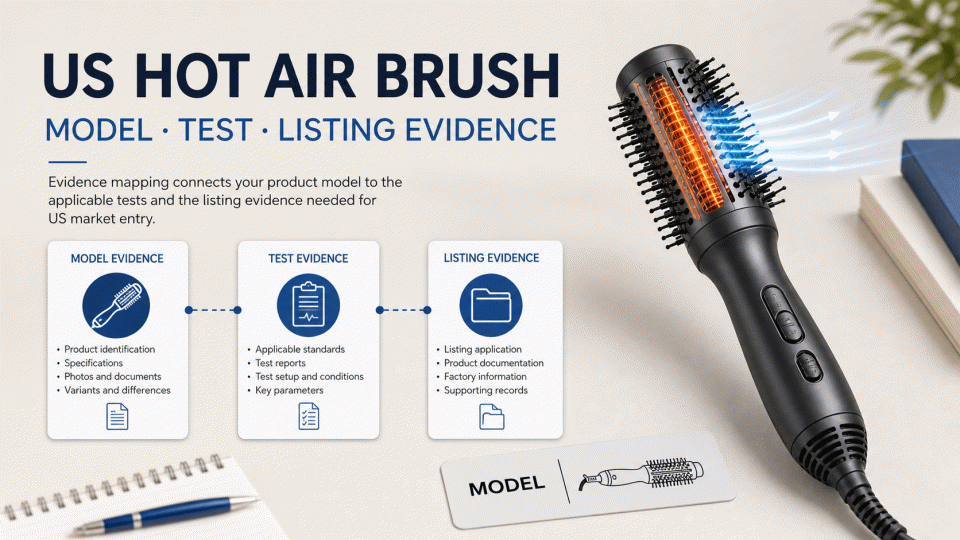
A hot air brush may combine a heater, airflow motor, temperature control, and digital electronics. A test report, a UL mark, or a polished product listing is not by itself a complete US compliance conclusion. The practical starting point is to define the product and intended use, then connect safety evidence, EMC evidence, CPSC certificates, packaging data, and online claims to one controlled model record.
This page is an evidence-mapping reference prepared by Greenark (Shenzhen) Certification Co., Ltd. It is not a certification decision, laboratory determination, legal opinion, or promise of approval, customs clearance, marketplace acceptance, or processing time.
1. Define the product before choosing a test route
“Hot air brush” is a commercial description, not an automatic regulatory classification. Before testing, freeze at least the following facts:
- Construction: rated voltage, frequency, input power, motor, heating method, temperature control, display or touch controls, power supply, and wireless functions.
- Intended environment: household, salon, or another commercial setting. The use environment can affect the applicable product standard and test conditions.
- Product family: hot air brushes, hair dryers, styling brushes, auto-curlers, and bundled attachments should be described separately when their construction or hazards differ.
- Marketing claims: flag hair growth, follicle restoration, dandruff treatment, antibacterial or sterilizing, therapeutic, and “medical-grade” language for a separate review.
- Variant control: record changes to voltage, wattage, heater, motor, control board, enclosure, attachments, and permanent markings before treating two models as one family.
Create a one-page product boundary card with product photos, ratings, construction, functions, intended use, manufacturer/importer, market, and model revision. If the boundary is unclear, every later comparison can be made against a different sample.
2. UL 859 is not a “mark-and-ship” shortcut
The UL Standards & Engagement catalog describes UL 859 as covering household electric personal grooming appliances, including hair curlers, dryers, combs, brushes, and similar appliances, within the stated scope and ratings. OSHA’s NRTL standard list also includes UL 859. For a household hot air brush, that is a more defensible starting point than the original claim that UL 850 is the only accepted US route.
The standard number still cannot be selected from the product name alone. A salon or other commercial-use product, a product with unusual attachments, a wireless function, a light source, or a therapeutic intended use may require a different or additional assessment. Ask the proposed NRTL or laboratory to identify the applicable standard, edition, scope, sample configuration, and any supplementary requirements in writing.
If a supplier sends a document labelled “UL 850,” check the complete standard title, edition, report holder, EUT model, sample photos, and scope. Do not accept a cover page or a UL logo as proof that the document covers the product being sold.
| Review block | Evidence to retain | Human decision |
|---|---|---|
| Product scope | Photos, construction drawing, ratings, household/commercial use statement, functions, and attachments | Does the report describe the actual product, rather than a similar appliance? |
| Sample and report | EUT model, revision, sample photos, test date, laboratory/NRTL information, and report index | Do the model, hardware, and safety-critical construction match production? Was a change assessed? |
| Safety design | Temperature control, over-temperature protection, insulation, grounding or double insulation, enclosure, and cord evidence | Is a whole-appliance conclusion being incorrectly inferred from a component or pre-test report? |
| Marking and instructions | Rating label, packaging, manual, warnings, and use limitations | Can the markings and instructions be traced to the tested configuration? |
3. FCC Part 15B: classify the device before reviewing the report
47 CFR Part 15 Subpart B addresses unintentional radiators, including equipment authorization, conducted limits, and radiated emission limits in §§15.101, 15.107, and 15.109. A hot air brush may contain digital controls, clocks, switch-mode power circuits, or other circuitry relevant to an FCC assessment. The product name “household appliance” is not a reason to skip classification; the laboratory should determine whether the rules apply and which authorization path fits the actual circuit.
“EMC tested” also does not automatically mean “FCC complete.” An EU EMC report, a general CISPR report, and an FCC equipment authorization record can have different regulatory bases, methods, report fields, and statement requirements. The laboratory package should identify the device classification, rule basis, test methods, operating modes, input conditions, sample model, and the party responsible for the final authorization or compliance statement.
- Hardware traceability: match the EUT model, board revision, heater, motor, adapter or power cord, wireless function, and attachments to the production configuration.
- Operating modes: document heat, fan, digital-control, and other potentially unfavorable modes; an idle photograph is not a substitute for an operating condition.
- Report evidence: review AC power-line conducted results, radiated results, setup photographs, equipment list, calibration information, and the stated basis for judgment.
- Statement boundary: do not add an FCC ID when the product has no intentional transmitter; use the statement supported by the actual authorization route.
4. CPSC GCC and 2026 eFiling: a transmission mechanism is not an automatic release
CPSC guidance explains that a manufacturer or importer must issue a General Certificate of Conformity for a general-use consumer product subject to an applicable CPSC consumer-product safety rule or other covered requirement, based on testing or a reasonable testing program. The certificate, responsible party, applicable citations, product identification, test date and place, and record availability must be traceable. Do not write either “every hot air brush automatically needs a GCC” or “a GCC proves total compliance” without confirming the specific product requirements.
CPSC’s current pages state that, beginning July 8, 2026, most regulated imported consumer products must transmit certificate data electronically through CBP’s PGA Message Set; products withdrawn from a Foreign Trade Zone for consumption or warehousing have a separate January 8, 2027 effective date. eFiling changes how certificate data is transmitted. It does not replace testing, the certifier’s responsibility, or a product-specific scope decision. The unsupported fixed seven-day rule, automatic CIC language, and universal “14-section eGCC” claim from the original article are not used here.
| Record | Connection to verify |
|---|---|
| GCC or other certificate | Product/model, applicable rule or citation, manufacturer/importer, testing basis, test date, and test place all refer to the same model record. |
| Import records | The party responsible for the certificate and entry data, customs role, product description, and model are not silently treated as the same party. |
| eFiling data | Confirm that the product is within the current eFiling scope, follow current CPSC/CBP guidance, and retain the submitted data and certificate version. Submission success is not a product-compliance conclusion. |
5. Build model traceability without inventing a marketplace algorithm
The product marking, carton, manual, UL/NRTL file, FCC file, GCC, invoice, and listing should use an explainable model mapping. A controlled model evidence table can link the base model, sales variant, colour or bundle, hardware differences, barcode, document version, and change date on one row.
This is an internal traceability control. It is not proof that CPSC, FCC, or Amazon uses a public API, OCR process, or edit-distance algorithm to compare every field. Claims such as “the marketplace will suppress the ASIN within 72 hours” or “one character always causes an automatic CPSC rejection” require a reliable source and a defined scope; they are not stated here.
- Product and package: retain the model, ratings, manufacturer/importer information, and dated photos.
- Laboratory records: retain EUT model, hardware revision, applicable standard, report revision, and sample photos.
- Certificates and import files: retain model, responsible party, rule citation, and testing basis.
- Listing and advertising: version the title, bullets, A+ images, video captions, Q&A, and customer-service wording.
- Change control: assess changes to the motor, heater, controller, power, attachment, package, and material claims before release.
6. Review ion, infrared, and “repair” claims by intended use
FDA explains that intended use determines whether a product is a cosmetic, a drug, or both. Claims on labels, websites, advertising, and other promotional material that treat or prevent disease or affect the structure or function of the body can place a product within drug regulation. FDA also makes clear that a cosmetic is not FDA-approved merely because it is described as a beauty product or has completed a registration-related step.
For a hot air brush, separate product functions from outcome claims. Heating, brushing, drying, and styling descriptions should match the design and instructions. “Hair growth,” “follicle restoration,” “dandruff treatment,” “hair-loss treatment,” “medical-grade infrared,” “antibacterial,” and “sterilizing” language needs a separate regulatory assessment; an ordinary UL or FCC document does not replace that assessment. Keep the substantiation, conditions, limitations, and prohibited-claims list with the listing review, and avoid “100%,” “guaranteed,” or other outcome promises.
7. Six human checks before release
- Freeze the product boundary card: construction, ratings, use, functions, attachments, and claims.
- Obtain written scope confirmation from the proposed NRTL and match the report to the production sample.
- Confirm the FCC Part 15B classification, test method, and authorization or statement path for the actual circuit.
- Confirm the CPSC rules, GCC responsibility, and whether current import eFiling applies; retain certificate and submission versions.
- Compare product, package, laboratory files, certificates, invoices, and listing using the model evidence table.
- Send ion, infrared, antibacterial, therapeutic, and hair-growth language to compliance or legal review before publication.
Official sources and limits
- UL 859: Household Electric Personal Grooming Appliances — scope and publication information.
- OSHA NRTL Appropriate Test Standards — NRTL-listed standard entries, including UL 859.
- 47 CFR Part 15 Subpart B — unintentional-radiator authorization, conducted limits, and radiated limits.
- CPSC General Certificate of Conformity and CPSC eFiling — certificate responsibility, requirements, and current electronic-filing milestones.
- FDA Cosmetics Labeling Claims and Is It a Cosmetic, a Drug, or Both? — intended-use and claim boundaries.
These pages establish a review direction. The full standard, model-specific test plan, import data, and marketing claims still require review against the actual product version by the relevant laboratory, certificate-responsible party, and professional advisers. Sources checked: 2026-08-21.


