
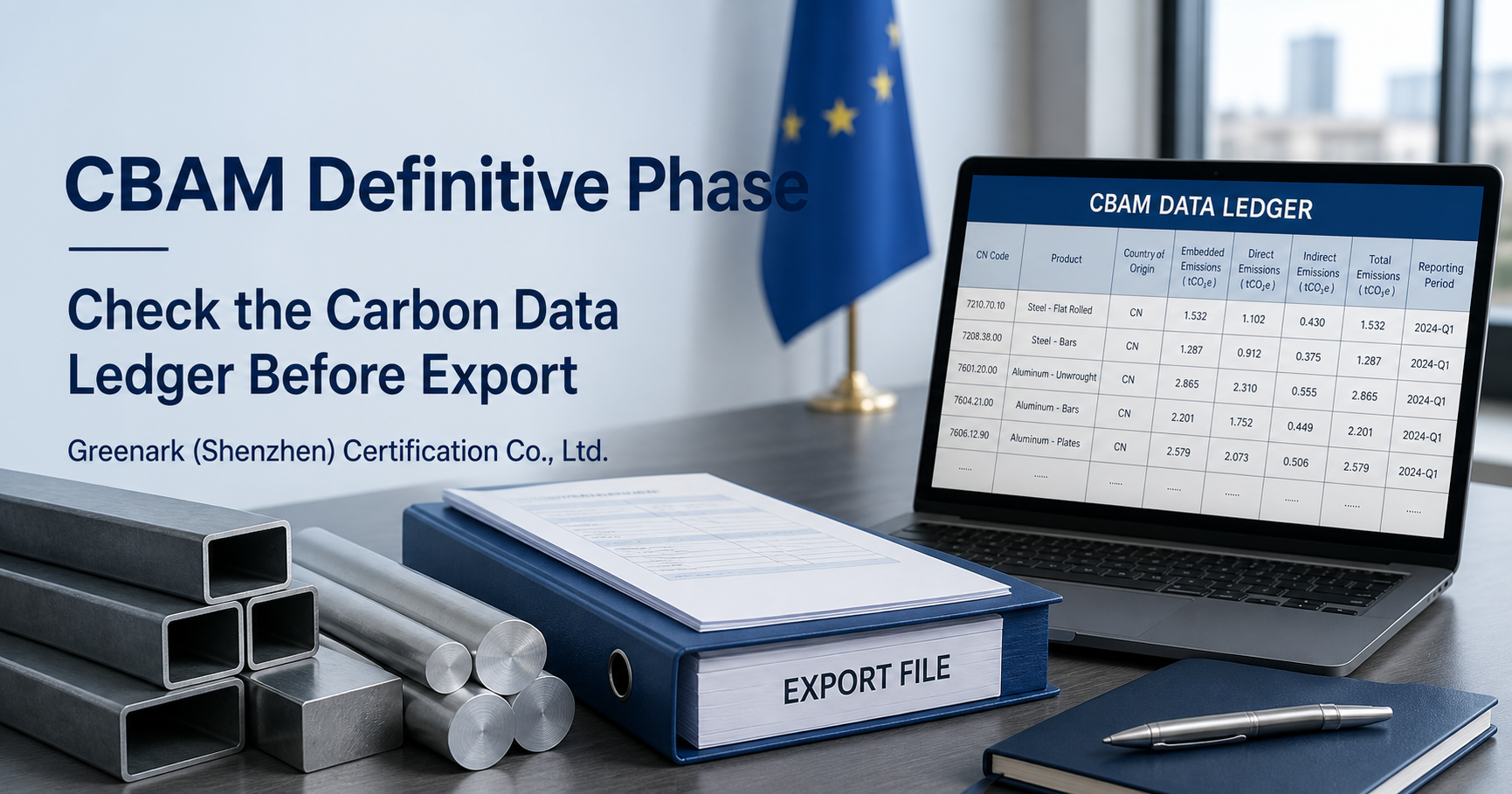
With the EU Carbon Border Adjustment Mechanism (CBAM) in its definitive period, a non-EU production installation is generally not the party that submits the annual EU declaration. Its product scope, installation information and embedded-emissions data nevertheless form part of the evidence an EU importer or qualifying indirect customs representative may need. Exporters should align the CN code, installation, quantity, emissions methodology and source files before agreeing the data handover with the EU-side declarant.
This page is a preparation reference, not a substitute for a declarant, customs representative, verifier or national competent authority. Scope, calculation methods and verification requirements must be checked against the current Regulation, annexes, implementing rules and European Commission guidance.
1. Start with the CN-code scope check
The definitive regime covers selected goods in six sectors: cement, iron and steel, aluminium, fertilisers, electricity and hydrogen. The starting point is not a marketing description. It is whether the customs CN code for the imported good falls within the goods listed in the current legal annexes and implementing rules.
Different goods, processing states or subheadings within one sector may have different boundaries. Keep the product specification, material or composition, processing route, origin and proposed CN code together. If the importer or customs broker still needs to confirm the code, record it as an open item instead of stating that every product in a sector is automatically covered.
2. Separate the installation, exporter and declarant roles
The annual declaration and certificate-surrender obligations sit primarily with the EU importer or an eligible indirect customs representative. Current Commission guidance states that an importer bringing more than the single mass-based threshold of 50 tonnes of CBAM goods into the EU must apply for authorised CBAM declarant status. The exact route still depends on the goods, import structure and rules in force.
The non-EU installation provides emissions information that can be traced to the facility and goods. The exporter or supply-chain coordinator connects the installation, order, quantity and evidence files. Do not describe a data handover to the importer as the exporter filing the EU declaration, and do not treat a platform form or customer spreadsheet as a universal CBAM legal field.
3. Record the emissions methodology, not just a number
A usable register should identify the good, installation, reporting period, production quantity, direct embedded emissions, applicable indirect embedded emissions, and any precursor inputs for complex goods. Direct and indirect emissions should not be collapsed into an unexplained total. Whether they are included and how they are calculated depends on the goods and the applicable methodology.
Importers may use actual emissions values or Commission default values where the applicable rules allow it. For actual values, confirm the verification conditions and the role of an independent verifier accredited under the relevant framework. Default values are not an internal industry-average estimate; use the current official values and conditions. This page therefore does not claim that default values are always more expensive or that actual data is always more favourable.
The installation should retain fuel, process, energy, production, input or precursor, allocation, metering and version-control records. Mark any estimate, default value or supplier document with its source, period and owner. A company-wide annual emissions total should not be used as a substitute for product-level embedded emissions without a documented allocation basis.
4. Build a register that the importer can read back
Index the evidence by good, installation, period and source. At minimum, capture:
- Good description, specification, CN code, order or batch reference and import quantity;
- Installation name and address, production route, and its relationship to the supplier or exporter;
- Reporting period, production output, direct and applicable indirect embedded emissions, and precursor sources;
- Calculation method, metering data, allocation rules, assumptions, default-value version and change history;
- Emissions reports, production records, energy or input evidence, verification material and issuing entity;
- File version sent to the EU-side declarant, delivery date, open questions and confirmation status.
When one installation produces several goods, do not spread a facility total across every product without an allocation basis. Likewise, do not merge several installations into one supplier average without explaining the boundary. If the data cannot be traced by installation, good and period, record the gap and agree the follow-up path with the importer.
5. Describe 2026 milestones carefully
The definitive CBAM regime applies from 1 January 2026. The Commission’s 2026 materials state that the first annual declaration covering 2026 imports is due by 30 September 2027, with the corresponding certificates to be surrendered. A customer-facing page should present this as the current official milestone, not as one universal annual deadline for every exporter. Later deadlines, certificate prices, deductions and treatment of a carbon price paid in a third country must be checked against the rules and the importer’s filing plan in force at the time.
The practical 2026 task is to establish scope, installation data, evidence versions and owners for each relevant good. It is not to promise customs clearance, platform acceptance or avoidance of penalties. If the importer, indirect customs representative, installation and exporter hold different parts of the data, the order or data-delivery schedule should state who supplies, confirms and records each item.
6. Six manual checks before handover
- Does the CN code match the current CBAM annex scope, product specification and customs documents?
- Which party is the declarant: the EU importer, an indirect customs representative or another confirmed role?
- Can the installation, good, order or batch and reporting period be matched line by line?
- Are direct and indirect emissions, precursor inputs and the calculation method recorded according to the applicable rules?
- Are actual values, default values, verification documents and official versions labelled with their source and boundary?
- Can the EU-side owner read back the delivered files without an internal estimate being presented as an official conclusion?
Sources and service boundary
This reference uses the European Commission overview of the definitive regime, the sector and non-EU installation guidance, the verification framework and Regulation (EU) 2023/956. Default values, calculation methods and implementing rules change; check the current Commission materials and Official Journal text before use.
绿色方舟(深圳)认证有限公司 can help organise a product, installation and evidence checklist. The company cannot decide an importer’s authorisation, a CN classification, a verifier’s conclusion or a Member State authority’s position on the basis of this article. No declaration, customs, platform or penalty outcome is promised.


