
Audience: Cross-border sellers placing packaged goods on the EU market, suppliers of cement, iron and steel, aluminium, fertilisers, electricity or hydrogen, brand supply-chain leads, export factories and EU import teams.
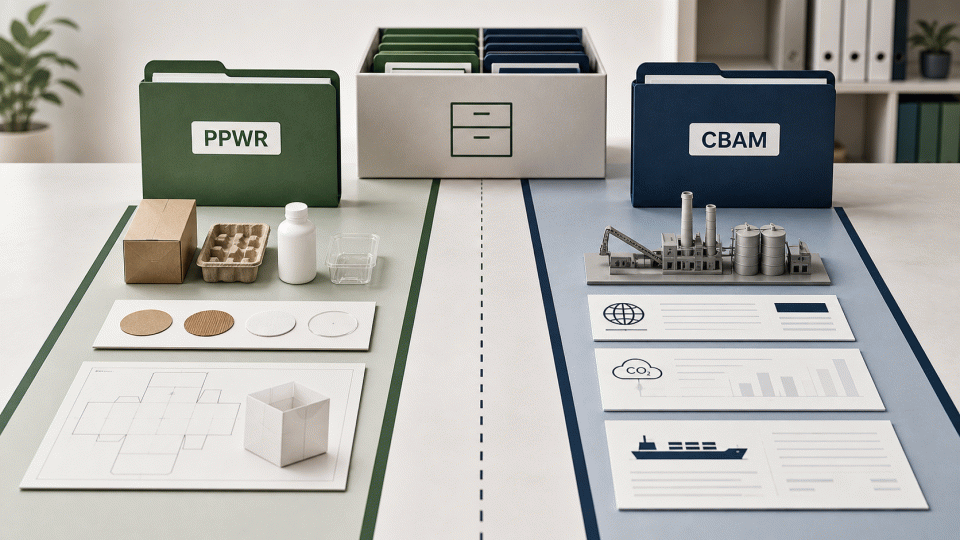
Short answer: PPWR and CBAM can sit under one repository root and can use verified product master data in common. They cannot use the same packaging evidence, reporting role or filing logic. PPWR addresses packaging and packaging waste; CBAM addresses embedded emissions in specified imported goods. Build two evidence lanes and link them only through controlled source data.
As of August 2026, the European Commission states that PPWR (Regulation (EU) 2025/40) entered into force on 11 February 2025 and generally applies from 12 August 2026. The CBAM definitive regime applies from 1 January 2026. This page follows current Commission and EUR-Lex material; it does not turn a proposal, a transitional-period practice or one Member State’s enforcement approach into a universal rule.
Scope boundary: A dual-scope conclusion requires separate checks of the packaging components, CN code, importer arrangement, origin, installation data and Member State procedure. One SKU is not automatically one regulatory filing object.
1. Put both regimes on one boundary table first
A shared repository is useful only after the regulated objects have been separated. PPWR concerns the design, composition, reusable or recoverable nature and management of packaging and packaging waste. CBAM concerns embedded emissions in specified imported goods, together with the authorisation, declaration, verification and certificate obligations attached to those goods.
2. PPWR lane: prove what the packaging is and how it is placed and managed
Start the PPWR file with the packaging components, not with a certificate. Identify sales, grouped, transport and e-commerce packaging by function. Record material, component weight, food-contact status where relevant, reuse design, and the relationship between the packaging and the product version.
Build four working tables: (1) packaging components and weights, with material, supplier, version and weighing basis; (2) design and performance evidence, linking recyclability, reuse, reduction, recycled-content or other claims to the applicable provision and supporting file; (3) labels and consumer information, with market, language, disposal wording and release date; and (4) producer-responsibility and Member State records, including responsible entity, authorised provider, reporting basis, receipts and countries in scope.
The original article presented a universal “30 May 2026 PCR percentage” rule and a universal QR-code requirement. That is too broad. For every recycled-content, recyclable, compostable or chemical claim, record the claim object, calculation basis, applicable provision, material batch and validation method. If a number or date has not been confirmed for the specific packaging category, mark it for review instead of expanding it into a listing or buyer file.
Do not cross-use: a site GHG inventory can describe facility or process emissions, but it cannot by itself prove the PCR percentage of a bottle, pouch or liner. Recycled-content evidence must map to the packaging component, material batch and applicable verification approach; a CBAM emissions file is not a substitute for PPWR packaging evidence.
3. CBAM lane: prove what was imported and how embedded emissions were calculated and verified
For the definitive regime, do not simply copy the old transitional quarterly-report template. First confirm whether the goods are in Annex I, who is the importer or indirect customs representative, how the quantity is measured, and whether authorisation is required. For cement, iron and steel, aluminium and fertilisers, Regulation (EU) 2025/2083 initially sets the single mass-based threshold at 50 tonnes of net mass per importer per calendar year. Electricity and hydrogen receive different treatment, so the 50-tonne rule must not be applied mechanically to every sector.
Build six evidence blocks: (1) CN code, goods description, origin and imported quantity; (2) importer, EORI, indirect customs representative and authorisation status; (3) installation, process boundary, activity data and emission factors; (4) the source and version of actual or applicable default values; (5) accredited verifier, verification report and corrective actions; and (6) annual CBAM declaration, certificate purchase/surrender records and proof of a carbon price paid in the country of origin where a deduction is claimed.
The CBAM regulation requires the annual declaration to contain imported quantity, embedded emissions, certificates to be surrendered and verification-report copies. The authorised declarant must also keep records detailed enough for verification and review. Quarterly production or import detail may be stored as working data, but it should not be described as a definitive-period quarterly declaration obligation, and a default value should not be presented as a measured factory value.
Keep three roles distinct: the installation supplies emissions data; the importer or qualifying indirect customs representative carries the authorised-declarant and annual-compliance role; the accredited verifier checks embedded emissions. Supplier, freight forwarder, importer and verifier may be different legal persons.
4. One repository root, two evidence lanes
Use one root such as “EU regulatory evidence”. The shared area should contain confirmed source facts, with source and version metadata. Number PPWR and CBAM calculations, statements, verification reports, registrations and filings separately; identical product wording is not a reason to reuse a document.
├ 00_Product_Master_Data: SKU, packaging components, material, weight, supplier, installation, shipment batch, candidate CN code and change log; every field has a source, owner and update date.
├ 01_PPWR: packaging scope and roles, component/material evidence, design/performance and labelling, producer-responsibility registration and reporting by Member State.
├ 02_CBAM: goods classification and quantity, importer and authorisation, installation and emissions calculation, verification, annual declaration and certificates.
└ 03_Decisions_and_Change_Log: applicability decisions, legal versions, authority answers, open questions and withdrawn claims.
If a BOM is shared, preserve the raw values and record the calculation purpose. Packaging-component weight may support a PPWR packaging record; it enters a CBAM calculation only when the goods scope, installation boundary and emissions method also support that use. The units, boundaries, formulas and reviewers differ, so do not overwrite raw values in a shared sheet.
5. Six human checks before a customer-facing claim or filing
1. Dual-scope matrix: for each SKU, identify the packaging components and separately check whether the goods fall within CBAM Annex I; brand or carton names are not substitutes for either decision.
2. Role matrix: name the packaging-responsibility entity, importer, indirect customs representative, installation and verifier; reconcile legal names, EORI and authorisation or registration numbers.
3. Evidence object: state the fact proved by every PCR, recyclability, label or emissions claim, then check product, material, facility and period alignment.
4. Version control: record the PPWR general application date, CBAM definitive period, provision-specific dates and the current default-value or implementation version separately.
5. Submission route: rehearse the Member State packaging registration/reporting path separately from the CBAM Registry, customs and annual declaration path; retain old quarterly reports only as historical material.
6. Claim cleanup: remove guarantees of approval, automatic clearance, automatic exemption, universal percentages, fixed penalties and certain marketplace outcomes; mark unresolved items for review.
Practical service boundary: 绿色方舟(深圳)认证有限公司 recommends starting with a product–role–evidence–version–submission index before deciding which documents require supplementation or testing. A complete file does not by itself prove that a legal requirement is met; applicability still depends on the product, Member State procedure, import arrangement and current legal text.
6. Sources and version note
The factual boundary in this page is based on the European Commission packaging-waste page, PPWR (Regulation (EU) 2025/40) and its 2026 implementation guidance, together with the CBAM definitive-regime page, Regulation (EU) 2023/956 and Regulation (EU) 2025/2083. Rules, default values, implementing acts and Member State procedures may change. Open the official source and confirm the current version before preparing a customer or filing package.
European Commission: Packaging waste | EUR-Lex: Regulation (EU) 2025/40 | European Commission: CBAM definitive regime | EUR-Lex: Regulation (EU) 2023/956 | EUR-Lex: Regulation (EU) 2025/2083


