
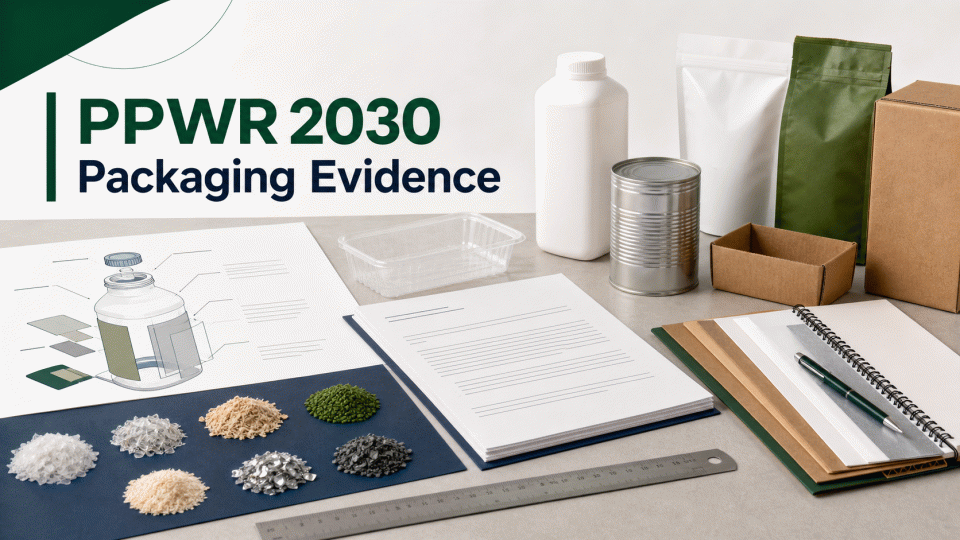
The EU Packaging and Packaging Waste Regulation, Regulation (EU) 2025/40 (PPWR), generally applies from 12 August 2026. It links packaging recyclability to design, components, material streams, collection, sorting and recycling capability; its design-for-recycling grades and related methods continue through later stages. For cross-border sellers, the practical starting point is not a generic “recyclable” label but a traceable record for each packaging unit and its design evidence.
1. Current applicability and the 2030 design requirements
Article 6 requires packaging placed on the EU market to be recyclable. The European Commission’s 2026 guidance explains that Article 6(1) generally applies from 12 August 2026, so current obligations and later methodology should be tracked together.
Recyclability involves at least two linked questions: whether packaging is designed for material recycling so that the resulting secondary raw material can reach sufficient quality, and whether it can be separately collected, sorted into appropriate waste streams and recycled at scale when it becomes waste.
Article 6 also requires the manufacturer to assess recyclability under relevant delegated and implementing acts and express the result through A, B or C performance grades. The design-for-recycling condition is linked to 1 January 2030, but the Regulation includes a later-of rule tied to the entry into force of relevant delegated acts. It is unsafe to present 2030 as one identical testing checklist for every packaging category. From 2035, the Regulation adds an assessment related to “recycled at scale”; from 2038, the market-placement threshold becomes stricter. These stages should not be collapsed into one certificate claim.
2. Build a packaging-unit register
Use the packaging unit placed on the market as the record object rather than filing everything only by brand or factory. Record the SKU, function, economic operator and EU countries; every component; material, structure, mass or dimensions; supplier, version and change date; applicable technical documents; and open questions about design, collection, sorting and material recycling.
The register separates “a material is commonly recyclable” from “this specific packaging unit can be assessed under the applicable regulatory method”. A multilayer pouch, coated paperboard or mixed-component pack cannot be treated as compliant solely because a supplier describes one material as recyclable.
3. Organize evidence by question
Design and composition: keep structural drawings, BOMs, material and component descriptions, mass or thickness data, coating and label information, and version-control records. A “recyclable” statement on an illustration is not itself a regulatory assessment.
Recycling pathway: record the collection, sorting and material-recycling pathway relevant to the destination market. A laboratory sample result alone does not answer every packaging-system question.
Entity and scope: retain manufacturer, importer and other economic-operator roles, linking each document to the packaging unit, supplier and market. A certificate applies only within its issuer, product scope, material and method; a third-party mark does not automatically cover every SKU.
Regulatory version: record the relevant PPWR provisions, the status of delegated or implementing acts, the source-check date and unresolved questions. Revisit affected packaging versions when methodology or classification changes.
4. Common mistakes
Mistake 1: treating a recyclable material as recyclable packaging. Component combinations, coatings, adhesives, labels and the actual sorting pathway can affect the assessment.
Mistake 2: merging legal dates, platform requests and internal planning dates. They have different sources and legal effects and should be recorded separately.
Mistake 3: applying a universal “24-month report” rule or fixed laboratory list. Article 6 does not create one report-validity period for every packaging type; evidence must match the method, category, entity and market.
Mistake 4: promising a platform outcome or uniform enforcement consequence. Missing or unsuitable evidence may require clarification or further review, but it should not be described as automatic delisting, detention, fine or recall in every case.
5. Four preparation steps
- Create a version-controlled list by SKU and packaging unit, including every component and material.
- Link drawings, BOMs, supplier documents and packaging-change records to each entry.
- Under Article 6 and later formal methods, mark each point as confirmed, evidence pending or awaiting regulatory detail.
- Recheck scope when design, material, supplier or destination market changes, preserving the review date and source basis.
绿色方舟(深圳)认证有限公司 recommends managing packaging design, material composition, recycling pathway, regulatory version and page wording as one evidence chain. A page may describe verified facts, but should not present an unfinished assessment as “compliant with the 2030 requirement”.
Sources and limits
Primary sources: Regulation (EU) 2025/40, especially Article 6 and Annex II; European Commission 2026 PPWR guidance; European Commission packaging-waste overview. This is an evidence-preparation framework, not legal advice for a particular packaging category, economic-operator role or destination market.


