
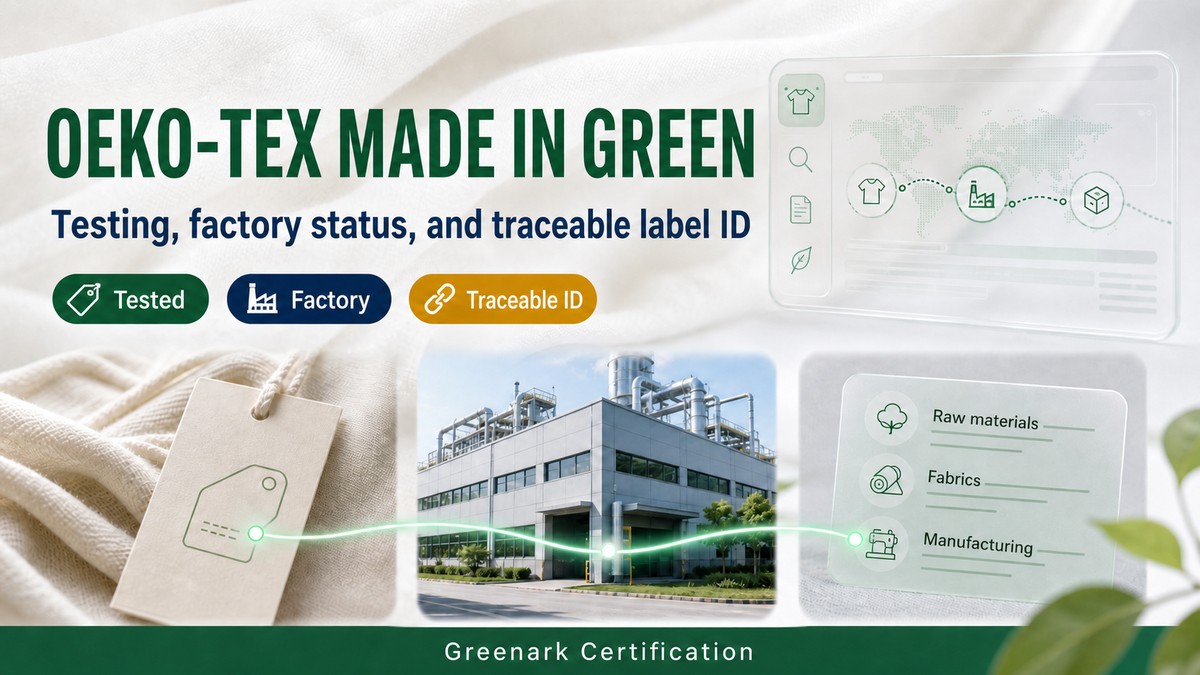
OEKO-TEX® MADE IN GREEN is a traceability label for textile and leather articles. It is not a stand-alone “green certificate” that can be detached from the product and its supply chain. The label is built around applicable product certification, production-facility conditions, component information and connected supply-chain records. This reference page follows the official OEKO-TEX® MADE IN GREEN page, standard and Label Check guidance.
1. What MADE IN GREEN identifies
OEKO-TEX® describes MADE IN GREEN as a label for textile and leather articles tested for harmful substances and made under more responsible production conditions. Its information dimensions include product safety, chemical and wastewater management, working conditions and supply-chain traceability. “Traceability” here means that a unique product ID or QR code connects the label with Label Check information; it is not an unlimited claim about every environmental or social outcome.
It is also not the same as OEKO-TEX® STANDARD 100. STANDARD 100 is primarily a product certification concerning harmful-substance testing. MADE IN GREEN adds conditions relating to production facilities and supply-chain information. A certificate for one fabric, supplier or raw-material batch does not automatically prove that a finished garment or other final article carries a MADE IN GREEN label.
2. How to separate the requirements and evidence
Based on the official MADE IN GREEN information, review the evidence in at least four layers:
1. Product-certification basis. The article must follow an applicable product-certification route such as OEKO-TEX® STANDARD 100, ORGANIC COTTON or LEATHER STANDARD. Confirm the exact route, certificate holder and component scope from the relevant records.
2. Production facilities. The official page requires making-up facilities to meet STeP conditions. For a single component representing 5% or more of the total product weight, wet or chemical production facilities also need to be checked against the applicable STeP conditions. A general management certificate should not be presented as proof that every MADE IN GREEN requirement is covered.
3. Components and supply-chain connections. For finished articles, the making-up facility and at least three components must be defined and confirmed. Participating companies register on myOEKO-TEX® and use the MADE IN GREEN dashboard to establish the relevant connections. The actual component list, supplier roles and platform records should agree.
4. Label and product ID. The label should be prepared and downloaded from the relevant dashboard. Do not reuse a supplier image or an old label for a different article. Keep the label number, article description, component list, underlying certificates, facilities and supplier confirmations in one product-level file.
3. Label Check, validity and change control
A buyer or reviewer can enter the label number in the official OEKO-TEX® Label Check. A proper review compares the label number, article description, holder, production information and other displayed details with the product being sold. Do not rely only on a screenshot showing that a result exists. If no result appears, first check the case-sensitive number and status, then ask the relevant institute or supplier to clarify.
Under the MADE IN GREEN Standard, the label is valid for one year. Articles made during the validity period can remain traceable in Label Check for five years after expiry. The label owner must monitor the validity of the underlying certificates and component confirmations. Major changes to the article or supply chain mean that a new product ID may be required; changing a webpage statement alone is not enough.
When fabric, dyeing or finishing facilities, key components or suppliers change, record the change date, affected product ID, certificate status and re-confirmation result. This is a document and label-status control practice, not a promise that a platform or market will accept the product.
4. How to write a product-page statement
Limit the statement to the verified article and label. For example: “This article is associated with an OEKO-TEX® MADE IN GREEN label, which can be checked by its label number in the official OEKO-TEX® Label Check.” Use the standard name or mark only after the certificate, label and product scope have been checked. Do not turn “made with OEKO-TEX® certified fabric” into “the finished article is MADE IN GREEN,” and do not expand the claim into “free of harmful substances,” “fully sustainable” or “compliant with all market laws” without separate evidence.
A practical product-level register can include: article or style number, label number and QR code, label holder, product certificate, components and proportions, making-up facility, supplier connections, Label Check record date, page locations and recent changes. If the evidence comes from a supplier, verify the legal entity and scope before copying any certificate image into a product listing.
5. Sources and limits
Sources: OEKO-TEX® MADE IN GREEN overview, the MADE IN GREEN Standard, the OEKO-TEX® Label Check and the official Claims Usage guidance. These sources describe the OEKO-TEX® label system and its communication boundaries. They do not replace an independent review of importing-country law, customer contracts, platform rules or other certification schemes.


