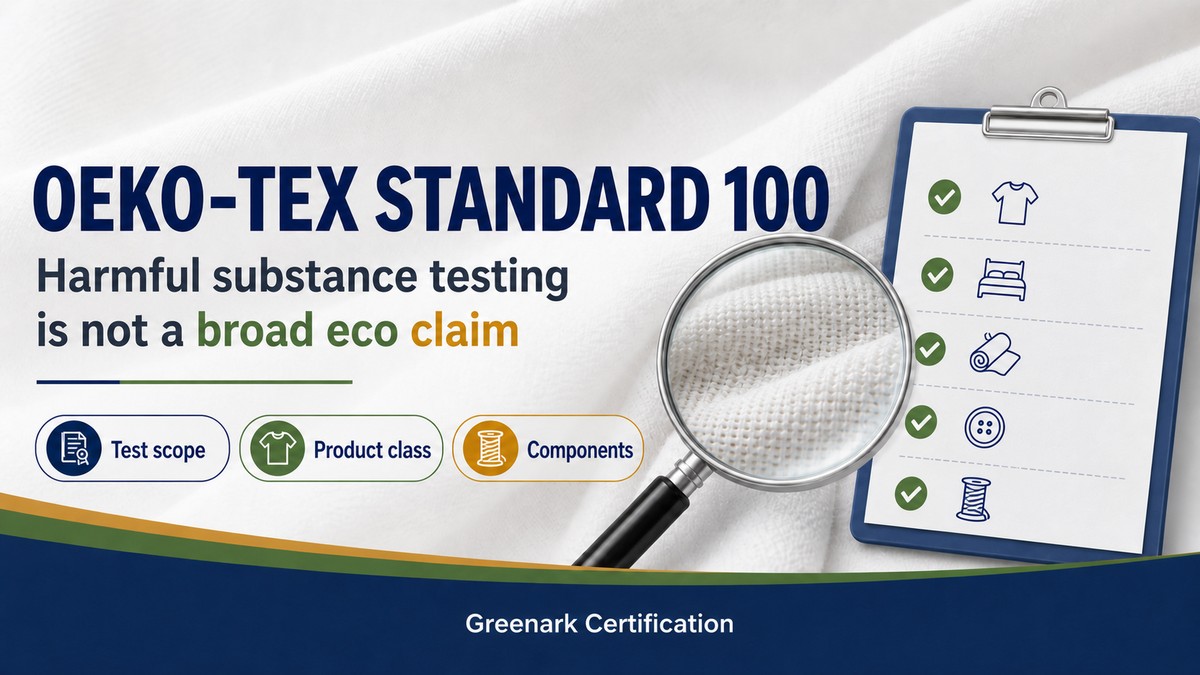
This reference page follows the official OEKO-TEX® STANDARD 100 overview, labelling guidance and current standard materials. STANDARD 100 is a harmful-substance testing label for textiles. It is not, by itself, an organic, recycled-content, factory-environmental or carbon-emissions certification. This article does not promise certification, platform acceptance or market access.
Start with the evidence object
STANDARD 100 focuses on harmful-substance testing for the certified article and its materials, from yarn and fabric to finished products. A label or certificate supports statements only for the product and scope it identifies. It does not automatically prove organic farming, recycled content, factory environmental performance or compliance with every market rule.
When a supplier says only that it has an “OEKO-TEX certification,” confirm the scheme, certificate number, product description and scope. STANDARD 100, STeP, MADE IN GREEN and ORGANIC COTTON address different evidence objects and should not be treated as interchangeable.
The four Product Classes
OEKO-TEX describes four classes based on intended use and skin contact. In general, requirements become stricter as contact becomes more direct or the user is more sensitive; the certificate, applicable standard edition and test plan remain decisive.
Product Class I: products for babies and children up to three years, such as diapers, with the strictest requirements.
Product Class II: products with direct skin contact, such as bed linen or close-to-skin apparel.
Product Class III: products normally without direct skin contact, such as jackets.
Product Class IV: home textiles and decoration materials, such as curtains.
Do not stop at “a certificate exists.” Compare the actual use, target user and contact pattern with the Product Class on the certificate. A certificate for one class should not be presented as evidence for a different use without confirmation.
Product and component scope
The evidence concerns the certified article, not an abstract supplier qualification. For a finished product, check whether the certificate or product description covers the current SKU’s actual construction, including fabric, sewing thread, buttons, zippers, prints and labels where relevant. If the colour, fibre content, construction or accessories change, do not assume that the original scope still applies; confirm with the certificate holder or certification body.
A supplier’s test file for the main fabric is not automatically evidence for the finished article. Maintain a SKU-to-evidence register with the certificate number, product description, materials or components, Product Class, applicable edition and status, together with the product specification and supplier confirmations.
Certificate status and page claims
The official OEKO-TEX overview states that a STANDARD 100 certificate is issued for one year. Record the certificate number, validity information, product description and current status, then use the official Label Check or the QR code/number on the label to verify it. If the certificate is expired, cannot be found, or is merely described as “under renewal” without a current valid status, do not present it as a current product certification.
Keep page wording tied to the evidence object. “This product holds a STANDARD 100 certificate within the stated scope” is more precise than “eco-certified,” “free of harmful substances,” or “compliant in every market.” Do not extend STANDARD 100 into claims about organic farming, recycled content, factory environmental management, carbon footprint or comprehensive market compliance.
Five checks before using the evidence
1) Can the certificate number be checked through the official Label Check? 2) Does the Product Class match the intended use, target user and contact pattern? 3) Do the product description, materials and components cover the current SKU? 4) Are the validity and current status clear? 5) Does the page claim stay within the harmful-substance testing scope supported by STANDARD 100? OEKO-TEX updates test criteria and limit values, so confirm the applicable edition and the latest documents supplied by the certification body when needed.
After these checks, list any buyer, platform or market-specific documents separately. A STANDARD 100 certificate should not be used as a substitute for other legal, contractual or customer-audit evidence. Greenark Certification recommends building the evidence chain product by product, certificate by certificate and claim by claim.