
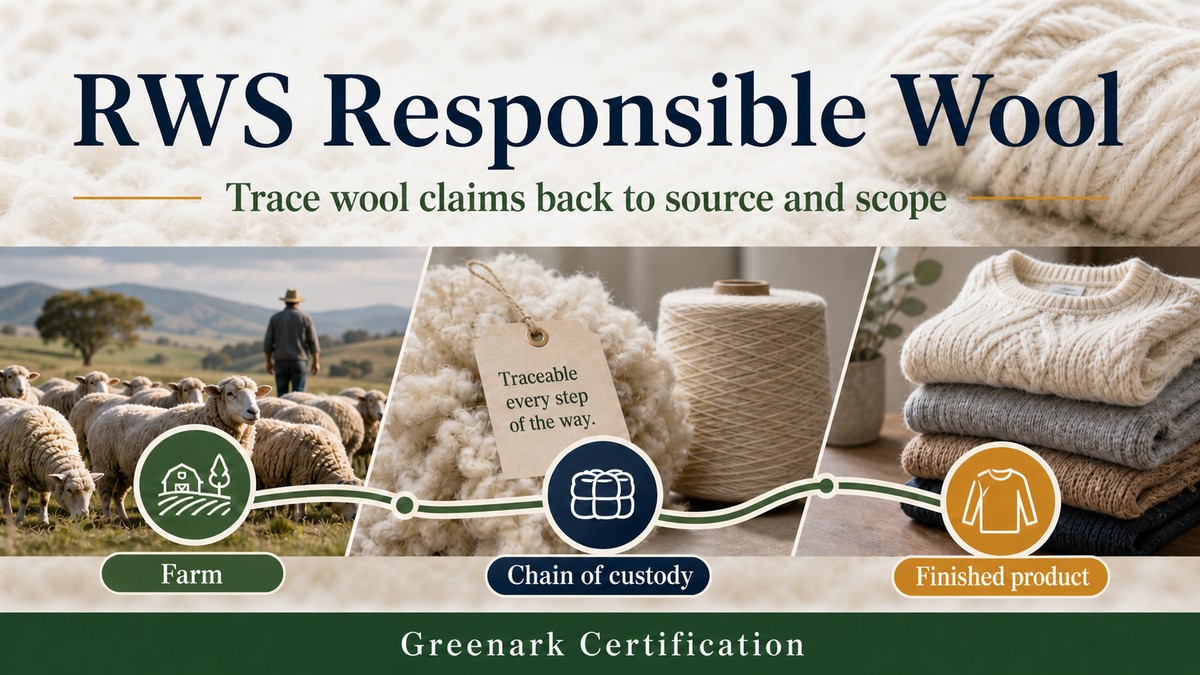
The Responsible Wool Standard (RWS) is not a stand-alone “green certificate” that can be detached from a product and a transaction. A defensible wool claim needs the standard scope, chain of custody, certified entities, product scope and transaction records to line up.
This guide is based on Textile Exchange materials for the RWS, its user manual and transaction-certificate policy. It focuses on the evidence boundaries that sellers, brands and suppliers should review. RWS is voluntary and does not replace the legal or regulatory requirements of a target market.
1. What RWS Covers — and What It Does Not
RWS is designed to recognize practices at sheep farms, including animal-welfare and land-management requirements, and to track certified wool through a chain of custody. Textile Exchange manages the standard, while independent third-party certification bodies conduct certification activities.
RWS addresses whether a wool claim is supported by the relevant standard and chain-of-custody evidence. It does not automatically prove every safety characteristic of a finished garment, an import authorisation, platform acceptance, or compliance with other textile, chemical, product-safety or advertising requirements.
2. Reading the Chain of Custody from Farm to Product
The RWS evidence path can include farms, raw wool, processing sites and later commercial transactions. Applicable sites must be certified within the relevant scope, and the business should be able to explain how purchasing, production, sale and the product claim relate to the same material flow.
Chain of custody does not mean that every farm must appear on a public product page, nor does one certificate cover every product. Review the seller and buyer, certified sites, product description or category, quantity, transaction date, lot or invoice references, and whether these details match the SKU and purchasing records.
3. Scope Certificates and Transaction Certificates
Scope Certificate: confirms the organization, sites and certified scope. It helps establish whether a supplier or processor is covered for the relevant standard and product area, but it does not by itself prove that a particular purchase or finished product is supported by a transaction claim.
Transaction Certificate (TC): is issued by a certification body to verify that products sold or shipped between specified organizations conform to the named standard and may be treated as claimed material by the receiver. Check the TC together with the applicable Scope Certificate, parties, product description and quantity.
Do not rely on a screenshot alone. Check the certificate name, number, certification body, standard, organization and dates through Textile Exchange authentication or the relevant public verification route. If the document, lookup result and transaction do not align, pause the claim and request clarification.
4. A Practical RWS Evidence Register
A minimum register can use five columns: claim, product, supplier, certificate and transaction.
Claim: define whether the page refers to RWS wool, a percentage or a certified product. Do not turn an RWS material claim into a broader animal, environmental or product-performance conclusion that the evidence does not support.
Product and supplier: record the SKU, style or colour, wool composition, processing steps, supplier legal name and production site, then compare them with the certificate scope.
Certificates and transaction: retain the Scope Certificate, TC, purchase order, invoice, shipping or delivery record and internal lot mapping. Cross-check parties, dates, quantities and product descriptions.
5. Common Mistakes and Boundaries
“The supplier is certified, so every product can carry an RWS claim” is not a safe inference. Certificate scope, sites, product categories, transaction records and claim rules can limit what is supportable. Re-check when the supplier, processing site, material composition or product range changes.
“There is a TC, so no other compliance file is needed” is also incorrect. A TC supports a material claim and the relevant transaction chain; it does not replace target-market labelling, product-safety, chemical, import or platform requirements. The applicable duties depend on the product, market, customer rules and current law.
Keep the wording at the same level as the evidence. If the file supports a certified-material claim, do not expand it into “always sustainable”, “officially approved” or “valid in every market”. 绿色方舟(深圳)认证有限公司 recommends mapping each RWS statement to the relevant SKU, certificate scope and transaction record before publication, then reviewing it when the standard or customer rules change.


