
Checked on 22 August 2026. This reference is based on Textile Exchange’s public OCS page, OCS 3.0, transaction-certificate policy, and its OCS-versus-GOTS explanation. OCS is a voluntary standard. It does not replace destination-market law or guarantee market access, platform acceptance, or a particular certification outcome.
What OCS Verifies
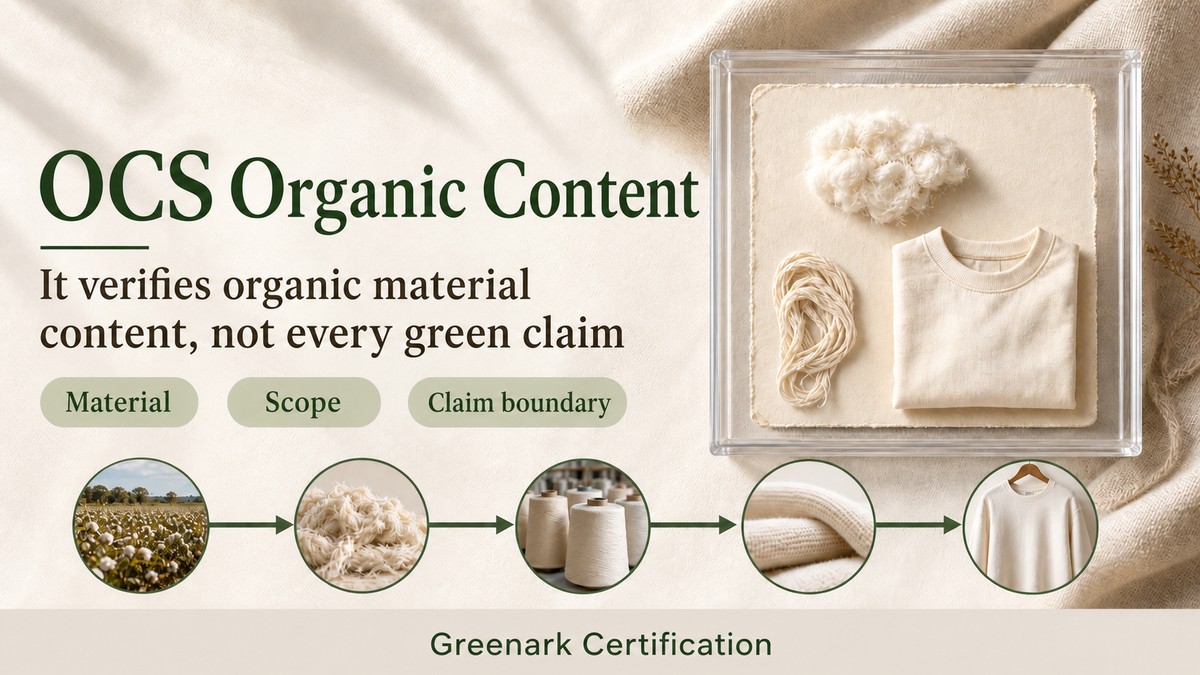
The Organic Content Standard (OCS) provides third-party verification of organic material content and chain of custody. Textile Exchange explains that accepted organic-farm inputs must remain traceable through production using records, material-flow controls, and audits. OCS focuses on organic material content and its source; it should not be presented as proof of every processing condition, social requirement, product performance attribute, or overall environmental impact.
For an organic-material claim, separate three questions: what the organic input is, how the organic content is calculated in the finished product, and whether evidence remains connected from the input to the product being sold. A supplier certificate alone does not automatically cover another company, shipment, product, or batch.
OCS Is Not the Same as GOTS
Textile Exchange distinguishes the schemes as follows: GOTS adds processing requirements to its organic-fibre criteria and has a 70% organic-fibre requirement together with restrictions on permitted blended fibres. OCS primarily supports organic-material content and chain-of-custody claims. OCS should therefore not be described as equivalent to GOTS, and it cannot substitute for GOTS when a buyer specifically requires GOTS.
The right evidence depends on the intended claim. OCS documentation may be relevant where the question is organic-material content. Claims about processing chemicals, environmental management, social requirements, or GOTS product labelling require a separate review against GOTS and its applicable policies.
OCS 100, OCS Blended, and Claims
The OCS 3.0 label system distinguishes OCS 100 and OCS Blended. OCS 100 generally corresponds to at least 95% organic content, while OCS Blended generally corresponds to at least 5% and less than 95% organic content. The category should not be used in isolation: confirm the label grade, composition, certified products, and current claims policy on the relevant certificate and supporting records.
“Contains organic cotton,” “made with organic material,” and “100% organic” are not interchangeable statements. Do not expand an OCS document into a claim about the entire product, every processing step, or overall environmental performance. Check Textile Exchange’s current claims policy and the buyer’s requirements before using a mark or product wording.
How to Review a Transaction Certificate
A Transaction Certificate (TC) is issued by a certification body to verify that products in a specific transaction conform to the named standard and may be treated as claimed material by the receiver. The OCS TC template includes the certification body, seller and buyer, product and shipment information, net and certified weights, material composition, label grade, and relevant input TCs. It is not a generic organic certificate that can be detached from the transaction and product scope.
Use an SKU- or batch-level checklist: compare product names, quantities, composition, and invoices; match the seller, buyer, last processor, and certified scope to the actual chain; connect input and output TCs, the Scope Certificate, and material-flow records; and keep the product wording within the certificate and current claims policy. Escalate discrepancies in identity, quantity, composition, or chain of custody to the certification body or responsible supply-chain party.
Pre-Publication Boundary Check
Before publishing a claim, retain the current certificate, TC, product specification or BOM, and the links between batch, invoice, and material composition. Do not call OCS “GOTS,” turn a supplier-level document into an unlimited finished-product guarantee, or promise platform approval, environmental performance, or another outcome that the evidence does not establish.
Sources: Textile Exchange OCS page, OCS 3.0, TC policy, and Textile Exchange’s OCS/GOTS comparison. Specific claims remain subject to the applicable version, certification-body documents, and target-market requirements.


