
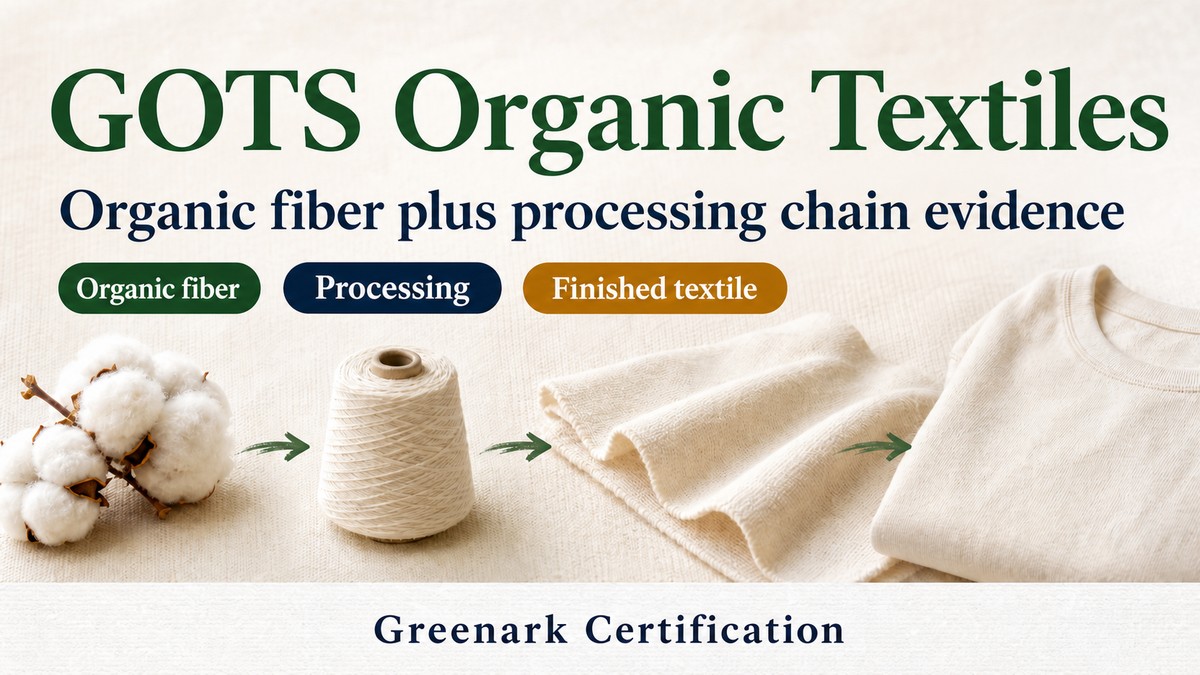
The Global Organic Textile Standard (GOTS) addresses organic-fibre inputs together with relevant textile processing, environmental and social criteria, supply-chain traceability, and labelling. This page is a document-review guide; it does not promise certification, label approval, or acceptance by a particular marketplace.
Start with the product scope and certified entity
GOTS is relevant where organic fibres move through textile processing, manufacturing, trading, and related retail activities. Whether a product may be represented as a GOTS product cannot be decided from an “organic cotton” statement or a supplier image alone. The product category, fibre composition, processing activities, and trading parties must line up.
A GOTS Scope Certificate (SC) is issued by an approved certification body under the applicable policy. It identifies the certified entity’s product categories and qualified processing, manufacturing, or trading activities. Subcontractors and their relevant processing steps should be checked in the certification records. A brand owner should not treat a spinner’s or fabric mill’s certificate as automatic proof for its own finished product.
Check the fibre threshold against current labelling rules
GOTS labelling grades have defined fibre-content thresholds. Under the public GOTS 8.0 (2026) standard, excluding accessories, products with at least 95% certified fibre content may use the “Organic” or “Organic in-conversion” grade; products with at least 70% may use “Made with (x%) organic materials” or the corresponding in-conversion wording. The product must still be assessed against the applicable rules for additional fibres, accessories, the current standard version, and the conditions for using GOTS signs.
A percentage should not be promoted independently of the product composition and certification documents. Keep the fibre specification, applicable certificates, and label-approval records together. “Contains organic fibre” is not automatically the same claim as “GOTS certified.”
The processing chain needs its own evidence
Depending on the product and activities, GOTS requirements can cover spinning, weaving or knitting, wet processing, printing, garment manufacturing, storage, and trading. Chemical inputs, wastewater, environmental management, social criteria, and traceability must be assessed under the applicable standard and implementation guidance. The exact scope depends on the product, process, certified entity, and subcontracting arrangement.
A finished-goods facility having a certificate does not by itself prove that every upstream step or every SKU is covered. Likewise, an OCS certificate, which focuses on organic content and the relevant chain, does not automatically replace GOTS requirements for processing and other criteria. Compare the scope and evidence of each standard before making a claim.
Use SC and TC for different questions
A Transaction Certificate (TC) supports traceability for specific GOTS goods moving through the certified supply chain. Review the supplier and certified-entity names, product description and fibre composition, quantity, lot or shipment information, trading parties, certification body, TC number, and date.
The SC answers “which entity and activities are within the certified scope”; the TC answers “how this transaction is traced.” Neither document should be used without checking the SKU, purchase order, invoice, shipment records, and product specification. If names, product categories, quantities, or processing steps do not match, ask the supplier or certification body to clarify instead of expanding the claim yourself.
Five checks before publishing a product claim
1) The fibre composition matches the label grade; 2) the SC covers the current entity, product, and activities; 3) the TC matches the relevant transaction or lot; 4) the label, sign, and advertising wording follow the applicable approval or licensing process; and 5) the page says only what the evidence supports. Do not treat “organic,” “made with organic fibre,” “meets a criterion,” and “GOTS certified” as interchangeable.
GOTS standards, implementation manuals, certification-body documents, and sign-use conditions can be updated. Before a submission or public claim, check the latest material on the GOTS website and with the relevant certification body, and record the document version, review date, and evidence trail.


