
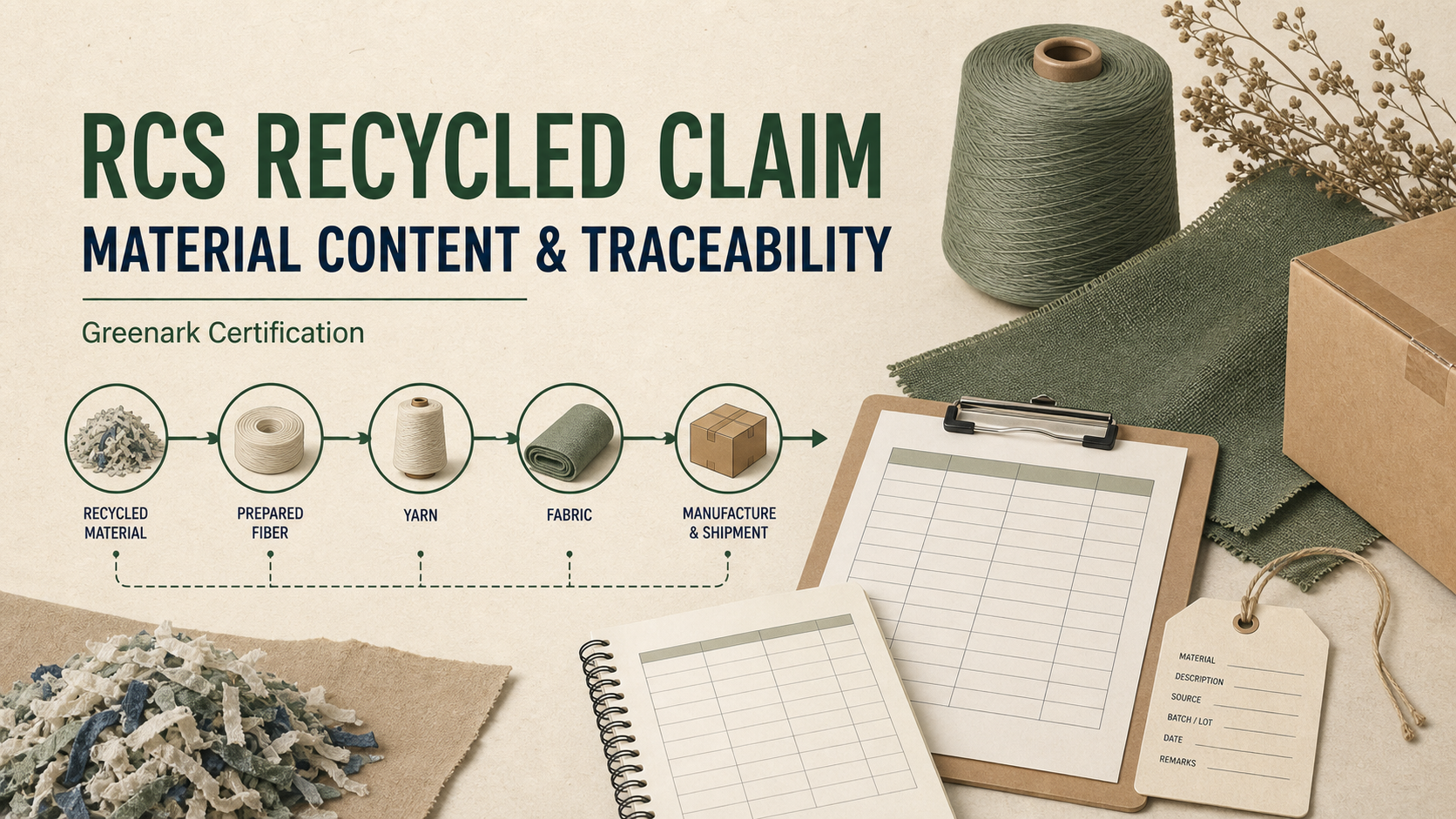
The Recycled Claim Standard (RCS) is used to review recycled material in a product and its chain of custody. It is not a general green endorsement that can be separated from the product, batch and transaction records. Before publishing an RCS-related claim, check the applicable RCS version, product or component scope, certificate status and evidence for the relevant transaction.
1. What RCS is designed to verify
Current Textile Exchange material states that RCS applies to products containing at least 5% recycled content, while exceptions and consumer-facing label conditions must be checked against the current standard, certification procedures and claims guidance. Recycled content is a mass proportion of recycled material in a product or package. “Recyclable,” “made with recycled material,” and “contains a stated percentage of recycled content” are not interchangeable claims.
RCS also distinguishes Reclaimed Material, which would otherwise have entered a waste or energy-recovery stream, from Recycled Material, which has been reprocessed into a product or component. Pre-consumer and post-consumer inputs, their sources and batch percentages should be documented under the applicable rules rather than inferred from a supplier statement or product image.
2. Keep RCS and GRS claims separate
RCS and GRS both address recycled material and supply-chain chain of custody through third-party assurance. RCS focuses on recycled material definitions, recycled content and chain of custody. GRS adds broader social, environmental and chemical-related requirements. Textile Exchange also distinguishes the GRS applicability threshold from the threshold for consumer-facing product claims, so an old single percentage should not be presented as a universal rule for every product and claim.
An RCS certificate does not automatically demonstrate compliance with GRS’s additional requirements. Conversely, a GRS input does not allow an RCS claim without the corresponding RCS scope and transaction evidence. If a buyer requires GRS, specific chemical controls or social criteria, list those requirements separately.
3. Match the SC, TC and material flow
A Scope Certificate (SC) identifies the certified entity, sites, product categories and activities within scope. A Transaction Certificate (TC), or an applicable eTransaction, records the seller, buyer, goods, shipment or batch information and certified-material volume for a transaction. They answer different questions: an SC does not replace transaction-level traceability.
RCS-101-V3.0, published on July 1, 2026, requires applicable recycled materials entering the supply chain to have a valid TC and requires pre-consumer and post-consumer percentages to be recorded separately for each batch at certified sites and on the transaction record. Compare the SC, TC or eTransaction with purchase orders, invoices, shipping documents, product specifications, batch quantities and loss or mass-balance records. If names, quantities, product descriptions or processing steps do not match, ask the supplier or certification body to clarify.
4. Set a precise product-page boundary
Consumer-facing labels and product-page claims have additional conditions. The product generally needs to be certified through the applicable chain up to the last business-to-business transaction and follow the RCS claims and logo guidance. If the evidence covers only a component or material, identify that object clearly; do not turn a component claim into a claim that the entire product is “100% recycled” or “RCS certified.”
Before publishing, record the claim object and model, pre-consumer and post-consumer content, certified entity and SC scope, the relevant TC or eTransaction, supplier, buyer and quantity, and the approval status of labels, trademarks or promotional wording. RCS is a voluntary standard and does not replace environmental-claim, consumer-protection or product requirements in the market of sale.
5. Check the current version and transition material
Textile Exchange published RCS-101-V3.0 on July 1, 2026. It is also transitioning its standards system toward Materials Matter. Existing standards may continue during the transition, but effective dates, audit requirements and claim or label conversion dates should be taken from the current official transition documents. Do not treat an old RCS 2.0, GRS document or marketplace explanation as the complete current rule.
绿色方舟(深圳)认证有限公司 recommends maintaining an evidence chain for each SKU: material definition, content calculation, SC, TC or eTransaction, batch records and webpage wording. Save the standard version, review date and source used. The final certification scope, transaction record and claim approval remain subject to current Textile Exchange documents and the relevant certification body’s assessment.


