
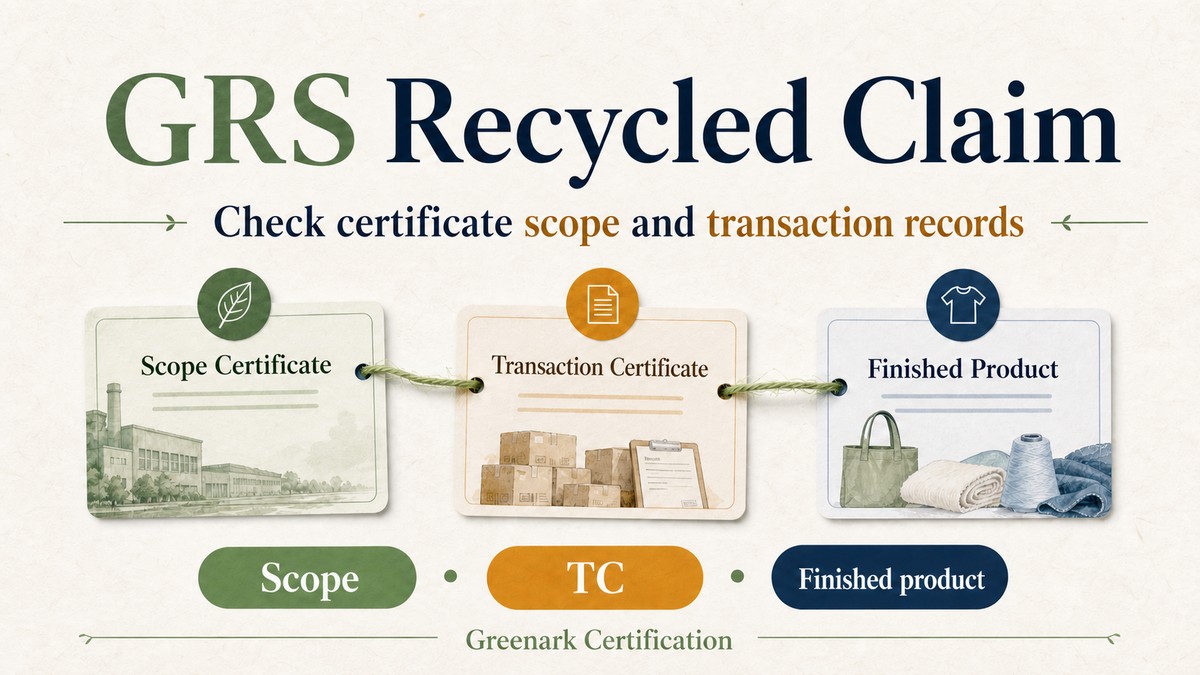
The Global Recycled Standard (GRS), managed by Textile Exchange, is a voluntary full-product standard. This reference follows the current public GRS-101-V5.0, RCS, certification and claims materials. The applicable version, certification body and destination-market rules must still be checked for each project. It does not promise certification, platform eligibility or market access.
1. What the GRS is designed to verify
The GRS addresses recycled-material content, chain of custody, and social, environmental and chemical requirements for processing. It is not a standalone finished-product test report and is not the same as a platform review. The certified scope must be connected to specific organizations, sites, products and activities.
Chain-of-custody evidence follows recycled material through the supply chain. Reviewing only the final factory is therefore insufficient: suppliers, processing steps, product descriptions, quantities and transaction records should connect to the same product flow.
2. Separate recycled-content thresholds from label use
Textile Exchange public materials describe the GRS as applicable to products containing at least 20% recycled material. Public FAQ and guidance materials also state that consumer-facing GRS product labelling requires 50% recycled content. The 20% threshold should not be rewritten as permission to place a GRS claim on any page or as proof of platform eligibility.
Page wording should match the product, material and permitted claim type. Keep the recycled-material type, calculation basis, product composition and supporting certificates or transaction records. Supply-chain certification should not be expanded into a claim about every environmental attribute, zero risk or a guaranteed compliance outcome.
3. GRS and RCS are not interchangeable
RCS primarily verifies recycled material and chain of custody. GRS adds social, environmental-processing and chemical requirements. Textile Exchange public materials describe RCS as applying from 5% recycled material, while the GRS baseline is 20% and consumer-facing labelling has the higher 50% threshold. The two standards have different scopes and claim rules.
Choose between them by asking what the buyer needs to substantiate: recycled content and traceability alone, or additional social, environmental and chemical requirements for processing. Then compare that need with the actual supply chain and proposed claim.
4. Review three evidence groups
Scope certificate. Check the certificate holder, certified sites, product or material categories, activities, status and applicable dates. A certificate does not automatically cover the current SKU, batch or every supplier.
Transaction evidence. Depending on the current certification system, review the Transaction Certificate (TC) or electronic transaction record. Check the parties, product description, quantity, recycled content, batch or date and upstream/downstream connection. An unrelated TC cannot replace chain-of-custody evidence.
Process and product records. Keep input records, purchase and production records, bills of materials or composition data, quantity-balance records, sorting or processing records, applicable social and environmental audit material, and records relevant to chemical requirements. The certification body and current standard determine what must be submitted.
5. Set boundaries before publishing a claim
Identify whether the claim concerns a material, product, company or supply chain. Then check that percentages, standard names, trademarks and certificate references match the evidence. A GRS certificate does not automatically prove compliance with every market law, platform policy or buyer standard, and it cannot support promises of approval, delisting reversal, customs clearance or sales results.
Before using the GRS name, label or recycled-content wording, review Textile Exchange trademark and labelling requirements, destination-market environmental-claim rules and contract terms. Claims should be specific and traceable; avoid unsupported wording such as “100% compliant” or “zero risk.”
6. A practical seller evidence register
For each SKU, record the product and material description, recycled-material source and percentage, supply-chain sites, scope certificate, TC or electronic transaction record, quantity and batch links, process-audit material, proposed page wording, trademark or label authorization, and any facts that still require verification. The certification body, brand owner or platform makes the final decision under its own rules.
Sources: Textile Exchange’s GRS-101-V5.0 Global Recycled Standard, official GRS/RCS FAQs and guidance, GRS certification procedures, and certificate-authentication materials. Standards, policies and systems can change; check the official source for the current version before use.


