
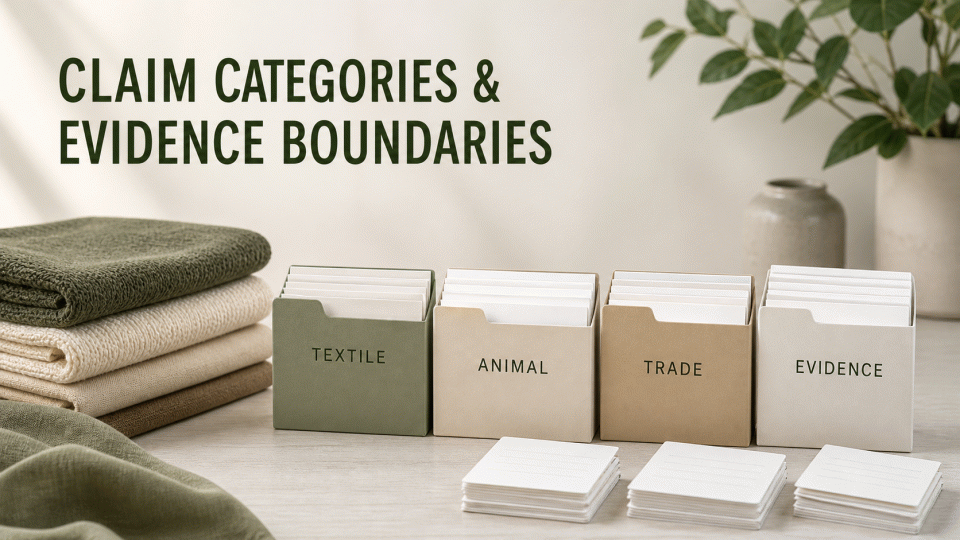
Amazon Climate Pledge Friendly (CPF) uses recognized third-party certifications and programs to help shoppers identify sustainability features. A CPF label or one certification does not prove every environmental, chemical, animal-welfare, cruelty-free or labor claim about a product. This reference separates finished-textile chemical claims, textile production systems, animal-welfare claims, cruelty-free statements and fair-trade claims so each statement can be tied to the product, supply-chain scope and evidence that actually supports it. Amazon’s current certification list, submission route and display rules must be checked for the relevant marketplace and account. This page does not promise CPF eligibility, certification approval, badge display or sales results.
1. Separate CPF from the certification or program behind a claim
CPF is an Amazon sustainability-feature program, not a single universal certification that makes a product “green” or “compliant” in every respect. Amazon describes CPF as working with third-party programs from government agencies, nonprofits and international standards organizations, while reviewing the certification landscape over time. For a submission, identify the marketplace, ASIN, finished product, certification name and current submission path, then confirm that the certifier can connect that product and claim to the relevant evidence.
Keep a claim ledger with the brand and product model, variants or material scope, program name, certificate or label identifier, certificate holder, status, covered sites or suppliers, permitted claim language, limitations, verification link and submitted ASIN. A supplier’s certificate does not automatically cover every finished product sold by the brand.
2. Textiles: finished-product testing and production systems are different evidence tracks
| Claim or program | Question it addresses | Boundary to check |
|---|---|---|
| OEKO-TEX STANDARD 100 | Whether the textile article and its components were tested for harmful substances under that standard | Check the label or certificate identifier, product class, components, colors and scope; it does not automatically cover every legal, quality or production-process question |
| bluesign/bluepass-related programs | How chemical inputs, production processes, resources, emissions, occupational safety and supply-chain controls are assessed | Distinguish consumer products, articles and chemical products; use the current label, verification page and program rules rather than rewriting the claim as a complete finished-product chemical guarantee |
The two tracks may complement each other, but neither replaces the other. A claim about harmful-substance testing should point to the finished article’s certificate or test scope. A claim about responsible textile production or chemical management should point to the relevant process, input and supply-chain records. Do not infer that a production-system assessment proves every finished-product parameter.
3. Animal welfare and cruelty-free claims answer different questions
Responsible Down Standard (RDS) addresses animal-welfare and chain-of-custody requirements for down and feathers. For a down product, match the finished product, down source, supplier and certificate scope to the same product and supply-chain record. A finished-textile chemical program cannot replace evidence about animal welfare or material origin under RDS.
Cruelty-free statements concern the brand, ingredients, suppliers and relevant testing-policy scope. Leaping Bunny and PETA Beauty Without Bunnies have their own application, commitment, listing and mark rules. A human patch test, a statement that a company did not commission animal testing, or a supplier’s general assurance should not be rewritten as a named program certification. Cosmetic safety and regulatory compliance are separate questions.
4. Fair trade claims depend on social and supply-chain scope
Fair Trade Certified maintains different standards for contexts such as agriculture, factories, fisheries and trade. The relevant requirements can address producers, workers or other supply-chain participants, working conditions, prices or premiums and community-development mechanisms. This is not a universal statement about every factory, raw material or labor condition of an entire company. Use the product, site, entity and supply-chain scope actually covered by the certificate and standard; do not expand one input or facility into a company-wide claim.
5. Six checks before a CPF submission or Listing edit
- Split each environmental, animal-welfare, chemical or social statement into a separate claim instead of using “sustainable,” “safe” or “fair” as a catch-all.
- For each claim, name the evidence object: finished product, component, chemical, process, raw material, facility, brand or transaction.
- Match the certificate holder, product model/ASIN, batch, brand authorization and certification scope, and retain the official verification result.
- Keep the certifier’s wording, Amazon’s current CPF recognition and the seller’s Listing copy as three separate layers.
- Check status, version and scope. Do not add a universal validity period, platform review window or guaranteed outcome.
- If evidence covers only a material, facility or supply-chain segment, preserve that limitation in the ledger and Listing language.
Sources and limitations
This reference was checked against Amazon’s public CPF and environmental-claims guidance, the official OEKO-TEX STANDARD 100 standard, bluesign’s current standards information, Textile Exchange RDS materials, Leaping Bunny and PETA program information, and Fair Trade USA standards pages. Official pages change; recheck the current version and marketplace before submission. 绿色方舟(深圳)认证有限公司 provides an evidence-mapping perspective and does not replace a certifier, Amazon or a competent authority’s decision for a specific product.


