
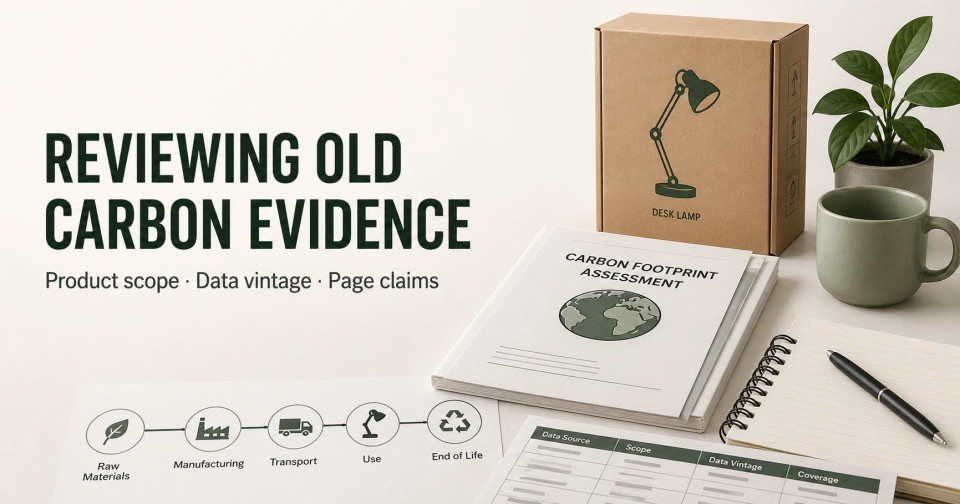
Whether an older carbon-footprint or carbon-neutrality file can support an Amazon Climate Pledge Friendly (CPF) page claim cannot be decided from the certificate date alone. A corporate inventory should not be treated as product evidence for a specific SKU. Based on Amazon’s public description of its third-party certification framework, the FTC Green Guides, EU green-claim rules and public carbon-footprinting standards, this article sets out a review order. Current eligibility, templates and submission requirements must be checked in Seller Central and against the applicable certification scheme. It does not promise a badge, certification, approval or market result.
1. Define the claim object first
State what the evidence is meant to prove: a product carbon footprint for one SKU, a material attribute, a corporate emissions statement or a carbon-credit retirement. Amazon’s public materials describe CPF as a way to highlight products associated with recognised sustainability certifications. A carbon-neutrality certificate therefore does not automatically establish that a particular ASIN qualifies under a current CPF route.
A brand may hold a corporate inventory, factory data, a product footprint, an environmental product declaration and retirement records. These files have different subjects, boundaries and uses. Start with a mapping between the SKU, model or variant, production site, destination market and exact page wording proposed for use.
2. Check four fields in the legacy report
Product scope: Does the report cover one product, a product family, a factory or the company? Does it explain raw materials, manufacturing, transport, use and end-of-life stages for the current SKU? A total-emissions figure cannot support a product conclusion when the boundary is unclear.
Functional unit and data vintage: Record the functional unit, base year or data period, main activity-data sources and estimates. A recent issue date does not make old underlying data current, while an older report is not automatically invalid. Assess representativeness against the current scheme and actual product changes.
Method and allocation: Check the product-footprinting or life-cycle method, system boundary, allocation rule, database or emission-factor versions and uncertainty notes. A corporate Scope 1, 2 or 3 inventory is not the same evidence as a product carbon footprint.
Verification and responsible parties: Record the preparer, independent verification or assurance statement, the relationships between brand, manufacturer and supplier, and whether the file traces to the current model and production batch. Missing information should be marked as an evidence gap, not rewritten as “approved.”
3. Keep carbon footprint, carbon neutrality and offsets separate
A carbon footprint quantifies emissions within a defined boundary. A reduction claim requires a stated baseline and comparison period. An offset is a separate set of project, purchase and retirement records. Purchasing credits does not automatically change a product’s life-cycle emissions or replace evidence about product scope, data quality or allocation.
The FTC Green Guides say carbon-offset claims need competent and reliable scientific evidence and caution against broad, unqualified environmental-benefit claims. If a page says “carbon neutral,” “low carbon” or “climate friendly,” the claim scope, baseline, data, offset arrangement and supporting records should form an understandable evidence chain. Unsupported strength should be removed or replaced with an accurate process description.
EU environmental-claim rules are also tightening restrictions on broad and offset-based environmental wording. Rules for the EU, the US and Amazon should be checked separately; they should not be presented as one universal conclusion.
4. Decide whether to supplement or redo
Do not use a fixed “expires after X months” template as the decision rule. Use these questions instead:
Start with consistency review: The product, model, site, boundary, functional unit and data sources all match; there have been no material changes in materials, process or supply chain; and the method and verification remain suitable for the current scheme. The certification body or platform must still confirm the current template.
Supplement may be needed: A product-family report does not explain SKU differences; a shared line lacks allocation logic; key activity data, factors, supplier evidence or verification scope are missing; or the proposed page wording is stronger than the report conclusion. The proper supplement should be defined by the preparer, verifier or applicable scheme.
A redo is more likely: Product, material, process or site changes are substantial; the old file cannot trace to the current SKU; a corporate total has been reused as a product conclusion; or offset records cannot establish the project, quantity, retirement status and beneficiary relationship. Changing a heading or adding a disclaimer does not cure a missing evidence chain.
5. Set boundaries for CPF page wording
Amazon’s public CPF materials emphasise the connection between third-party certifications and product eligibility. Turning “we have a carbon-footprint report” into “Amazon recognised,” “CPF awarded” or “guaranteed to pass” exceeds what the public evidence supports. Current eligibility depends on Amazon’s current recognised list, product template, certification status and Seller Central submission outcome.
A page can accurately state the product and boundary covered, method, data period, independent verification, separate offset records where relevant and open verification items. Do not combine GRS, FSC, ISO, a corporate inventory or one carbon-credit project into a claim that all environmental requirements are met; each certification and claim has its own scope.
6. Build a SKU evidence register before publication
Use one row per SKU: model and variants, product scope, production site, functional unit, data period, method and version, allocation rule, key data sources, verification statement, offset records where applicable, certification or platform template fields, proposed page sentence and open questions. Reconcile the report numbers, certificate subject and product name shown on the page.
Read the finished copy twice: once for facts and sources, and once for whether a customer could mistake “may be submitted for review” for “already approved.” Where the current file cannot prove a point, write “check against current requirements” rather than adding pass rates, deadlines, penalties or commercial promises.
Sources: Amazon’s public Climate Pledge Friendly programme description and Seller Central guidance; the FTC Green Guides; Directive (EU) 2024/825 on empowering consumers for the green transition; and public ISO 14067 and GHG Protocol Product Standard materials. Policies, certification lists and platform templates can change; check the current official source before use.


