
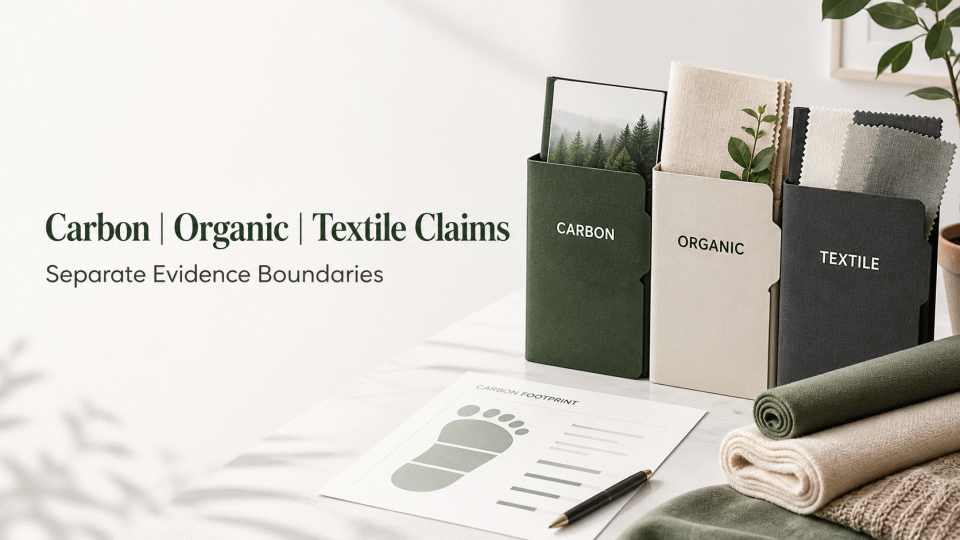
Climate Pledge Friendly (CPF) is an Amazon program that helps shoppers identify products with sustainability features backed by recognised certification or Amazon programme pathways. This reference separates carbon impact, organic content and textile-material claims so sellers can map each claim to the product, certificate scope and page wording. It does not promise CPF display, certification approval or market access.
1. Separate the CPF programme from the underlying claim
CPF is not a universal certificate covering every environmental attribute. Amazon’s public materials connect CPF with product-level sustainability features and certification information. Whether a product displays a label or a particular feature depends on the current programme rules and product records. A single sustainability certificate must not be expanded into a claim that the whole product is environmentally superior or that every related claim is proven.
2. Carbon claims: match the object, method and offset evidence
Product carbon footprints, emissions-reduction comparisons and carbon offsets are different claim objects. A footprint should state the system boundary, functional unit, data period, emission factors, allocation method and accounting standard. A reduction comparison also needs a clear baseline and reproducible quantified result. An offset claim needs records for the project, amount, ownership and prevention of double counting. A certificate or report supports only the product, subject and period within its scope; it does not prove organic content or textile supply-chain attributes.
The FTC Green Guides call for competent and reliable evidence for environmental claims and give specific cautions for carbon-offset quantification, double counting and disclosure. Avoid unqualified wording such as “green,” “zero carbon” or “fully sustainable” when the evidence covers only one carbon attribute.
3. Organic claims: check scope and label grade
For an organic claim, confirm the product category, fibre or input status, certified entity and whether the final product is within the certificate scope. For organic textiles, current GOTS public materials distinguish label grades: at least 95% certified organic fibre supports the “Organic” grade, while at least 70% supports a “Made with organic materials” type grade. The label also has requirements for the certification body, certificate number and use of the GOTS signs.
“Contains organic cotton,” an organic-fibre percentage and “GOTS-certified product” are therefore not interchangeable. OCS and other standards have their own scopes and claim rules. Page wording should be checked against the current standard, product appendix and label authorisation; organic content alone does not prove low carbon, chemical-free processing or overall sustainability.
4. Textile claims: separate material, processing and safety attributes
A textile page may mention recycled material, processing, chemical management and product safety. GRS/RCS recycled-material and chain-of-custody scopes are different from OEKO-TEX STANDARD 100 harmful-substance testing and from other processing or supply-chain standards. Each claim should map to the actual product, material percentage, supply-chain sites and permitted name.
A scope certificate does not automatically cover every SKU, batch, supplier or environmental attribute. For each SKU, keep the composition or BOM, input source, scope certificate, transaction certificate or electronic transaction record, batch and quantity links, applicable process records and proposed page wording.
5. The three evidence groups cannot substitute for one another
Using a carbon-footprint report as proof of organic material, an organic certificate as proof of emissions reduction, or a recycled-material certificate as proof of chemical safety is evidence mismatch. Ask four separate questions: What is the claim object? Which product and version does the evidence cover? Which period and supply-chain steps are covered? Does the page say only what the evidence supports?
6. A pre-publication claim-to-evidence register
For each product, record the proposed claim, standard or certification, certificate holder and scope, product or material percentage, batch or transaction record, accounting or testing method, label authorisation and facts still requiring verification. Before using certification names, marks or CPF-related wording, check Amazon’s current creative guidance, the certifier’s trademark rules and the destination market’s environmental-claim requirements.
Sources: Amazon’s public Climate Pledge Friendly programme and creative guidance, Textile Exchange GRS/RCS and organic-content materials, GOTS standards and labelling conditions, and the U.S. FTC Green Guides. Programme rules, standards and market requirements can change; check the official source for the current version before use.


