
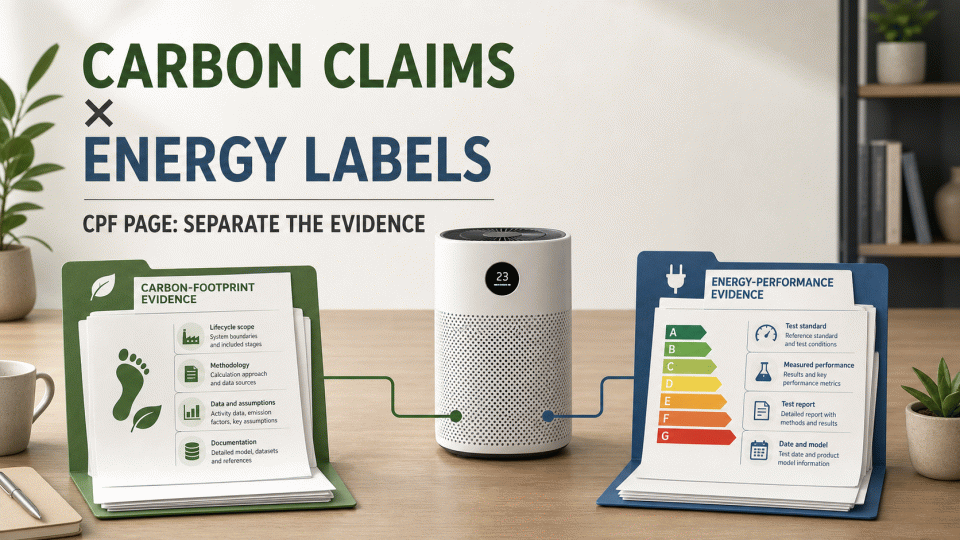
When one product carries both a product-carbon-footprint claim and an energy label, the product identity, programme basis, evidence scope, and page wording should be reviewed as separate records. This is a documentation reference; it does not represent Amazon Climate Pledge Friendly (CPF) inclusion, display, or any certification outcome.
Separate the attributes and their programme basis
Energy performance: ENERGY STAR product programmes set energy-performance requirements for defined categories. EPA explains that products must be third-party certified against the applicable specification. Record the model, category, specification version, and directory record rather than treating the label as an unlimited environmental endorsement.
Product carbon footprint: A product carbon footprint is a lifecycle greenhouse-gas calculation within a stated boundary, commonly expressed in CO₂e. Carbon Trust materials distinguish boundaries such as cradle-to-gate and cradle-to-grave; the claim also depends on the product, method, comparator, and assurance scope.
Build four links for the CPF page
First, identify the product: model, variant, capacity, software or hardware version, and the SKU actually offered. Second, record the basis for each attribute: which programme supports the energy label and which accounting or assurance route supports the carbon claim. Third, confirm that certificates, test records, footprint reports, and assurance documents cover that SKU. Fourth, map each page sentence to the relevant evidence.
Do not turn two separate records into a broad statement such as “fully green” or “certified low-carbon and energy-efficient.” The FTC Green Guides caution that broad environmental-benefit claims are difficult to substantiate and that certifications or seals do not replace support for the express and implied claims made on a page.
A practical review sheet
Energy layer: Record the model, category, applicable ENERGY STAR specification version, third-party certification information, and product-directory status. Do not use a footprint report to substantiate energy performance, and do not extend a model-specific label to unlisted variants.
Carbon layer: Record the system boundary, functional unit, data period, lifecycle stages, emission factors, comparator, and assurance conclusion. If the page says “lower than the market” or “reduced,” the wording must match the documented comparison scope, baseline, and conditions.
Page layer: Split every claim into four columns: product attribute, evidence file, applicable scope, and exact page wording. Claims such as “carbon neutral,” “zero emissions,” or “better for the environment” need their own clear and verifiable basis; they should not be inferred from an energy label.
Sources and limits
ENERGY STAR, Carbon Trust, and CPF have different programme scopes, mark-use rules, and presentation practices. Keep the source page and review date in the evidence file. If the model, specification, footprint boundary, or assurance status changes, review it again instead of applying a universal validity period.
Sources: ENERGY STAR Certification; Carbon Trust Product carbon footprint label; FTC Environmental Claims: Summary of the Green Guides. Check current official programme material on the review date.
Greenark (Shenzhen) Certification Co., Ltd.


