
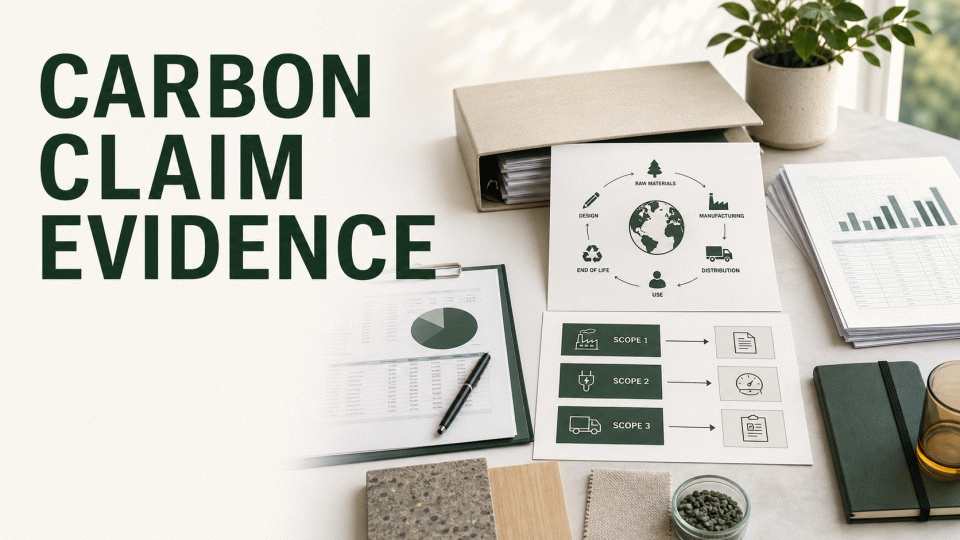
A carbon statement should be reviewed as a claim-to-evidence chain, not as a slogan. Before publication, identify the subject of the claim, the product-life-cycle boundary, the data and method, any offset project, and the exact page where the wording appears. If the evidence is incomplete, use a specific attribute or process statement instead of an outcome claim.
1. Define what the sentence is actually claiming
A product carbon footprint, manufacturing emissions, an organisation's operational inventory, and the purchase or retirement of carbon credits are different subjects. A product claim should identify the product or SKU, functional unit, data period, life-cycle stages and system boundary. An organisation-level inventory does not automatically substantiate a conclusion for every SKU.
If the records cover only factory electricity or packaging, describe that boundary. Do not expand a partial record into a product-wide, brand-wide or order-specific result.
2. Keep a traceable method line for the product footprint
ISO 14067 specifies principles, requirements and guidelines for quantifying and reporting a product carbon footprint consistently with life-cycle assessment. It can support a full or partial study, but the standard name is not a substitute for the study. The GHG Protocol Product Standard addresses life-cycle stages such as raw materials, manufacturing, transport, storage, use and disposal.
A review file should therefore identify:
- the product, SKU or model, functional unit, included stages and exclusions;
- the data period, primary activity data, supplier data and emission factors;
- allocation rules, assumptions, data-quality limits and whether the study is partial;
- the result unit, boundary, version and any review or verification record.
ISO's public description also states that carbon offsetting and communication of product carbon-footprint information are outside ISO 14067 itself. A reference to ISO 14067 should not be presented as proof that a product is carbon neutral.
3. Treat an offset project as a separate evidence set
When a page mentions credits, tree planting, renewable-energy projects or retirements, check the registry or program, project identifier, credit vintage, quantity, retirement status, beneficiary, relevant scope and double-counting controls. An invoice, donation receipt or tree-count certificate does not by itself prove that a specific SKU has offset its full life-cycle emissions.
Even when the project record is genuine, its scope, time period and quantity must be reconciled separately with the product footprint. Without that binding evidence, describe participation in an environmental initiative or an ongoing footprint study; do not convert it into “100% carbon neutral,” “net zero,” or “zero-carbon product.”
4. General green words and images are part of the claim
Directive (EU) 2024/825 treats written, graphic and symbolic representations as relevant to environmental-claim analysis. General terms such as “green,” “eco-friendly,” “sustainable,” or “climate friendly” need a clear and prominent specific attribute on the same medium; colour, trees or checkmarks cannot supply missing substantiation. The Directive also addresses claims that rely on offsetting outside the product's value chain to create the impression that a product has no climate impact or a positive climate impact.
Use an object—boundary—method—period—evidence order when rewriting:
- For a partial product study: state that a specified production stage was measured and point to the boundary and data period; do not call it a full life-cycle result.
- For operational records only: say that 绿色方舟(深圳)认证有限公司 is building an operational emissions record; do not extend it to products or customer orders.
- For a project document only: describe the documented participation and its scope; do not equate participation with product carbon neutrality.
5. A pre-publication claim-to-evidence check
- List every environmental word in the Chinese, English and image versions, and identify whether it refers to the product, organisation, factory, packaging or project.
- For every number, record its unit, period, boundary, source and calculation version. Remove numbers without source records.
- Confirm that “partial footprint” has not become “full life cycle” in English, and that project participation has not become “carbon neutral.”
- Check the title, H1, summary, image text, body and customer-facing reuse for the same scope.
- Store source links, studies, limitations and review notes in the same SKU evidence file, with triggers for updating the material.
6. What to do when an old draft is too broad
First pause unsupported outcome words and unqualified general environmental claims. Then reduce the statement to a specific attribute or process that the evidence supports. Only after that should you close gaps in product data, review records and project documentation. A new certificate or offset receipt cannot retroactively define a product boundary that the old draft never stated.
This article is a general reference based on public standards and regulatory materials. It is not legal advice for a particular market, SKU or dispute. Before publication, check the current requirements of the target market, platform and available primary evidence.


