
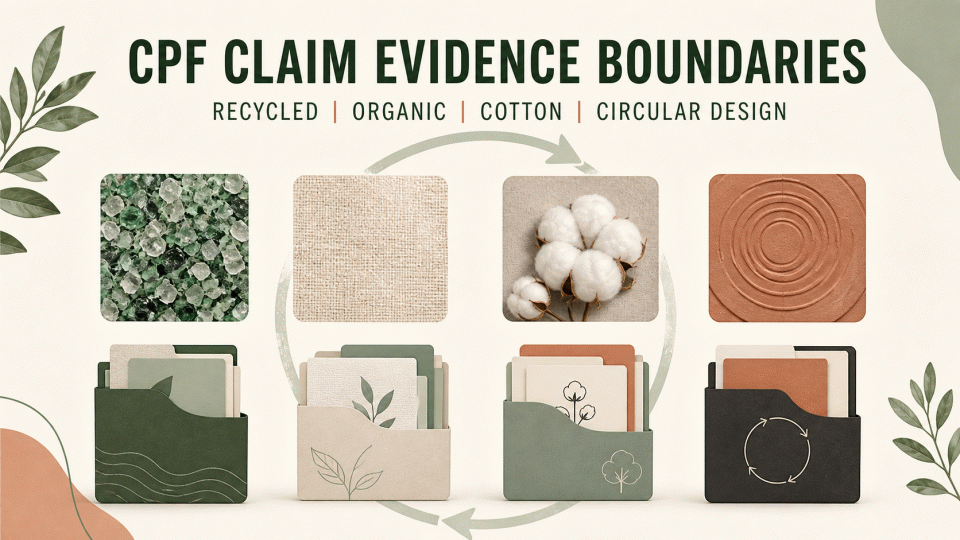
Evidence date: 22 August 2026. This is a reference page for organizing evidence and wording. It is not an Amazon eligibility decision for any ASIN and does not promise certification, a Climate Pledge Friendly label, approval, market access, or any other outcome. The current CPF program rules, product status, and accepted evidence govern how a product is treated.
Start with the claim, then map the evidence
Amazon describes CPF as a program that uses qualifying products and sustainability information from trusted certification programs. The program and its certification landscape are reviewed over time. “Contains a material,” “holds a certificate,” and “will display a CPF feature” are therefore different statements. Identify the product, SKU/ASIN, certificate scope, certifier, status, and proposed wording before making a claim.
1. Recycled-material claims
GRS and RCS both address recycled materials and chain-of-custody controls, but their scopes, content thresholds, processing requirements, and additional criteria must be checked against the applicable standard version and certificate. Textile Exchange currently describes GRS as having a higher minimum recycled-content threshold than RCS and additional social and environmental requirements. Do not carry the old draft’s blanket “GRS 20% / RCS 5%” figures into a customer-facing page.
Check the product and certificate identity, recycled material type and content, covered sites and processes, chain-of-custody documents, transaction evidence where applicable, and whether the wording matches the certificate scope. A recycled-content statement does not automatically prove an organic or circular-design claim.
2. Organic-content claims
For textiles, GOTS label grades must be checked against the product, label rules, and certificate scope. GOTS states that the “organic” label grade requires at least 95% certified organic fibres and “made with organic” requires at least 70%. These percentages should not be detached from the certificate, product composition, processing scope, and applicable labelling rules. OCS, USDA Organic, and COSMOS have their own scopes and evidence requirements.
Check fibre type and percentage, covered entities and facilities, processing scope, certificate status, and the exact proposed wording. “Organic cotton” describes an organic-fibre attribute; it does not by itself prove recycled content, low carbon, circularity, or a general sustainability conclusion.
3. Cotton-related claims
Cotton is a material category, not one certification conclusion. First define whether the page is describing organic cotton, recycled cotton, or another cotton-farm or supply-chain program. Then map the claim to the relevant certification or program evidence. GOTS/OCS organic-content evidence does not by itself prove recycled content, and GRS/RCS recycled-material evidence does not by itself prove organic cultivation.
For programs such as Better Cotton, do not infer CPF acceptance or a specific Amazon feature from the program name alone. Check Amazon’s current recognition scope, the product’s actual eligibility, and the program’s own evidence boundaries.
4. Circular-design claims
Cradle to Cradle Certified is a multi-attribute product certification. Its official standard covers Material Health, Product Circularity, Clean Air & Climate Protection, Water & Soil Stewardship, and Social Fairness. The publicly described achievement levels are Bronze, Silver, Gold, and Platinum, and the product scope, standard version, category results, and overall level must be read from the certificate or registry.
Check the covered product or variants, certification version, overall level, and category levels before writing the page. Do not turn one material attribute into a full circular-design certification, or turn one category level into the overall level.
A four-step evidence map
- Identify the product: SKU/ASIN, variants, material composition, and listing page.
- Identify the evidence: certifier, certificate number, scope, version, status, and transaction or supply-chain records.
- Limit the wording: use only the material, attribute, or certification name directly supported by the evidence.
- Check the program boundary: review the current CPF rules, recognition scope, and the product’s actual status.
Boundary note
A certification standard, an Amazon program, and a product listing are separate layers. Complete files do not guarantee a CPF feature, and one certification does not establish every other environmental attribute. If the certificate scope, product variant, wording, or program rule is unclear, pause the claim and complete the check first.
Source basis
Amazon Climate Pledge Friendly Creative Guidelines; Textile Exchange public GRS/RCS materials; GOTS official label-grade guidance; and the Cradle to Cradle Products Innovation Institute Product Standard and certification-level guidance. Accessed 22 August 2026.


