
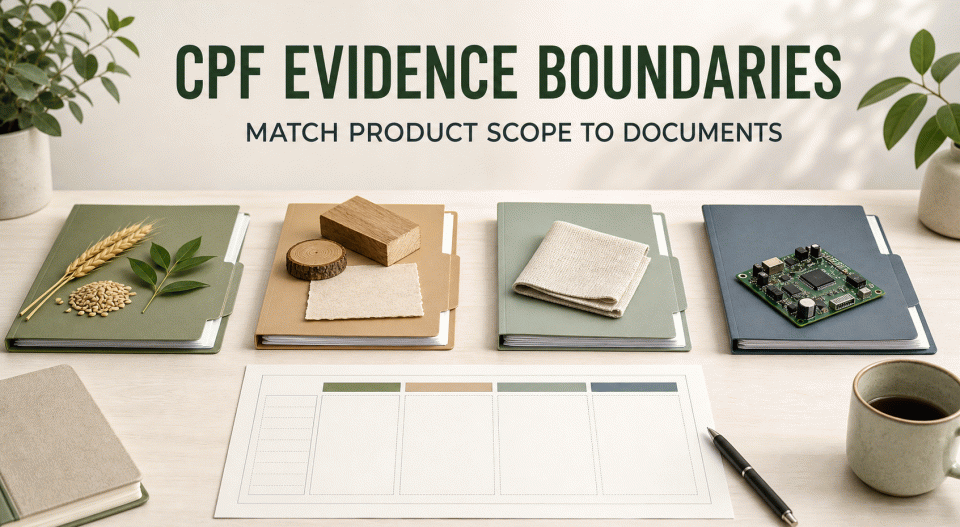
Amazon Climate Pledge Friendly (CPF) is a program that helps identify products associated with qualifying sustainability certifications or programs. Its sustainability features can relate to different attributes, such as carbon impact, organic content, recycled material, safer chemicals or responsible sourcing. Those attributes are supported by different programs and are not interchangeable. Based on Amazon’s public CPF materials and public information from USDA Organic, FSC and ENERGY STAR, this article provides a scope-matching framework. It does not promise certification, CPF display, platform eligibility or sales results.
1. Define what the CPF record is meant to support
Start one record for each SKU: product name, model or variant, materials or formulation, manufacturing entity, destination market, proposed sustainability wording, and the certification or program supporting that wording. Amazon’s sustainability-features label points to certification details; it does not turn a product into a claim of being “fully green,” and it does not replace mandatory safety, labelling, import or other market requirements.
Keep four scopes separate: product scope, certificate-holder or production-entity scope, supply-chain or transaction scope, and page-claim scope. Move to substantive review only when those scopes can be connected to the same SKU or to a clearly identified component.
2. Agriculture and food: check production method and label category
USDA Organic illustrates why scope matters. Certification may cover specific agricultural production, handling or processing activities, while USDA labeling rules distinguish categories such as “100 percent organic,” “organic” and “made with organic ingredients.” The certificate, formulation or ingredient record and finished-product label must align. An organic certificate for one ingredient does not automatically support calling the finished product USDA organic. Textiles also require separate review of the applicable organic-fiber or textile standard.
Keep the certified product or crop scope, production or handling entity, certifier, certificate status, market, formulation or batch records and proposed label wording together. Evidence supports only the products and claims within its stated scope; it should not be extended to every supplier, batch or category.
3. Forestry and paper: separate material claims from chain of custody
FSC chain of custody tracks forest-based material from source through production and distribution. FSC’s public information explains that finished-product labels and trademarks depend on the relevant certification or licensing arrangements; product categories, material claims and supply-chain roles must be checked against the certificate and trademark rules. FSC, PEFC and other forestry systems cannot be treated as interchangeable simply because they all concern wood or paper.
For paper, packaging or wood products, keep purchasing records, supplier certificates, the CoC scope, finished-product category, label version, trademark permission and transaction records in the same SKU file. If the certificate covers packaging but not the item inside it, the page should describe only the packaging or the identified material.
4. Textiles: separate recycled, organic, chemical and animal-fibre attributes
GRS/RCS, GOTS/OCS, OEKO-TEX, RWS and similar systems address different questions. Some concern recycled content and chain of custody; some concern organic fibres and processing; some concern harmful substances or production conditions; and some concern wool sourcing and animal welfare. Their presence in CPF materials does not make them substitutes for one another.
Check the raw material, processing sites, finished model or batch, certificate scope, transaction certificates where applicable, quantities and proposed page wording. Only the fibres, facilities and finished products expressly covered by the documents should support the corresponding claim. “Contains certified material” is not the same as “the entire product holds every related certification.”
5. Electronics: verify model and program attributes
Electronics also require different evidence boundaries. ENERGY STAR’s public materials state that brand owners must certify product models before associating the label with them or marketing them as ENERGY STAR, and certified models appear in the product lists. EPEAT, carbon-footprint programs and environmental product declarations may use different product, company or life-cycle scopes. Confirm the program category, model, version and database record before drafting the page.
Connect electronics evidence to the model, hardware and software version, test or assessment material, certification body or program database, manufacturer or brand entity and listing. A supplier-level document does not automatically prove the performance of another brand’s SKU; a revised model should not inherit old wording without review.
6. Pre-publication checks for CPF pages and customer files
Titles and summaries should describe CPF evidence classification and scope matching. Avoid presenting this as a universal catalogue or suggesting that one certificate resolves every market. Use only sourced program names, product attributes and document types. Do not show invented certificate numbers, official-agency marks, pass rates, penalty amounts, detention or recall outcomes, or fixed processing times.
Before publication, manually check whether the certificate is current and covers the relevant entity; whether the model, formulation, material or batch matches; whether the certification scope matches the page claim; whether the CPF program currently recognises the route; and whether a voluntary sustainability program has been misdescribed as mandatory law. GreenArk (Shenzhen) Certification Co., Ltd. may support document organisation and review, but it does not replace a certifier, Amazon or a regulator’s decision.
Sources: Amazon Climate Pledge Friendly Creative Guidelines and Sustainability Features materials; USDA Agricultural Marketing Service materials on Organic Certification and Labeling; FSC Chain of Custody materials; and ENERGY STAR certification and product-list materials. Programs, lists and product configurations can change, so recheck the current official pages and specific files before use.


