
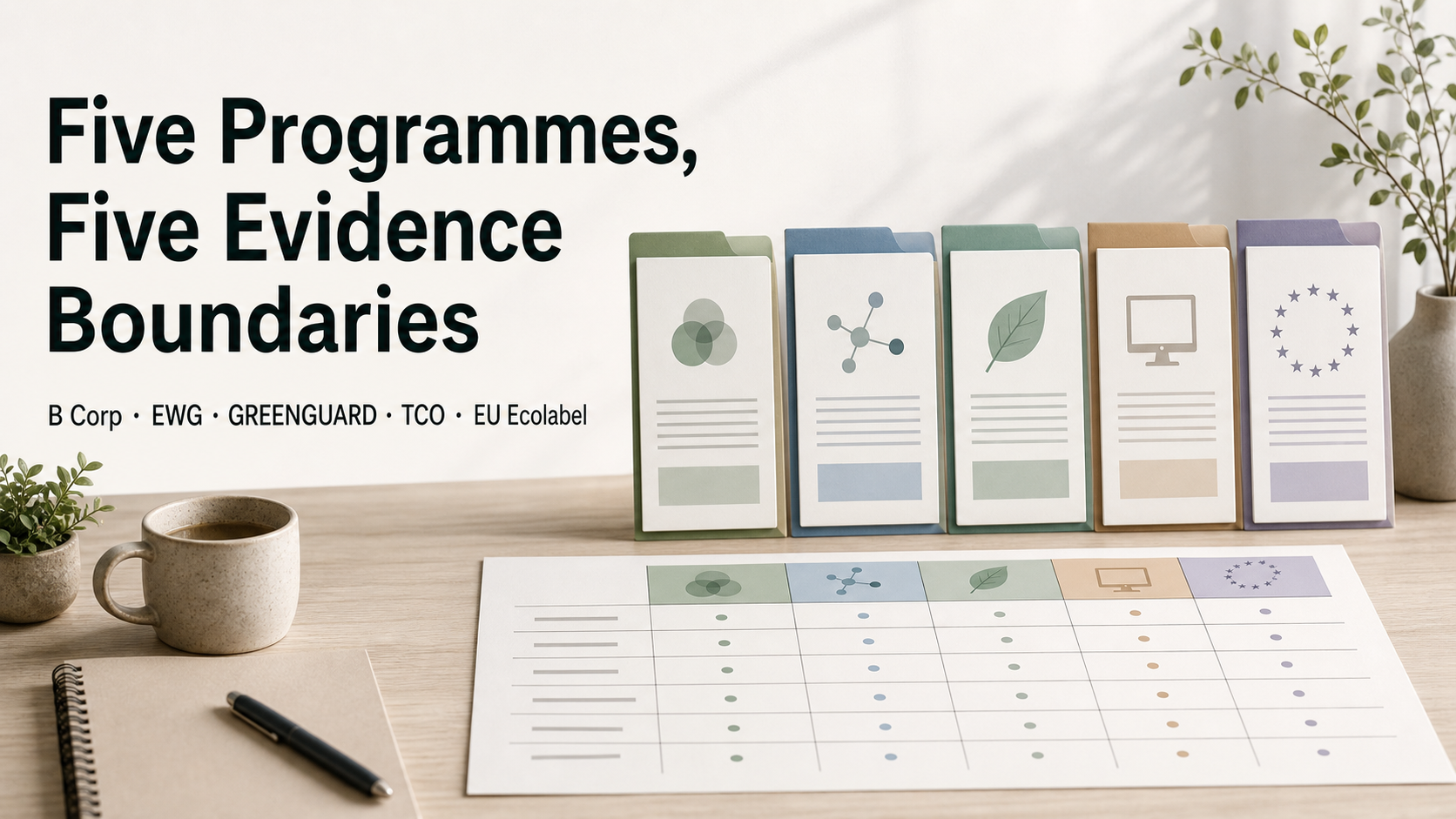
B Corp, EWG Verified, UL GREENGUARD, TCO Certified and the EU Ecolabel do not assess the same thing. Some concern an organisation, while others concern a formulation or product, indoor-air emissions, electronics sustainability, or a defined product group. Build the evidence record around scope before drafting a product-page claim.
1. Separate the subject of each programme
B Corp: an organisation-level framework covering social, environmental and governance practices. B Lab describes a process that starts with self-assessment and includes independent third-party verification. An organisation record is therefore not a substitute for SKU-level testing or a product label licence.
EWG Verified: category-specific product review. Eligible categories include personal care, cleaners, pet grooming, diapers and mattresses. The evidence may involve ingredient disclosure, restricted or unacceptable ingredients and category-specific requirements. A formula or ingredient change can affect the review scope.
UL GREENGUARD: a product-emissions and indoor-air-quality programme. UL Solutions explains that GREENGUARD Gold uses lower VOC emission limits and specific test methods. It addresses emissions performance; it is not a universal substitute for every safety, building or environmental rule in a market.
TCO Certified: a sustainability framework for electronics and related equipment. The applicable criteria depend on the product category, model and current standard. A TCO record does not replace electrical safety, radio, EMC or chemical documentation that may apply to the same product.
EU Ecolabel: a voluntary EU environmental label with criteria set by product group. The European Commission lists groups such as cleaning products, clothing and textiles, electronic equipment, furniture and mattresses, and paper. Confirm that the product belongs to a current group and use the relevant criteria and competent-body process.
2. Build a programme–subject–evidence–claim register
Use one row for one programme, one entity or product scope, and one proposed claim. Record the programme and version, certifier or competent body, certificate/licence/product-record reference, holder, model or formulation, product group, document date, market, source link and proposed wording.
For B Corp, check the legal entity and certification scope. For EWG, GREENGUARD, TCO and the EU Ecolabel, check whether the product, model, formulation or product group is actually covered. A supplier document supports only the entity and scope named in that document; it does not automatically prove the brand owner’s or seller’s SKU.
If the record will support a CPF page, keep the certifier’s evidence separate from Amazon’s programme eligibility. Amazon describes CPF as a product-discovery framework based on recognised third-party certifications and Amazon-developed programmes. Do not describe CPF as a government approval, a universal certificate or an automatic result for every product.
3. Keep the page claim within the evidence
Safer wording: “The named organisation/product has a record within the stated scope”; “the programme addresses organisation impact, ingredient transparency, indoor-air emissions, electronics sustainability or a defined product group”; “this statement covers only the entity, product and market identified in the record.”
Avoid: “the five certifications are interchangeable,” “one report covers every market,” “the platform must accept it,” or “the product cannot be delisted or detained.” These statements merge different subjects, standards and conditions and go beyond the evidence.
Do not confuse a voluntary programme, platform eligibility or environmental label with mandatory law. Product safety, chemical, labelling, import and other market obligations still depend on the product, intended use, destination and applicable rules.
4. Six checks before a claim goes live
Check: (1) programme name and version; (2) holder and legal entity; (3) product, model, formulation or product group; (4) verification through the certifier or competent-body source; (5) wording that stays within the documented scope; and (6) any separate CPF eligibility record for the current marketplace and product.
Re-review after a formulation, model, factory, material, brand entity, label or market changes. Without a new verification result, “pending confirmation” or “for evidence organisation only” is safer than adding a definite outcome.
Sources for further checking
B Lab standards and certification: B Lab; EWG Verified categories and review: EWG; GREENGUARD scope: UL Solutions; EU Ecolabel product groups: European Commission; CPF framework: Amazon Ads. Check current TCO Certified criteria and product records on TCO Development’s official site.
Prepared by 绿色方舟(深圳)认证有限公司 as an evidence-organisation reference. It does not guarantee a product, company or market outcome.


