
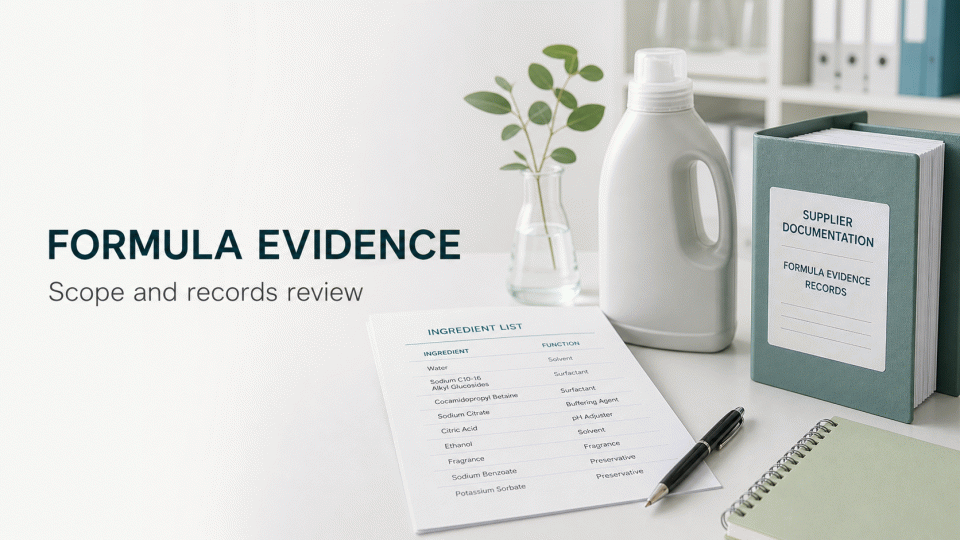
This reference is based on the U.S. Environmental Protection Agency (EPA) Safer Choice Standard, ingredient criteria, product search page, and label guidance. Safer Choice is a voluntary EPA program. A product carrying the Safer Choice label must meet the applicable ingredient, product-class, performance, packaging, and other program requirements. It is not a claim that one individual ingredient is certified, and it does not automatically cover another formula, fragrance, size, or brand.
1. Separate the standard, the ingredient list, and the product record
The Safer Choice Standard sets requirements for products and ingredients. SCIL lists chemicals evaluated by EPA and organized by functional use class. EPA’s product search page identifies products that meet the Safer Choice Standard. These resources support different decisions and cannot replace one another. An SCIL entry can help a formulation team identify a candidate ingredient; it does not by itself support a statement that the finished product carries the Safer Choice label or that EPA certified the ingredient for every use.
2. The formula evidence must cover the complete formulation and use scope
| Evidence area | What to compare | What it does not prove |
|---|---|---|
| Complete formula | Ingredient names, functional classes, impurity or purity information, and the formula version tied to the product record. | One surfactant or solvent appearing in SCIL does not make the whole product labeled. |
| Product scope | Product name, company or partner, use category, fragrance or size, and the EPA product record. | Another fragrance, concentration, size, or SKU cannot be included automatically. |
| Product-level requirements | Applicable performance, packaging, pH, VOC, and product-class requirements in addition to ingredient review. | An ingredient list match does not prove that the finished product passed the full Safer Choice review. |
3. Keep product-page and CPF wording within the evidence
If the specific product is actually listed in EPA’s product records, a page may accurately describe the relationship between that product and the Safer Choice label, while retaining the product name, company information, and record used for the check. If the evidence only shows an SCIL ingredient, use wording such as “formulation reference” or “ingredient information for further review”; do not turn it into an EPA, Safer Choice, or CPF certification claim. For a CPF submission, keep platform requirements separate from the EPA program: a platform intake decision or page badge is not a new EPA review of a product that is absent from the relevant record.
Do not overstate the label: Safer Choice describes the program’s requirements for safer chemical ingredients, product performance, and related criteria. It does not mean “non-toxic,” edible, harmless to every user, disinfecting, antiviral, or medical. Actual wording should be limited to the specific product record, label guidance, and evidence that has been checked.
4. Build a record-level evidence index before submission
For each product, keep one traceable index containing: (1) the current complete formulation and version date; (2) each ingredient name, functional class, and supplier material; (3) the applicable Safer Choice Standard and product-class criteria; (4) the EPA product record or program correspondence used; (5) packaging, performance, and label-use materials; and (6) the exact Safer Choice and CPF wording used in the listing. If the formula, packaging, product name, or responsible company changes, re-check the scope before relying on the earlier record.
5. Official sources
EPA Safer Choice Standard and Criteria: https://www.epa.gov/saferchoice/standard
Safer Chemical Ingredients List: https://www.epa.gov/saferchoice/safer-ingredients
Search Products that Meet the Safer Choice Standard: https://www.epa.gov/saferchoice/products
Learn About the Safer Choice Label: https://www.epa.gov/saferchoice/learn-about-safer-choice-label


