CPF preparation should start with the product’s main material, supply chain, existing records, and intended page claims—not with a search for the “easiest” certificate. Similar scheme names do not mean identical scopes. Eligibility, documents, and product-page requirements must still be checked against Amazon’s current programme information.
This is an evidence-planning reference. It does not promise CPF eligibility, approval, traffic, or timing. Greenark Certification (Shenzhen) Co., Ltd. recommends building one evidence matrix for each ASIN before selecting a scheme. The current documents of the standard owner and certification body govern scope, versions, labels, and transaction evidence.
1. Define the product before selecting a scheme
Record the ASIN, SKU, intended use, main materials and composition, the distinction between the product and its packaging, actual production sites, suppliers, and relevant batches. For mixed-material products, retain the BOM, weight or content basis, procurement records, production records, and batch identifiers. If a claim applies only to packaging, keep packaging evidence separate from product-body evidence.
Also write down the intended page claim: material origin, recycled or organic content, forest-based sourcing, processing, chemical management, energy efficiency, or another attribute. The wording must stay within the combined support of the certificate, transaction records, and product facts.
2. Match the evidence route to the product attribute
| Product fact | Routes to investigate | First checks |
|---|---|---|
| Forest-based paper, board, or wood | FSC chain-of-custody and other forest-material routes | Product groups, supplier certificates, material identification and flow records, and sales-document claims. Forest certification does not automatically cover other materials in the product. |
| Recycled material | Textile Exchange RCS or GRS and other material-specific routes | Recycled-material definition, content, certified stages, scope certificate, transaction certificate, and claims rules. GRS adds social, environmental, and chemical requirements; RCS and GRS should not be treated as interchangeable. |
| Organic fiber or organic content | OCS and, for relevant textile processing, whether GOTS applies | Organic source, content, processing stages, scope, and labeling rules. OCS focuses on organic material and chain of custody; it is not automatically a full textile-processing scheme. |
| Alternative feedstock, bio-based, or circular material | ISCC PLUS and other relevant routes | Feedstock characteristic, certified supply chain, physical segregation/controlled blending/mass balance, and input-output attribution records. |
| Energy-efficiency or electronic-product attributes | ENERGY STAR, EPEAT, or another category-specific programme | Model, market, registration or assessment scope, and current programme rules. A material certificate cannot replace an energy-efficiency or electronics programme record. |
| Cleaners, chemicals, or personal-care attributes | EPA Safer Choice, USDA Biobased, EWG Verified, COSMOS, or another relevant route | Formula, ingredients, product category, market, and programme rules. Cruelty-free or animal-welfare claims are separate evidence types and do not replace formula or material evidence. |
These are examples of investigation directions, not a complete list of CPF-eligible certifications and not a fixed primary/secondary/prohibited table. Whether a route can support a particular ASIN depends on the standard scope, certificate scope, product category, current Amazon programme requirements, and the submitted records.
3. Existing documents prove only the segment they cover
- Scope certificate: check the holder, sites, product or material scope, status, and version. A supplier certificate is not automatically a brand certificate or a certificate for every SKU.
- Transaction and chain-of-custody records: connect supplier, product description, quantity, batch or period with procurement, production, and shipment records. Mark gaps for follow-up instead of filling them by assumption.
- BOM and product records: retain material, ratio, model, packaging, process, and change-control records. A test report or supplier statement is supplementary evidence; it cannot expand the standard’s scope.
- Pages and labels: map each proposed content, certification name, trademark, and environmental statement to a verifiable source. Do not use certification marks without authorization or turn a packaging attribute into a product-body claim.
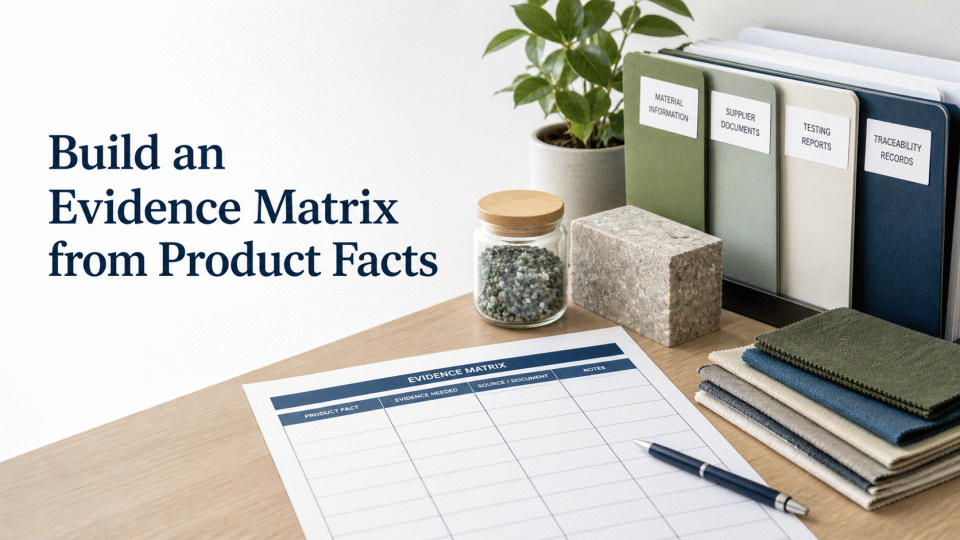
At minimum, the matrix should contain: product fact, proposed claim, required document, source, covered SKU or batch, gap, and open question. Its purpose is to expose inconsistencies, not to replace the certification body or Amazon review.
4. Use four questions to screen a route
- Does the claim concern the product body, the packaging, or a supply-chain process?
- Does the standard and certificate scope cover the current category, material, site, and production stage?
- Can the existing records connect the same SKU or batch from input to finished product and page?
- Are label, trademark, and page-wording permissions documented without expanding the claim into a category-wide statement or an outcome promise?
If any answer is unclear, verify it with the standard owner, certification body, or Amazon’s current programme support channel. Do not choose only because a provider says it is faster, cheaper, or likely to pass, and do not sign an agreement that guarantees an Amazon review outcome.
5. Minimum pre-submission checklist
- ASIN, SKU, model, materials, packaging, and production sites are identified.
- Scope certificates, transaction or chain-of-custody records, BOM, production records, and page drafts point to the same product.
- Chinese and English pages use only supported scope language; no unsupported percentages, costs, timelines, penalties, rankings, traffic, or pass-rate claims have been added.
- Certification names, versions, labels, and trademarks have been checked against current owner rules.
- CPF eligibility and submission fields have been checked against Amazon’s current seller-side or official support information, with the submitted document versions retained.
Sources and boundaries
This article was prepared from FSC chain-of-custody material, Textile Exchange descriptions and claims resources for RCS, GRS, and OCS, ISCC PLUS system information, and other publicly available programme material. Standards change; re-read the original documents before submission. This article is not a certification decision, legal opinion, or Amazon approval promise.
Greenark Certification (Shenzhen) Co., Ltd. can help organize product facts, evidence matrices, and page wording. The relevant standard system and independent certification body make certification decisions, while Amazon handles CPF programme eligibility and review under its current rules.