
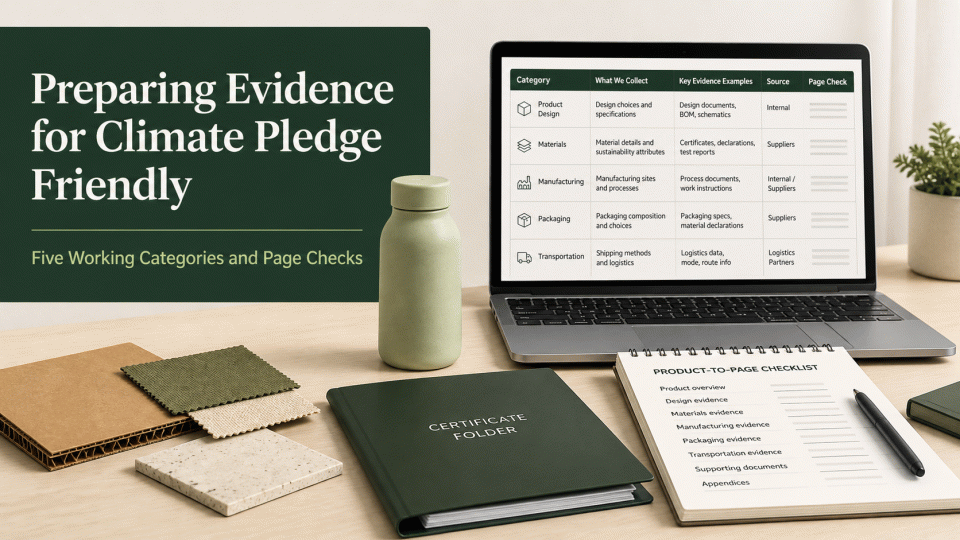
Climate Pledge Friendly (CPF) is an Amazon program that helps customers identify products with sustainability attributes. Amazon’s public materials describe partnerships with many third-party certifications and Amazon-developed programs such as Compact by Design and Pre-owned Certified. This article uses five practical working categories for organising a seller’s evidence pack. They are not an official Amazon “five-lane” review taxonomy and do not promise certification, a badge, platform eligibility or sales results.
1. Start with the covered object
Define three objects before drafting a claim: the exact product or ASIN, the material or production step supporting the attribute, and the wording that will appear on the page. A finished product, a packaging component, a supplier facility and an organisation-wide management system are different objects. Certificates, transaction records and test reports should identify the relevant product scope, certificate holder, model or batch. A supplier certificate does not automatically cover every product, SKU or batch sold by a brand.
Amazon’s CPF advertising guidance says claims should be supported by appropriate substantiation and that the CPF label qualifies a particular product. Keep the certificate, scope material, batch or transaction records, final artwork and listing copy together. Before submitting, re-check the current Seller Central CPF instructions and entry point.
2. Five working evidence categories
| Category | What to reconcile | Boundary to keep |
|---|---|---|
| 1. Third-party certification | Certification name, issuer, status, holder, product or facility scope and sustainability attribute. | A management-system certificate is not automatically a product certificate; a raw-material certificate does not automatically cover the finished product. |
| 2. Material and content | BOM, component weights, batch records, transaction certificates or supply-chain records for recycled, organic or other content claims. | Do not combine unsupported supplier estimates, different batches or distinct content concepts. |
| 3. Carbon and environmental attributes | Methodology, boundary, data source, accounting period and the product covered by the report. | One carbon number does not by itself prove carbon neutrality or an environmental claim about the whole product. |
| 4. Amazon-developed programs | Program name, eligible product, application or review record and current program requirements. | Compact by Design and Pre-owned Certified are not interchangeable with third-party certifications. |
| 5. Product-to-page mapping | Whether the ASIN, title, bullets, detail page, images and submission file use the same product scope and claim. | Do not use the CPF leaf mark or a certification logo for an ineligible product or as generic brand advertising. |
3. Third-party certifications: verify scope, not just a logo
Amazon describes CPF as working with recognised third-party certifications. For a preparation file, verify the certification status, holder, product category, facility or supply-chain scope, version and other current details against the issuer’s documents or database. If a brand relies on a supplier’s certification, retain the records that connect the supplier, the brand, the ASIN or product scope and the permitted claim.
FSC, GOTS, GRS, RCS, OCS, ISCC PLUS, EPA Safer Choice and USDA Organic have different objects and evidence rules. ISO 14001, for example, should not be presented as a product certification. FSC forestry or chain-of-custody evidence should not be rewritten as a recycled-content claim. Whether a particular certification is currently recognised by CPF, and how it is submitted, should be checked in the current Amazon and scheme materials.
4. Material, content and carbon claims: return every number to its record
A recycled, organic or bio-based content claim should trace to the BOM, material batch, weight or calculation, transaction certificate, test report and the applicable scheme rules. Do not round a percentage upward to make the listing sound stronger. PCR, PIR, organic fibre and bio-based content should not be merged without a defined basis and supporting records. If the evidence covers one batch or component, keep the page claim within that same scope.
A carbon-footprint or carbon-neutral claim is a separate evidence chain. Record the method, system boundary, activity data, accounting period, allocation approach and review information. For stronger wording such as “carbon neutral,” separately check the basis for reductions or offsets, registry information and the beneficiary or claim owner. A marketing number, an internal consultancy code or a generic green certificate is not a substitute for the underlying accounting evidence.
5. Amazon-developed programs and submission records
Amazon’s public materials identify Compact by Design and Pre-owned Certified as Amazon-developed programs. They have their own product scope and requirements and should not be presented as a universal third-party certification. If a product follows one of these programs, keep the current program instructions, product data, application or review record, and the final page wording and artwork. Do not add a program name, mark or “certified” wording before the relevant qualification exists.
The submission record is part of the evidence chain: retain the entry point, submission date, ASIN list, file versions, Amazon response and later corrections. A submission, automatic display or temporary page state should not be expanded into a permanent eligibility or sales claim.
6. Manual pre-submission review
□ Each environmental claim maps to an exact product, component, batch or supply-chain entity; □ certificates, scope documents and transaction or test records explain one another; □ third-party certifications, Amazon programs and management systems are not conflated; □ material percentages, carbon data and dates are not rounded or combined across batches; □ titles, bullets, detail pages, images and submission files use consistent, restrained wording; □ no unverified CPF mark, certification seal, certificate number, pass rate, fixed timeline, penalty, delisting or sales-lift promise appears; □ final versions and source links are retained and the current Seller Central requirements are checked before submission.
GreenArk (Shenzhen) Certification Co., Ltd. may support claim-to-evidence mapping and gap identification, but it does not replace Amazon, a certification body or a regulator’s decision. Program pages, certification lists and platform entry points can change; re-check the relevant official materials and current Seller Central information before use.
Sources: Amazon Climate Pledge Friendly Creative Guidelines, Amazon Business sustainability materials and Amazon Buy with Prime Sustainability Features eligibility guidance. This is an evidence-organisation framework, not a certification, platform or sales outcome promise.


