
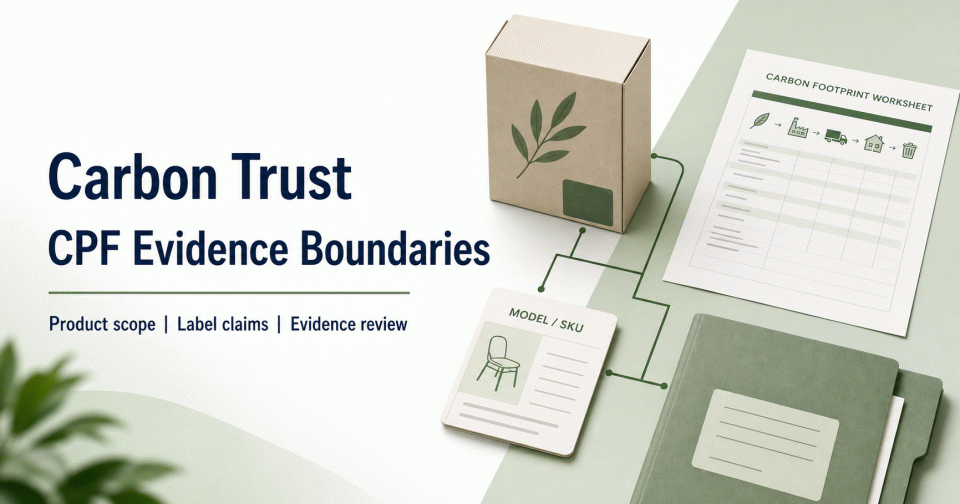
Carbon Trust product carbon-footprint labels communicate information about a defined product or packaging footprint and related reduction claims. Amazon Climate Pledge Friendly (CPF) relies on the relationship between recognised third-party certifications or programmes and a specific product. Because both topics concern sustainability, they should not be presented as automatic mutual recognition or a guaranteed platform outcome. This reference sets out a product, claim, boundary and record review order without promising certification, CPF display, approval or sales results.
1. Define the label and claim object
Carbon Trust’s current product-label portfolio includes different claim types, such as reductions achieved, reductions planned, reductions with climate-project funding, alignment with a Net Zero pathway, packaging scope, comparative claims and B2B CO₂e footprint claims. The exact label name, scope and assurance requirements must be checked against the current Carbon Trust pages and documents. Do not treat an older Carbon Neutral Label as a universal route for a new application: Carbon Trust says it has not offered new carbon-neutral verification since September 2023, although legacy labels may remain in the market within their verification period.
Separate four objects: the product or packaging, the brand or manufacturing entity, the footprint boundary, and the exact page sentence proposed for use. A corporate inventory, a factory dataset, a product footprint for one SKU and offset records are not interchangeable evidence. Move to CPF review only when entity, model, boundary and wording can be reconciled.
2. Match the product-footprint boundary to the claim
Carbon Trust explains product footprints using boundaries such as cradle-to-gate and cradle-to-grave. Consumer-facing product labels generally need the applicable life-cycle boundary to be clear under the relevant assurance requirements. Record the functional unit, model or variant, materials and production sites, data period, system boundary, allocation rule, emission-factor or database version, preparer and independent assurance information.
If the evidence covers packaging only, the page should describe packaging only. If a report covers a product family, show how the current SKU relates to that family scope. Do not turn a corporate total, a single supplier dataset or another model’s report into the current product’s full footprint by changing the heading.
3. Keep reductions, comparisons, offsets, and neutrality separate
“Emissions reductions achieved” should be connected to the earlier footprint, reduction evidence and an ongoing reduction plan. A planned-reduction claim is not the same as reductions already achieved. “Lower than the brand family” and “lower than the market standard” are comparative claims that require the comparator and method boundary. A packaging claim remains a packaging claim. These categories should not be collapsed into “zero-carbon” or “fully sustainable.”
Legacy carbon-neutral verification also involved a verified footprint, a reduction plan and offset records, but that does not make it the current Carbon Trust label portfolio or mean that purchasing credits changes a product’s life-cycle emissions. Keep project, quantity, retirement, beneficiary and claim-scope records separately, and check the target market’s current rules.
4. CPF review is a product-level eligibility chain
Amazon’s public CPF materials describe the programme as helping customers discover products with sustainability features backed by third-party certifications or programmes. Amazon’s public creative guidance also states that the CPF mark applies to a single product rather than a brand as a whole. A Carbon Trust label therefore does not by itself establish a CPF outcome. Confirm whether the label or claim is within the current CPF route, whether the product model matches, and what the current Seller Central or certifier submission process requires.
Use one record per SKU: ASIN or model, brand and manufacturing entity, Carbon Trust label or certificate reference, claim type, product or packaging scope, functional unit, data period, report version, assurance evidence, proposed page sentence, current CPF route and open questions. A supplier’s document does not automatically cover every SKU of the brand; brand authorisation and label-use rules need their own check.
5. Six manual checks before publishing
- Entity: do the certificate, report, brand, manufacturer and page identify the same relevant parties?
- Model: does the evidence cover the current model, variant, batch, product family or packaging version?
- Boundary: are cradle-to-gate, cradle-to-grave, packaging and B2B footprint limits stated accurately?
- Claim: are reduction, comparison, climate-project, Net Zero and legacy-neutrality statements kept separate?
- Version: are the current Carbon Trust assurance requirements, CPF recognition list and submission template being used?
- Wording: does the page avoid turning “can be submitted for review” into “approved,” or a voluntary programme into mandatory law?
Sources and scope note
This reference is based on Carbon Trust’s Product carbon footprint label and Carbon neutral verification pages, together with Amazon’s Climate Pledge Friendly Creative Guidelines and public Sustainability Features materials. Label claims, recognised routes, platform templates and market rules can change; recheck the current official page and the specific file before use. Greenark (Shenzhen) Certification Co., Ltd. may support document organisation and review, but it does not replace Carbon Trust, Amazon, a certifier or a regulator’s decision.


