
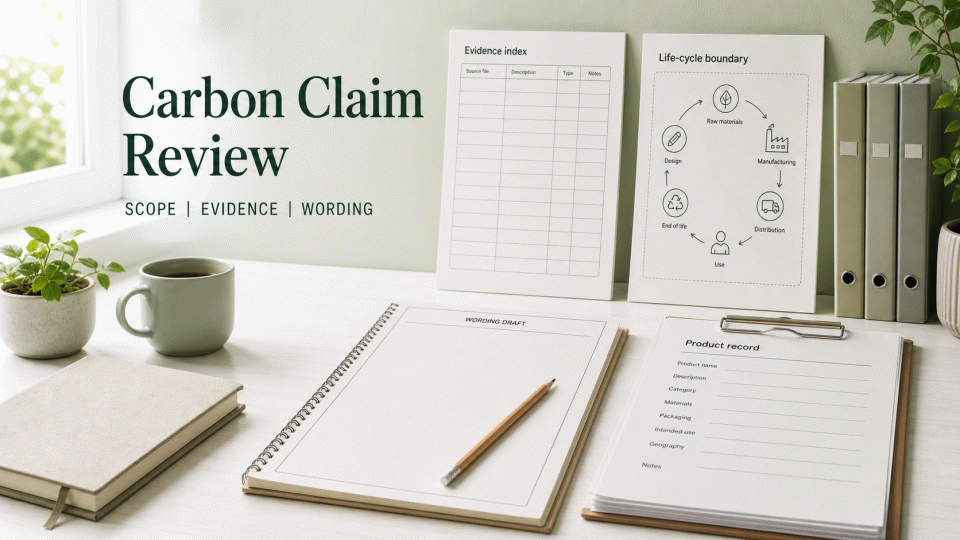
Carbon-neutral, carbon-footprint and climate-related wording should not rest on a certificate or a slogan alone. Before publication, reconcile the product, accounting boundary, data sources, any offset information and the exact page wording in one evidence index. This is a review framework; it does not promise certification, platform placement, an audit outcome or sales results.
1. Separate three commonly confused subjects
Product carbon footprint: this concerns greenhouse-gas emissions and removals within an agreed product-system boundary, expressed as carbon-dioxide equivalents. ISO 14067:2018 provides principles, requirements and guidance for quantifying and reporting a product carbon footprint, including a full or partial footprint. It addresses the climate-change impact category only; it is not a conclusion that a product is environmentally friendly or sustainable in every respect.
Organisational emissions: an organisation’s operational and value-chain boundary is not the same as the boundary of an individual SKU. An organisational statement does not automatically support an equivalent claim about every product.
Offsets or environmental projects: an offset record concerns reductions, avoided emissions or removals outside the product system under study. It must not be merged with the product’s life-cycle impact. The page should identify the subject, boundary, period and supporting record separately.
2. Turn each claim into reviewable fields
Create one record for each proposed environmental statement: product name, SKU or model, functional unit, market, page location, exact wording, data period, life-cycle boundary, emission factors and sources, calculation method, assurance or review document, offset information if any, version date and owner. Leave unsupported fields open; do not fill them with assumptions.
Reconcile the subject of every file. Does supplier or organisation data actually cover the product? Is a partial life-cycle result or a subset of SKUs being presented as the whole product, range or business? Do the product name, model, boundary and period agree across the report, statement and artwork?
3. EU green-claim boundaries: separate adopted rules from application timing
Directive (EU) 2024/825 has been adopted and requires Member State implementation of amendments addressing misleading green marketing. It targets, among other practices, generic environmental claims without relevant recognised excellent environmental performance, claims that expand a limited feature to the entire product or business, and claims based on greenhouse-gas offsetting that a product has a neutral, reduced or positive environmental impact. Use the Directive as legal background and state the implementation and application position for the relevant market; do not present a proposal as a uniform rule already enforced everywhere.
The Directive also addresses claims about future environmental performance. Such wording requires clear, objective, publicly available and verifiable commitments and targets, supported by a detailed and realistic implementation plan and resources. An internal ambition must not be written as an achieved product outcome. Unsubstantiated absolute or generic wording such as “zero carbon”, “climate friendly” or “carbon neutral” should remain out of the page until the subject and evidence boundary have been reviewed.
4. Rewrite the page without inventing a conclusion
| Risk | Review response |
|---|---|
| Treating an offset project as proof that the product has no climate impact | Record the product footprint, offset project, periods and boundaries separately |
| Extending organisation data to every SKU or the whole business | Limit the wording to the documented product, functional unit and organisational boundary |
| Using “environmentally friendly” or “sustainable” as a synonym for a footprint | Describe only the measured climate-impact subject and do not infer other impacts |
| Presenting assurance, certification or platform eligibility as an achieved result | Check the document, entity, scope and current status; do not state an outcome without the record |
5. Manual review before publication
Read the title, bullets, A+ content, detail page, packaging and artwork line by line, and retain before-and-after versions. Confirm that the claim subject and SKU are clear; the functional unit and boundary are stated; data sources, period and method are traceable; the document holder is connected to the product or organisation; offset information has not replaced life-cycle information; artwork and layout do not imply certification, approval or zero impact; and the English page has been localised rather than mechanically expanded from Chinese.
For a platform such as Amazon Climate Pledge Friendly, separately verify the current programme page, product category, submitting entity and requested records. Platform eligibility and legal substantiation are different layers; a product footprint report does not by itself establish platform placement.
GreenArk (Shenzhen) Certification Co., Ltd. may support claim-to-evidence mapping, gap identification and version control, but it does not replace a scheme owner, independent assurance provider, platform or regulator. Recheck the current law, standard edition and specific documents for the target market before use.
Sources: Directive (EU) 2024/825 as published on EUR-Lex; ISO 14067:2018 official standard information. This page distinguishes the adopted EU Directive, Member State implementation, platform programme rules and internal review practice; it does not turn a proposal, initiative or inference into a uniform mandatory conclusion.


