
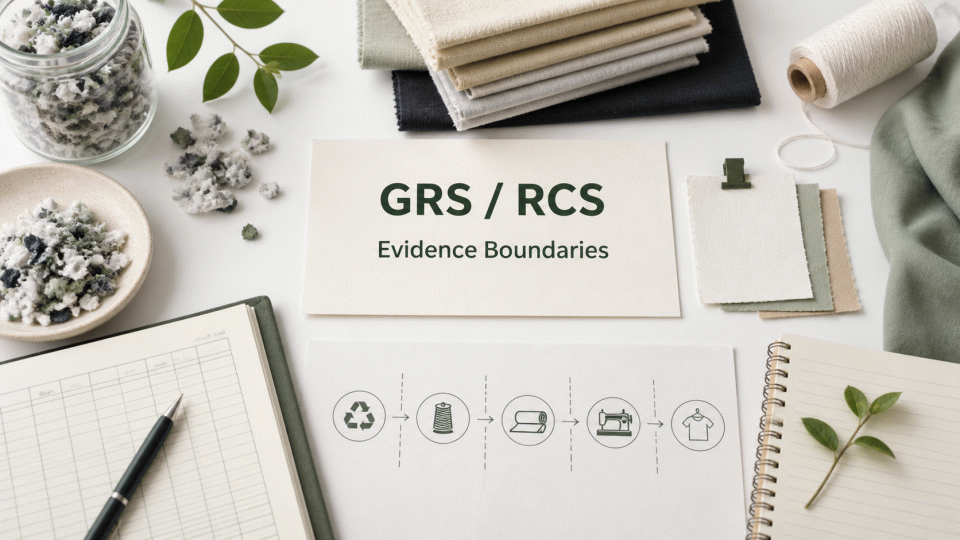
GRS, RCS and a recyclable claim are different things. The first two are voluntary third-party standards concerned with recycled inputs and chain of custody; a recyclable claim concerns whether a particular product or package can be handled by recycling systems in a defined market. This article separates those objects and maps product facts, materials, certificates, transaction records and page wording. It does not promise Amazon CPF eligibility, certification, platform display or sales results.
1. Define the claim before collecting files
Break the page wording into three questions: is the object the finished product, a component or a material; does the wording claim verified recycled content or recyclability; and which model, batch, processing step and market does the evidence cover? A supplier certificate, an organisation-wide management certificate or a single material record does not automatically cover every SKU, batch or finished product sold by a brand.
If a page refers to GRS, RCS or a related mark, verify the scheme, certificate holder, status, product or process scope, applicable version and permitted claim wording. If supplier evidence is used, retain the links between the supplier, brand, product, batch and supply-chain records.
2. GRS and RCS: shared evidence, different scope
| Object | What the official material covers | Page boundary |
|---|---|---|
| RCS | Textile Exchange describes RCS as a voluntary third-party standard for verifying recycled inputs and chain of custody. | Use wording that matches the certificate scope, recycled-material definition and supply-chain records; do not import GRS processing requirements into an RCS claim. |
| GRS | It builds on recycled-input and chain-of-custody requirements with additional social, environmental and chemical requirements for processing. | Do not rely on a brand name or logo alone; check the applicable GRS version, product-claim threshold, certificate scope and transaction evidence. |
| Recyclable claim | It is not a substitute for GRS or RCS certification and requires a separate assessment of design, components, target market and recycling infrastructure. | Recycled content or an RCS/GRS certificate does not by itself prove that a product is “100% recyclable”; retain the basis and market scope of the claim. |
Textile Exchange’s current materials show that GRS and RCS are being updated and transitioning toward the Materials Matter Standard. Version numbers, thresholds and labeling rules from older documents should not be applied without checking their effective date. Before publication, review the current Textile Exchange standards, Claims and Labeling Policy and certification-body guidance.
3. Build the evidence chain from product fact to page
Start with product facts: model, material composition, component weights, production batch, package structure and target market. Add supply-chain evidence: scope certificates, transaction certificates, records for recycled inputs, BOM or content calculations, processing records and relevant test documents. Then control the claim: title, bullets, detail page, images, certification marks and submission files should use the same product scope, percentage basis and standard name.
If evidence covers one fabric, one shipment or one component, keep the page claim within that same object. Do not treat PCR, PIR, chemical recycling, recyclable design and “sustainable” as synonyms; each term needs a definition, record and scope. A transaction certificate can support a particular transaction or chain-of-custody record, but it does not replace every substantiation needed for a product-page claim.
4. CPF: do not invent a fixed review taxonomy
Amazon’s public sustainability materials describe Climate Pledge Friendly as combining recognised third-party certifications with Amazon-developed programs such as Compact by Design and Pre-owned Certified. That public description is not a universal, permanent “GRS/RCS slot table” for every category, marketplace or date. Check the current Amazon pages and Seller Central information for actual eligibility, certification lists, submission routes and display rules.
For CPF preparation, create a mapping sheet with the ASIN or model, claim object, certification or program, holder, scope and validity information, transaction or test evidence, page wording, artwork version, submission record and source link. This sheet is a control tool, not an Amazon review taxonomy or a platform promise.
5. Manual pre-publication checklist
□ Each claim maps to an exact product, component, batch or supply-chain entity; □ certificates, scope documents, transaction records and BOM explain one another; □ GRS, RCS, recyclable claims, Amazon programs and management systems are not conflated; □ percentages, versions and dates are not inflated or combined across batches; □ titles, bullets, detail pages, images and submission files use the same scheme name; □ no unverified official logo, certification seal, CPF mark or result-like wording appears; □ final files and sources are retained and current platform and scheme requirements are checked before use.
GreenArk (Shenzhen) Certification Co., Ltd. may support claim-to-evidence mapping and gap identification, but it does not replace Amazon, a certification body or a regulator’s decision. Standards, certification lists and platform entry points can change; return to the relevant official materials before use.
Sources: Textile Exchange official RCS/GRS materials, standards and claims-policy resources, and Materials Matter transition notices; Amazon Business public materials on Climate Pledge Friendly, third-party certifications, Compact by Design and Pre-owned Certified. This is an evidence-organisation framework, not a certification or platform-outcome promise.


