
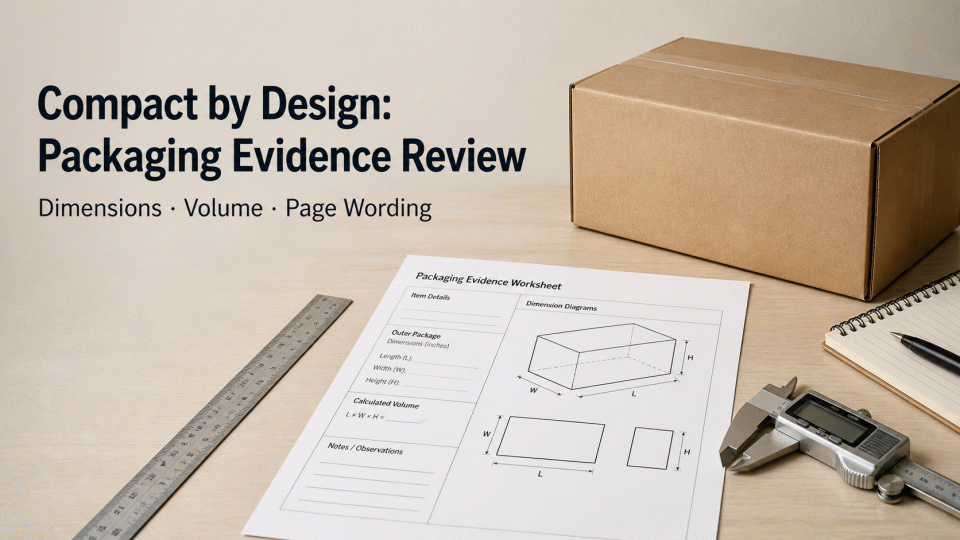
Use case: A reference for brand, product, and supply-chain teams reviewing Amazon Compact by Design (CbD) data, packaging dimensions, unit efficiency, and customer-facing wording. It is not an Amazon qualification decision and does not promise that a product will receive or retain any badge.
Short answer: CbD review starts with consistent product dimensions, weight, unit or customer-use data, followed by comparison with the applicable category threshold. Concentrated products may require equivalent product volume. Thresholds, fields, and program requirements can change, so the current Seller Central / Vendor Central interface and Amazon source material control the final review.
1. Separate CbD, CPF, and your own evidence
Compact by Design is an Amazon-owned sustainability program for identifying products with efficient unit use of space and materials. Amazon has publicly described CbD as one of the paths associated with Climate Pledge Friendly (CPF). CbD, CPF, and a seller’s packaging or formulation records are not interchangeable: the first two are platform programs, while the records support a product-data and wording review. “Evidence prepared” should not become “certified,” “approved,” or “guaranteed to display.”
2. Read the unit-efficiency equation carefully
Amazon’s public examples express unit efficiency as (package length × width × height ÷ unit) × (weight ÷ unit). “Unit” is not an arbitrary count: it must follow the category and the current field definition. Dimensions, weight, unit, and measurement system must use a consistent basis. If the product uses fl oz, mL, lb, or another unit, verify conversions and field definitions against the current official instructions.
The January 2026 official example calculations also show that categories have their own thresholds. A value from one category should not be copied into another category. Keep the source fields, calculation, version date, and category scope instead of retaining only a “pass” conclusion.
3. Review equivalent product volume for concentrates
For concentrated cleaners, powdered drinks, and similar products that require the customer to add liquid, Amazon’s official material uses “equivalent product volume” for the usable volume after dilution. Record the concentrated amount per use, added liquid, number of uses, and resulting equivalent product volume. Use the field only where the current category and listing workflow support it; “concentrated” alone is not proof of CbD qualification.
Keep the product label, directions for use, formula or capacity record, and listing field linked together. If dilution instructions, recommended dosage, packaging, or ASIN changes, review the calculation again rather than carrying forward an old worksheet.
4. Build an evidence table that records facts
| Field group | Keep these records | Boundary |
|---|---|---|
| Product and ASIN | ASIN, marketplace, category, pack format, quantity, listed net content or weight, capture date | Do not substitute a brand-level record or adjacent SKU for the reviewed ASIN. |
| Dimensions and weight | Current package dimensions, weight, unit system, measurement method, and measurement evidence | Separate net content, product weight, and package/shipping data; do not present an estimate as a measurement. |
| Concentrate / dilution | Label, directions, dose, dilution liquid, and equivalent-product-volume calculation | Use only when the current category supports the field; do not invent concentration, use-count, or reduction percentages. |
| Page wording | Product facts, calculation basis, source date, and official links | Say “subject to review” and “based on current rules”; do not promise approval, a fixed period, revocation statistics, or automatic display. |
5. Use careful wording in pages and client communication
A supportable statement is that the product page’s dimensions, weight, capacity, and directions have been organized against the current records and that the calculation can be reviewed. Avoid “100% compliant,” “guaranteed to pass,” fixed percentage advantages, fixed remediation windows, fixed review times, or promises that Amazon will display or retain a badge.
绿色方舟(深圳)认证有限公司 can help organize product–field–evidence mappings and page-claim boundaries. Amazon controls program qualification, display, and subsequent status under the rules and data applicable at the time.
6. Pre-submission checklist
1. Lock the ASIN, marketplace, category, and current rule version. 2. Record package dimensions, weight, unit, or customer uses. 3. For concentrates, review the equivalent-product-volume field and calculation. 4. Preserve source records, conversions, worksheets, and dates. 5. Check each page sentence for an unsupported outcome promise. 6. Before submission or update, review the current Seller Central / Vendor Central field instructions again.
Sources: Amazon Compact by Design Example Calculations (2026-01-14); Amazon’s public introduction to Climate Pledge Friendly and Compact by Design. Current Amazon pages control thresholds, fields, and qualification.


