
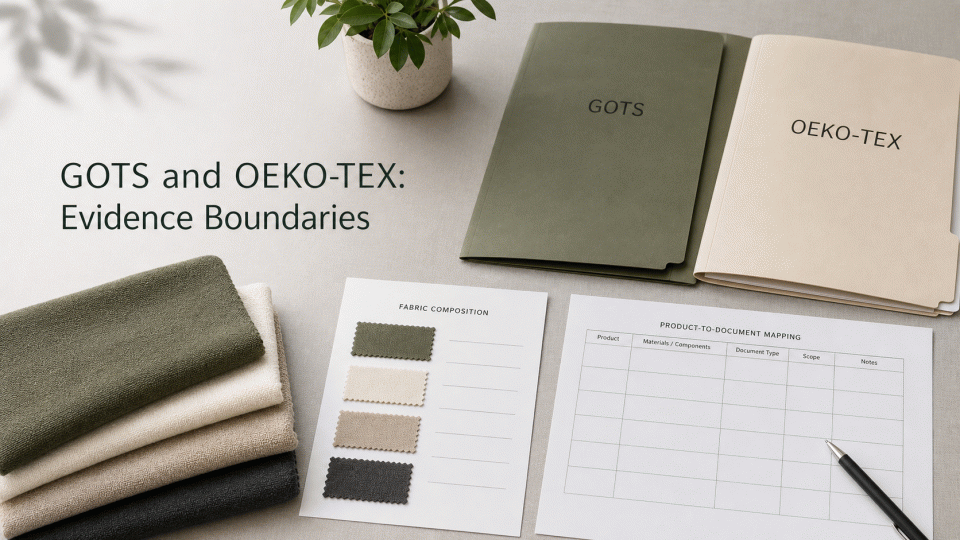
GOTS and OEKO-TEX STANDARD 100 may appear in the same textile file set, but they answer different questions. GOTS addresses organic fibres and the processing and trading chain, while STANDARD 100 addresses harmful-substance testing for finished textiles and their components. This guide separates the evidence so sellers can review product scope, certificate holders and claim strength before preparing Amazon Climate Pledge Friendly (CPF) material or page copy. Current CPF eligibility, recognised programmes and submission requirements must be checked in Seller Central and with the certifier. This article does not promise a badge, approval or platform outcome.
Core boundary: GOTS is not proof that a product is free of every harmful substance or meets every textile rule. STANDARD 100 is not proof of organic farming, fibre origin or full-chain traceability. The certifications can coexist, but neither should be rewritten as the other.
1. Separate the subject of each standard
GOTS: focuses on organic-fibre textiles and their processing and supply chain. Its public materials explain that operators receive a Scope Certificate after assessment by an approved certification body. Whether specific goods meet the requirements is addressed through a Transaction Certificate for the relevant shipment or batch. GOTS label grades also address organic-fibre content: “Organic” is generally at least 95%, while “Made with Organic materials” starts at 70% and is below 95%. Use the wording and version shown in the current certificate and standard.
OEKO-TEX STANDARD 100: focuses on harmful-substance testing for textiles and components, with four product classes based on intended use: babies and young children, direct skin contact, limited skin contact, and decorative materials. The classes are not an environmental ranking; they relate to use and limit requirements. The certificate, label and Label Check record should correspond to the current product and certificate holder.
2. Build a product–document–claim register
Use one row for each SKU or model. Record the product name, model or variant, fibre composition, colour and size range, finished product and components, production and trading entities, destination market, proposed certification wording, certificate number, current status, scope, batch records and exact page sentence. A supplier certificate supports only the entity, products and scope named in that certificate; it does not automatically prove every SKU sold by the brand.
For GOTS, compare the Scope Certificate’s product and facility scope, processing steps and holder with the Transaction Certificate’s goods, quantities, buyer, seller and shipment information. For STANDARD 100, check the certificate, product or component scope, product class, current status and the official Label Check or certifier record. Do not extend a fabric report to an unlisted garment, zip, button, print or coating.
3. Keep page wording within the evidence
When GOTS evidence is available: describe the product, label grade, certificate holder and documented scope only when they match. Do not turn GOTS into “zero chemicals,” “completely non-toxic,” or a conclusion covering every supplier, market and regulation.
When STANDARD 100 evidence is available: state that the identified product holds the stated STANDARD 100 certificate class when the model, components and record match. Do not infer “organic cotton,” “organically farmed,” “fully sustainable” or compliance with every market safety requirement. Testing remains bounded by the certificate scope, samples and current rules.
For a CPF-related page, review the certifier’s documents separately from Amazon’s current product eligibility record. Amazon describes CPF as a sustainability-discovery and eligibility framework for individual products; certification, product scope and platform status are not one automatic result. If the current record is unavailable, say that confirmation is pending rather than writing that the product is approved.
4. Six manual checks before submission
1) Confirm the programme name, version and certificate holder; 2) compare the documented product scope with the SKU, model, fibre composition and components; 3) review the GOTS Scope Certificate and relevant shipment or batch evidence separately; 4) review the STANDARD 100 class, certificate status and official lookup record separately; 5) trace every environmental or safety-related page sentence to a specific file; and 6) if both certifications are held, organise and describe them independently rather than using one as a substitute for the other.
Sources: public Global Organic Textile Standard materials on Scope Certificates, Transaction Certificates, label grades and certified supply chains; public OEKO-TEX STANDARD 100 materials on product classes, testing scope and Label Check; and Amazon’s public Climate Pledge Friendly programme and advertising-policy materials. Standards, certification lists and platform processes may change, so check the current official pages before use. Prepared by 绿色方舟(深圳)认证有限公司 as an evidence-organisation reference; it does not guarantee a product, company or platform outcome.


