For Amazon US sellers and product, operations, and supply-chain teams working with appliances, electronics, office equipment, or lighting products and reviewing an ENERGY STAR record alongside a possible Climate Pledge Friendly (CPF) path.
Key point: a brand name, series name, or supplier statement is not evidence that every ASIN variation has the same product record. Before submitting or changing a page, map the physical product, model documents, the current ENERGY STAR Product Finder record, certificate or partner files, and the proposed wording. Whether a document is accepted for CPF depends on the current certification catalog and submission fields shown in Seller Central.
1. What an ENERGY STAR record establishes
ENERGY STAR is an energy-efficiency labeling program administered by the U.S. Environmental Protection Agency (EPA). The EPA Product Finder helps users locate ENERGY STAR certified products by category and product information. EPA’s product-data resources explain that public product data can be searched and downloaded using fields such as model information and is updated on an ongoing basis. The current Product Finder result and the applicable product specification are the starting points for a product-level check.
A brand, product family, marketing statement, or a supplier’s general claim that it “has a certificate” does not by itself establish coverage for the ASIN being sold. Record the product category, brand or manufacturer, model or model number, query date, listing status, and the relationship between the record and the product. Fields and requirements differ by product category, so do not copy a process from one category into another.
2. Evidence to compare at model level
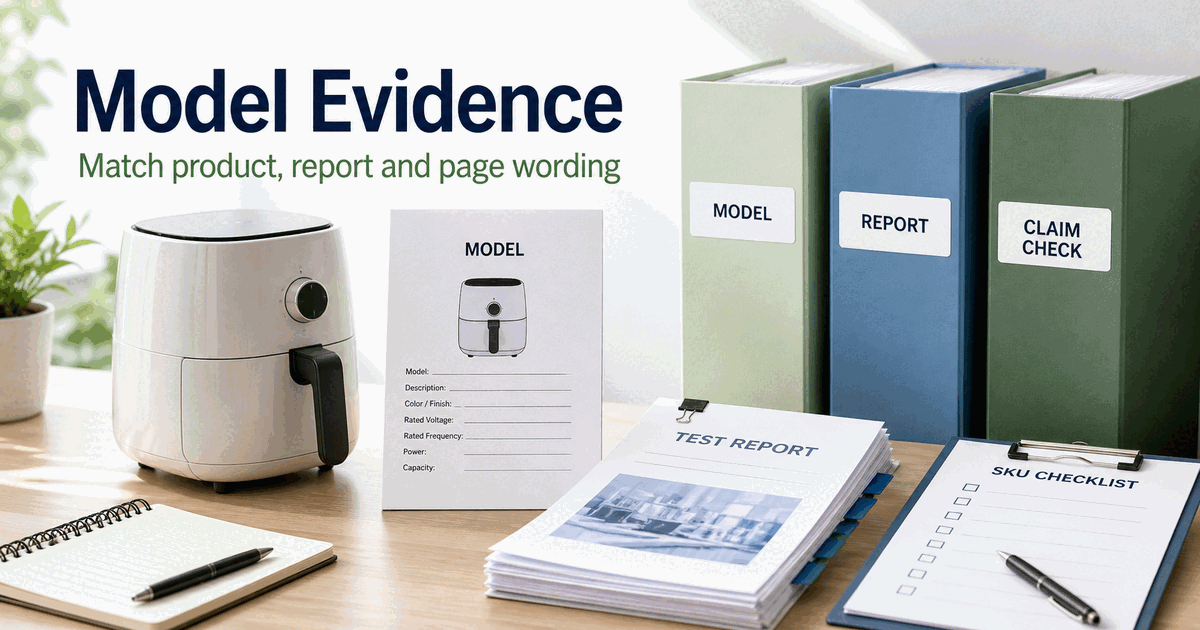
Product and packaging: retain the model shown on the rating plate, package, and instructions. Separate the model number from the series name, SKU, color or capacity suffix, and internal inventory code.
Official product record: search the ENERGY STAR Product Finder using the identifiable brand, manufacturer, and model information. Save the result or downloaded data with the query date. If the record covers one model, do not extend it to other models in the same family.
Certificates and partner files: compare the holder, product category, model scope, and current status in the certificate or partner material. If the model differs from the product label or official record, determine whether the difference is a version, regional name, alias, or documentation error before using the claim.
Amazon page fields: keep the ASIN, parent-child relationship, manufacturer, model, variation attributes, and product images in one mapping table. A parent ASIN, brand name, or custom SKU should not replace the actual model of a child variation.
3. Parent-child listings, revisions, and aliases
A parent-child relationship organizes a page; it does not automatically prove that every child variation has the same certification evidence. For differences in color, capacity, power, or market version, check whether the official record covers that variation. If coverage cannot be confirmed, do not write the page as if the same certification applies to every child.
When a product is revised, or its hardware, software, packaging, or manufacturer information changes, retain the old and new documents and their dates and ask the certificate holder or relevant certification partner to confirm the scope. Do not append sales names such as “Pro,” “Plus,” or “Upgraded” to an official model, and do not treat similar strings as proof that two models are identical.
If a record cannot currently be found, a missing screenshot, supplier verbal statement, or estimated synchronization time is not a substitute for evidence. Check the product category, search inputs, data refresh status, and source documents before deciding whether to ask the relevant partner for clarification.
4. Keep ENERGY STAR and CPF conclusions separate
An ENERGY STAR product record supports a product-level conclusion within that program’s scope. It does not automatically establish compliance with every destination-market rule, packaging requirement, chemical requirement, or other Amazon page requirement. CPF paths, accepted categories, required fields, and review requirements should be checked in the current Climate Pledge Friendly certification catalog and submission page in Seller Central; an old screenshot or third-party article is not a substitute for the current platform instructions.
Page wording should state only what the evidence supports. For example, it may identify that a particular model was found in the ENERGY STAR Product Finder on a stated date and describe the source and scope. Do not turn a single-model record into a brand-wide claim, and do not promise a CPF badge, continued eligibility, approval, or a fixed synchronization time.
5. Evidence map before submission
- Define the marketplace, product category, and ASIN; save the current page and parent-child structure.
- Extract the actual model, manufacturer, and variation information from the product, packaging, instructions, and supplier documents.
- Search the ENERGY STAR Product Finder and save the result, query date, and product category.
- Map each ASIN and variation to its model, manufacturer, certificate or product-list record, and proposed wording; mark every mismatch separately.
- Open the current CPF certification catalog and submission fields in Seller Central and confirm the applicable path and evidence scope. Do not treat this article as a substitute for platform requirements.
- Before submission or publication, review the title, images, model fields, and claim scope. Delete or qualify any wording that the available evidence cannot support.
6. Sources and responsibility boundary
Primary sources: EPA ENERGY STAR Product Finder; ENERGY STAR Products Tools and Resources; ENERGY STAR Product Specifications & Partner Commitments Search. Product categories, specifications, and data can change, so recheck them before use.
This article is an evidence-mapping framework for product models and page wording. It is not a certification decision and does not replace current requirements from EPA, a certification partner, or Amazon Seller Central. 绿色方舟(深圳)认证有限公司 can help organize the relationships among products, models, documents, and page wording, but any certification or platform review outcome depends on the applicable program, current evidence, and the relevant organization’s decision.