
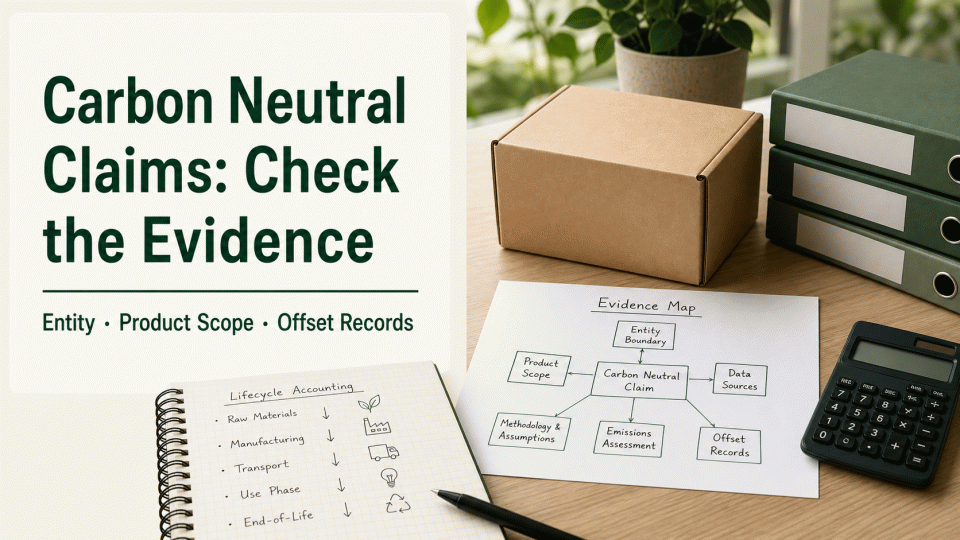
Before placing “carbon neutral” on an Amazon Climate Pledge Friendly (CPF) related page, start with the evidence structure rather than a marketing phrase. Confirm who makes the claim, which product or organisation it covers, which accounting boundary was used, what reductions and offsets support it, and what the page will actually say. CPF visibility or eligibility depends on the current program rules and an accepted third-party certification or evidence path; a footprint, offset purchase or corporate target does not automatically mean that a particular product has CPF visibility. This is a document-review framework, not a promise of certification, platform display, approval, ranking, traffic or timing.
1. Separate four objects
Separate: (1) the claimant, such as a brand, manufacturer, supplier, project operator or corporate group; (2) the claim object, such as one SKU, a product family, packaging or the organisation; (3) the accounting boundary, including which stages from materials to end of life are included; and (4) the page wording, whether it describes measurement, reduction, an offset purchase or carbon neutrality. If these four objects do not correspond, an organisational target should not be rewritten as a product-level conclusion.
2. A product footprint is not an organisational inventory
The GHG Protocol Product Life Cycle Accounting and Reporting Standard is used to understand greenhouse-gas emissions associated with a specific product across its life cycle. The boundary should identify the functional unit, product system, data period, activity data, emission factors, allocation choices and uncertainty. A Scope 1, Scope 2 or Scope 3 inventory answers an organisational or value-chain question. The two can be linked in an evidence map, but corporate totals or office electricity records do not replace a product life-cycle assessment.
A working file should connect the SKU, BOM or specification, site and processes, material and energy data, transport assumptions, use-stage assumptions where relevant, end-of-life boundary, method, and verification or review record. Unsupported “full life-cycle”, “zero emissions”, “100% offset” or precise numerical claims should not be placed in the title, bullets, A+ content or artwork.
3. Record reduction, offsetting and neutrality separately
Reduction records describe the source, baseline, measure and calculation. Offset records describe the project, standard or registry, project status, quantity, serial numbers, ownership and retirement or transfer. Offset evidence does not prove that the product itself has no emissions, and “an offset was purchased” should not automatically become “the product is carbon neutral”. Any carbon-neutral or similar claim needs its definition, boundary and disclosures checked against the responsible verifier, applicable standard and current advertising rules.
The FTC Green Guides state that carbon-offset claims need competent and reliable scientific evidence and address issues such as double counting, whether reductions have occurred, and whether the underlying activity is already required by law. This is a boundary reminder, not a finding that any particular offset project qualifies.
4. Put only path-supported wording on a CPF page
Start with Amazon’s current Climate Pledge Friendly information and the scope of the relevant approved third-party certification. Then check whether the SKU falls within that certification’s product scope, whether the certificate holder matches, whether the status is current, and whether the page wording stays within the evidence. Do not turn a leaf icon, certification mark or internal submission status into government approval, a platform guarantee or a sales outcome.
A useful review table has four columns: exact claim, claimant and product scope, supporting file and source, and permitted qualification. Each “carbon neutral”, “low carbon”, “offset” or “reduced emissions” statement should return to a specific file. A corporate policy, brochure or supplier assurance alone does not support an unconditional SKU-level claim.
5. Manual pre-publication checklist
□ claimant matches the evidence holder; □ SKU, BOM, site and batch scope correspond; □ product and organisational boundaries are not mixed; □ data period, functional unit, allocation and material assumptions are sourced; □ reduction and offset quantity, ownership and retirement records are traceable; □ the carbon-neutral wording has a basis in the applicable standard, review and disclosures; □ CPF path, certification scope and page wording have been checked separately; □ title, summary, body and artwork contain no seal, pass rate, fixed deadline or outcome promise.
绿色方舟(深圳)认证有限公司 can support document organisation, claim-to-evidence mapping and gap identification, but it does not replace a certification body, Amazon or a regulator’s decision. Program rules, certification directories and advertising requirements can change; recheck the current official materials and the specific evidence before publication.
Sources: GHG Protocol Product Life Cycle Accounting and Reporting Standard, GHG Protocol Corporate Value Chain Scope 3 Standard, the FTC Green Guides on environmental and carbon-offset claims, and Amazon’s public Climate Pledge Friendly program materials. This article is not a certification, platform-eligibility or legal determination.


