
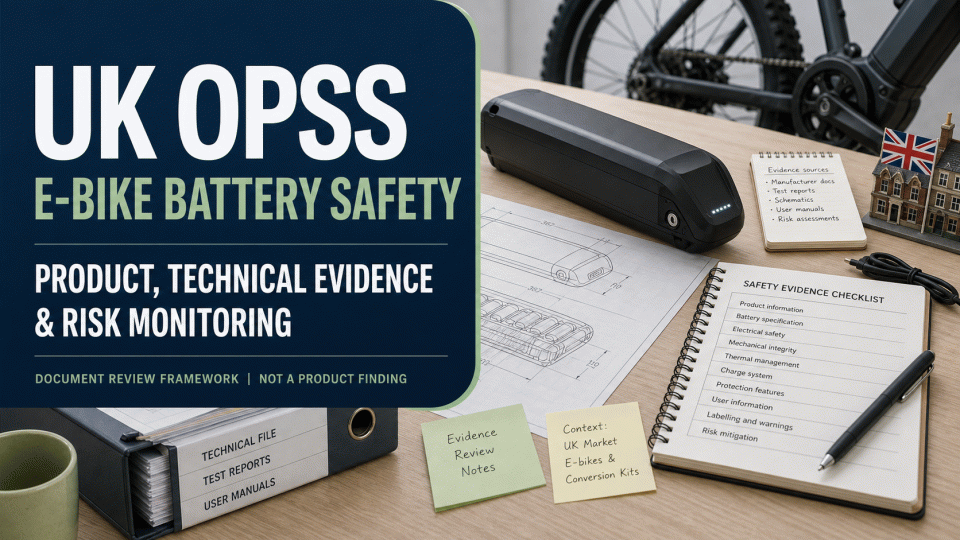
The UK government’s statutory guidelines on lithium-ion battery safety for e-bikes are aimed at businesses that produce, import or distribute relevant products on the UK market. This article turns the guidance into a document-review framework covering product safety, technical evidence, user information and ongoing risk monitoring. It is not a finding that any particular product is compliant.
1. Products and business roles in scope
The scope includes battery packs supplied with complete e-bikes, replacement packs, and batteries used in conversion kits. Under the guidance, producers include manufacturers and importers; distributors have separate duties relating to care, cooperation and traceability. One laboratory report should not be treated as proof that every business role has met every legal duty.
The guidelines apply to England, Scotland and Wales, and are strongly recommended for businesses placing relevant products on the Northern Ireland market. A complete product review may also need to consider the bike, charger, transport or other rules separately. This article is not a substitute for a product-specific legal inventory.
2. Review the battery’s core safety design
Thermal runaway is a central risk in the OPSS guidance. A lithium-ion battery for an e-bike or conversion kit should have safety mechanisms capable of preventing thermal runaway during normal operation and reasonably foreseeable misuse, such as a battery management system or equivalent protective features.
The evidence review should consider whether the protection system can monitor individual-cell voltage, pack current and cell temperature, and act against over-voltage, under-voltage, over-current, over-temperature or under-temperature conditions. It should also address protection when an incompatible charger is connected. Resistance to reasonably foreseeable external impact, vibration, high or low temperatures and water ingress belongs in the product safety assessment as well.
3. Match technical evidence to product information
A producer can build a “product characteristic–risk–evidence” map with at least these groups of records:
Product records: battery model, compatible e-bike or conversion kit, cell and protection-system information, compatible chargers and version-change history.
Safety assessment: analysis of thermal runaway and its causes, design information for protective mechanisms, construction and durability information, and test or verification reports that match the actual configuration. The guidelines do not prescribe one exclusive assessment route; the business remains responsible for its own products and processes.
User information: compatible-charger information, safe charging and use instructions, and material that helps users establish whether the battery is suitable for the intended system. Manuals, markings and technical files should match the actual model and sales version.
The guidance points to BS EN 50604-1:2016+A1:2021 and BS EN 15194:2017+A1:2023 as useful standards references. Citing a standard alone does not establish that a particular product meets every legal requirement.
4. Ongoing producer and distributor work
Producers should assess safety before placing a product on the market and use measures such as sample testing, complaint records and risk monitoring to learn about problems. If a product already placed on the market presents a risk incompatible with the general safety requirement, the guidance describes written notification to OPSS or the relevant local authority Trading Standards.
Distributors should act with due care, avoid supplying products they know or ought to know are dangerous, and cooperate with authorities by providing relevant risk, identity and origin information when requested. Withdrawal, corrective action or recall depends on the facts of the incident and the authority’s requirements; it should not be presented as a fixed, automatic outcome.
5. Boundaries for a practical review sheet
A useful review sheet can include the model and configuration, producer or importer information, compatibility, protective mechanisms, risk assessment, test or verification records, manuals and warnings, complaints and risk-monitoring records, change history, and any notification trail required by the circumstances. Reassess the evidence whenever cells, the protection board, charger, supplier or control logic changes.
Do not combine OPSS product-safety guidance with platform reviews, customs paperwork, transport rules, other countries’ regulations or environmental-label requirements into one generic certificate list. The official guidance, GPSR and the actual product configuration are the starting points; page wording should state only facts supported by the relevant product and records. The responsible business and an appropriately qualified professional should review any submission for its specific use.
Source basis: the UK government and Office for Product Safety and Standards, Statutory guidelines on lithium-ion battery safety for e-bikes, together with the related GPSR information. Official pages may change, so review the current source before use.


